Student Academic Integrity
Guidance for supporting academic integrity, promoting good practice, and responding to academic misconduct.
Plagiarism

Sally is copying text from a published source directly into her report without acknowledging the author or using correct citation methods.
From the University's academic integrity guidance:
"Presenting work or ideas that are not your own for assessment is plagiarism. Failing to properly acknowledge where the work or idea came from is dishonest and unacceptable. This applies to all written documents, interpretations, computer software, designs, music, sounds, images, photographs, and ideas that were created by someone else."
Plagiarism might take the form of:
- Copying without acknowledging the source,
- Scaffolding your own work using another author's key points or structure without acknowledging the source, or
- Paraphrasing poorly or without acknowledging the source
How can I detect plagiarism?
In the past, staff have suspected plagiarism in student submissions with:
- Inadequate paraphrasing, where students have tried to explain an author’s ideas in their own words, but their wording remains too close to the original text
- Incomplete reference lists with in-text citations missing
- Older (more than three months) access dates for online resources
- Online resources that cannot be accessed via the link provided
- Online images and diagrams, presented without acknowledgement, being used to communicate:
- Design research and / or stages of project development
- Spatial qualities and / or design details of the project
- Building systems including technical details such as ESD features
- Original sketches created by tutors or peers during a design review of their work (ie, the student includes the sketch as part of their project development) presented without acknowledgement
- Use of original ideas prepared by their peers presented without acknowledgment. (This may also be Collusion.)
- Precedent studies applied too literally to the student's design
NB: Understanding precedents and engaging in feedback loops are important parts of built environment education. Students should acknowledge the source of any ideas and be supported by staff to participate in an iterative design process where another person’s idea takes on a new identity/purpose.
NB: It is becoming increasingly common for students to limit academic research to online sources. Students can unintentionally plagiarise through over-reliance on the ‘copy and paste’ function, combined with poor record keeping about what content was sourced from where.
Submissions with very low similarity scores in Turnitin can signal that students are employing strategies to deliberately avoid detection. Such strategies include:
- Replacing words in the author’s original text with synonyms
- Replacing all the spaces in the text with invisible (white) text
- Inserting an image of the text
- Swapping common characters with foreign language characters that look similar
- Cycling the author’s original text through Google translation
NB: Alongside traditional sources, students might also access material generated by artificial intelligence software. For details, please see the section on unauthorised or undisclosed use of technology and BEL+T's Guidance on Generative AI.
Guidance for ABP subject coordinators on investigating and reporting academic misconduct can be found on the ABP Academic Integrity Sharepoint site.
Self-plagiarism
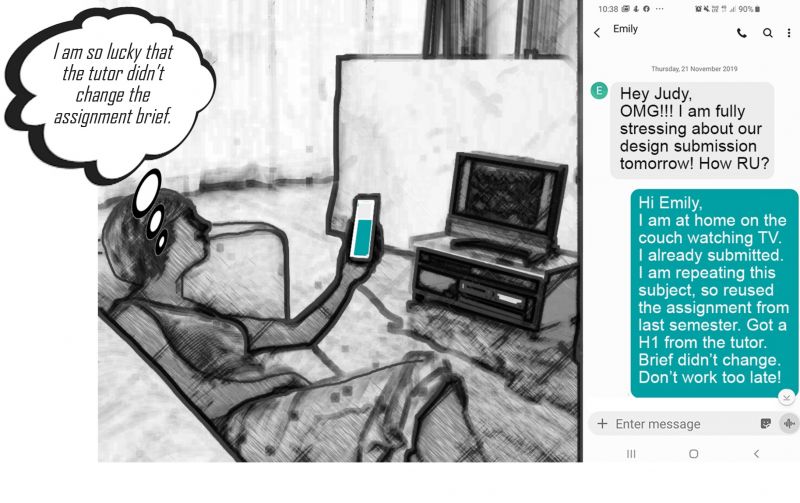
Judy is repeating a subject and has resubmitted an assignment that she has already received a grade for.
Self-plagiarism involves resubmitting an assignment (in full or in part) that has already been submitted for assessment (and graded) in any course at any university. This includes when students are repeating subjects.
From the University's academic integrity guidance:
"Reusing your own work, either entirely or partially, for more than one assessment without permission or proper disclosure is not permitted."
How can I detect self-plagiarism?
In the past, staff have suspected self-plagiarism in submissions where students have:
- Explored familiar ideas and / or made similar mistakes
- Referred to in class activities that were conducted in previous semesters
- Included out-of-date content and / or references (specifically websites)
- Complained about their final grade, suggesting that previous assessor had marked the content more favourably
- Completed work to a standard that could not be achieved within the time-frame
NB: It is common for students to mistakenly believe that as the ‘creator’ of original work (essay, design, models, drawings, etc.) they can submit it for assessment multiple times. It is important that staff clearly communicate to students that this not allowed.
Guidance for ABP subject coordinators on investigating and reporting academic misconduct can be found on the ABP Academic Integrity Sharepoint site.
Collusion
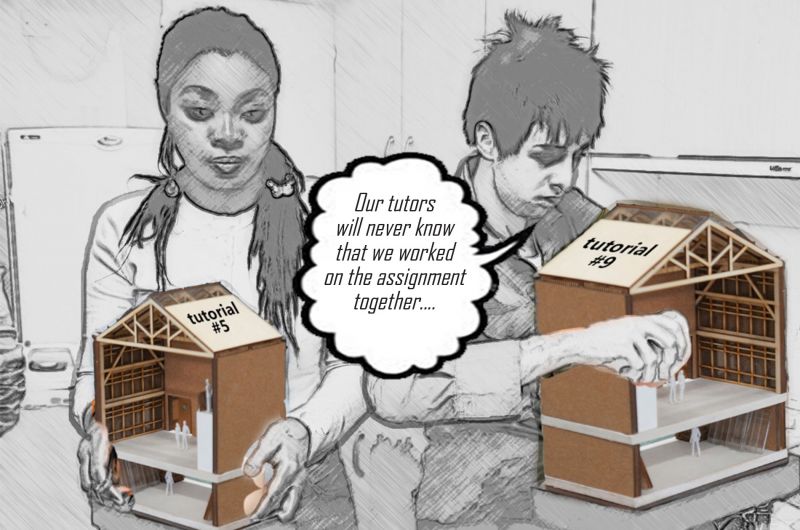
Imani and Zane are in different tutorials groups and think that no one will notice the similarity of their submissions.
From the University's academic integrity guidance:
"Collusion involves unauthorised collaboration between more than one student to complete work that is then submitted for assessment that has been restricted to individual effort.
Students are encouraged to engage in discussion and debate of subject content, but any work submitted for assessment must be the student’s own.
Researching, discussing, and sharing ideas is fine, but do not write your assessments with other students. This is different from group assessment work where students are instructed to work together, and the work is assessed as a group effort. Collusion in producing individual work for assessment is academic misconduct.
You should not:
- Provide work for another student to submit as part of their own assessment
- Use the work of another student as your own for assessment
- Co-write or share the background information that you will use in your assessable work.
Working collaboratively with other students when you have been instructed by the University to do so for group assessment is fine."
How can I detect collusion?
In the past, staff have suspected collusion when:
- Two students used the same construction details in physical models
- Turnitin reported two essays with high similarity scores
- Students allocated to a group received identical scores on an online quiz
- A student took another student’s lecture notes into an open book exam
NB: Staff have a responsibility when setting assessment tasks to clearly explain to students whether they can collaborate with peers.
Guidance for ABP subject coordinators on investigating and reporting academic misconduct can be found on the ABP Academic Integrity Sharepoint site.
Unauthorised file access or sharing
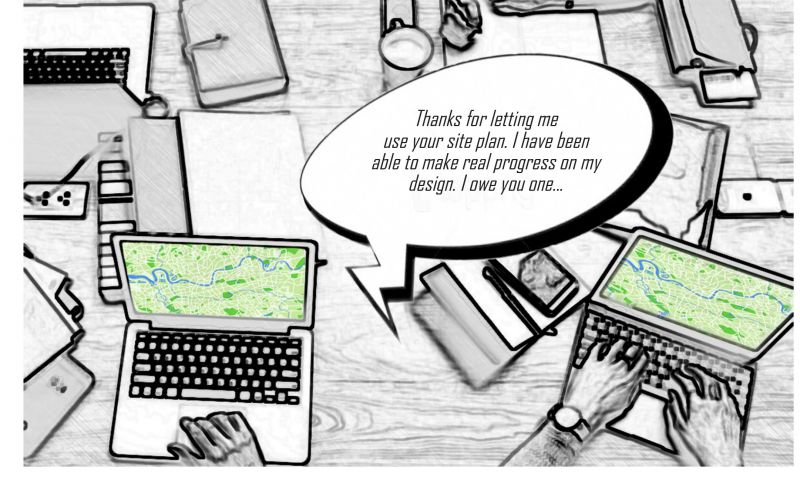
Stephen has agreed to let John use the site plan that he prepared for their design studio.
Unauthorised file access or sharing (aka 'borrowing') involves using another student’s computer file/s and/or data to make progress on an individual assessment task in a way that would have otherwise impossible. Borrowing is a form of collusion.
From the University's academic integrity guidance:
"Using file sharing sites or social media as a platform for inappropriately sharing information is academic misconduct. Even if you don't know, or have no contact with, the people providing or accessing this information, the sharing of resources online and via social media platforms is academic misconduct . This includes any sharing of information via a website, app, or other electronic platform that is owned, operated, administered, or hosted by the student, or otherwise within the student's control."
How can I detect borrowing?
In the past, staff have suspected students of borrowing content from a peer when two or more assignments:
- Present the same site context for different design solutions. For example, the land contours, location and type of landscaping, and details of neighbouring buildings are identical
- Use the same data set to support different recommendations. For example, students sharing calculations for housing density, financial predictions and patterns of transport use
NB: Borrowing can be difficult for staff to detect. This is because the ‘final products’ submitted for assessment by two or more students can be visibly different despite the sharing of critical information. Staff have a responsibility when setting assessment tasks to clearly explain to students whether they can collaborate with peers.
Guidance for ABP subject coordinators on investigating and reporting academic misconduct can be found on the ABP Academic Integrity Sharepoint site.
Assessment outsourcing (contract cheating)
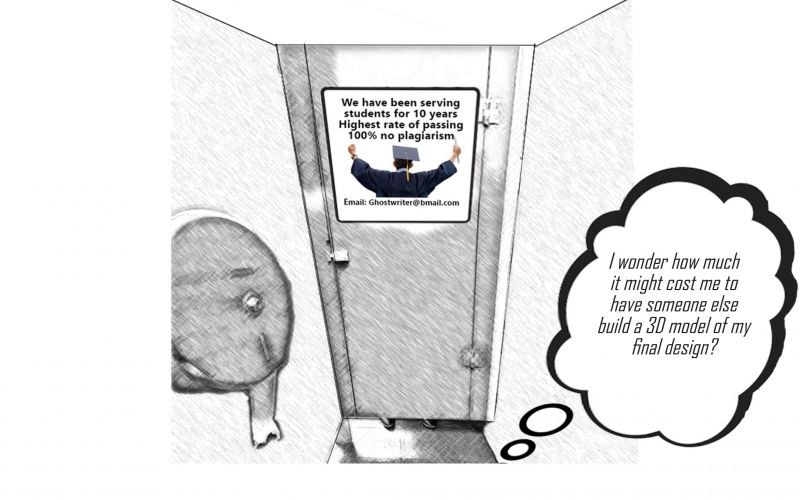
Linda is thinking about commissioning someone to help her complete an assessment task.
From the University's academic integrity guidance:
"Assessment outsourcing, commonly known as contract cheating, occurs when you have someone else produce any work (in whole or part of) that you submit as your own for assessment. This is deliberate cheating and considered serious academic misconduct.
Similarly, writing or producing work for another student to submit as their own is also considered contract cheating and constitutes academic misconduct. Never produce work for someone else to submit as their own assessment.
Contract cheating also includes having someone else sit an exam on your behalf or sitting an exam for someone else. Importantly, payment doesn’t have to be involved for it to be considered contract cheating.
The University takes this behaviour seriously, and engaging in contract cheating can lead to significant consequences, such as, expulsion from the University or revocation of your degree. Contract cheating can also harm your future by impacting your employment opportunities, registration with professional associations and other career prospects.
Contract cheating is illegal under Australian law and is considered high-risk, as it can sometimes lead to blackmail. Protect your academic integrity by ensuring that the work you submit is entirely your own."
The University goes on to advise students:
"Always exercise caution when engaging with external tutoring services.
There has been a significant rise in the number of contract cheating companies disguising themselves as ‘tutoring services’ or ‘assignment/ exam support.’ These organisations will often target students through platforms like Instagram, WeChat, and Telegram, or by hosting events near or on campus. They often target specific language or cultural groups and may even use University branding to appear legitimate and trustworthy.
Services that offer to provide you with ready-made answers or complete assessments for you are contract cheating companies. Using these services is not only a serious breach of academic integrity but also a missed opportunity to grow and learn.
Always seek support from trusted University resources, such as Academic Skills. These services help you learn, improve, and understand key concepts—they guide you in developing your skills, rather than doing the work for you."
How can I detect assessment outsourcing (contract cheating)?
Contract cheaters who are commissioned generally create bespoke solutions for assignment, making detection difficult, but not impossible.
The University has produced a guide for staff on Identifying Contract Cheating, available via the Student Academic Integrity Network Sharepoint site.
In the past, staff have suspected plagiarism in student submissions which:
- Significantly exceeds the standard of work previously submitted
- Significantly exceeds staff expectations of the cohort’s skill and experience
- Couldn’t reasonably be completed within the time-frame
- Is submitted quickly after an extension is requested and / or requested
- Answers the question without using any in class examples
- References texts not available in English
- References websites that are either no longer available, or access dates that are older than three months
- Has missing sections, in particular the requirement for self-reflection on the task
- Answer the question with examples provided in previous semesters
- Inconsistent language, tone and / or grammar in different parts of the task
- The ghost writer has reported the student to the faculty for nonpayment
- Turnitin reports high or very low percentage of similarity with other sources
NB: Alongside traditional sources, students might also access material generated by artificial intelligence software. For details, please see the section on unauthorised or undisclosed use of technology and BEL+T's Guidance on Generative AI.
Guidance for ABP subject coordinators on investigating and reporting academic misconduct can be found on the ABP Academic Integrity Sharepoint site.
Unauthorised or undisclosed use of technology (including genAI)

Elliott is using content generated by AI software in their assignment submission without appropriately acknowledging or citing their use of the tool.
The increasing availability of generative artificial intelligence tools has opened new possibilities for academic misconduct. Alongside traditional sources for plagiarism and for contract cheating, students now might also access material generated by AI tools.
From the University’s advice for students regarding Turnitin and AI writing detection:
"The acceptable use of AI will vary across disciplines, subjects, and assessment tasks... ...If an assessment task does permit the use of AI tools and technologies in the preparation of the submission, this usage must be appropriately acknowledged and cited."
And from the University's academic integrity guidance:
"Using artificial intelligence software such as ChatGPT or QuillBot to generate material for assessment and representing this as your own ideas, research or analysis is not submitting your own work. Knowingly submitting work for assessment that has been produced by a third party, including artificial intelligence technologies, is deliberate cheating and is academic misconduct.Any use of artificial intelligence technologies to generate material used to prepare for assessment submission must be appropriately acknowledged in accordance with the Assessments and Results Policy (MPF1326)."
Teaching and Learning Innovation have published guidance for subject coordinators on clarifying the level and type of allowable student use (if any) of generative AI in assessment tasks.
How can I detect unauthorised or undisclosed use of technology?
Staff may suspected unacknowledged use of AI tools in assignments that:
- Significantly exceed the standard of work previously submitted
- Significantly exceed staff expectations of the cohort’s skill and experience
- Couldn’t reasonably be completed within the time-frame
- Are submitted quickly after an extension is requested and/or granted
- Include references to projects and/or literature that, on closer inspection, doesn't exist
NB: For use once students have submitted work, an AI Writing Detection Tool has been integrated into Turnitin, and is being further refined through its use at the University. Learning Environments has produced comprehensive information on the reliability of the tool, its functionality, and what to do if the tool returns a high percentage of text flagged as likely to have been AI-written. "As with the Turnitin similarity report, a high percentage of text flagged as likely to have been AI-written is not proof that academic misconduct has taken place but may be a sign that further investigation is warranted."
NB: In assignments where the use of AI tools is allowed--but where citation is required--students can unintentionally plagiarise through over-reliance on the ‘copy and paste’ function, combined with poor record keeping about what content was sourced from where.
Guidance for ABP subject coordinators on investigating and reporting academic misconduct can be found on the ABP Academic Integrity Sharepoint site.
For further information--including information on how you might consider AI in your assessment design--please see BEL+T's guidance on generative AI.
Falsification of data (academic fraud)
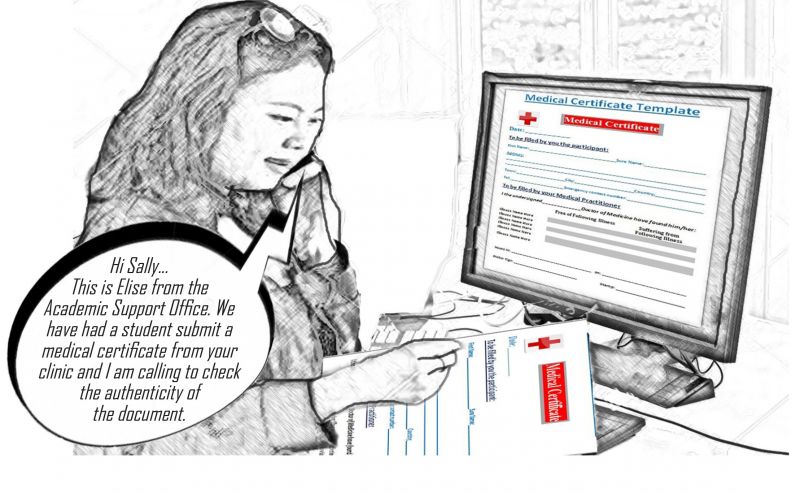
Elise works in the Academic Support Office. She is calling the medical clinic to request verification that a student’s medical certificate is genuine.
From the University's academic integrity guidance:
"Fabrication involves students falsifying information that is used as evidence to support a claim. This is fraudulent behaviour and is serious academic misconduct."
How can I detect fabrication?
The following are some of the issues that caused staff to question the validity of a medical certificate:
- Incorrect spelling and poor grammar
- The student is referred by two or more names
- The medical clinic is not in Australia or is online
- The date is not clear
- The official stamp is missing
- The clinic appears to not have a phone number
- The medical professional’s registration number is missing
- The font of the typing is inconsistent
- The use of correction tape or white-out pens
Guidance for ABP subject coordinators on investigating and reporting academic misconduct can be found on the ABP Academic Integrity Sharepoint site.