Humankind has been designing and making cities for almost 9,000 years. According to the UN, by 2100 as many as 84 per cent of the world’s 10 billion people will live in cities. Potentially dozens more megacities – cities with populations of 10 million or more, 28 of which exist today – will pepper the earth.
As we become a ‘planet of cities’ what does this mean for urban designers and their role?
Right across the world, the unstoppable march of urbanisation means it’s the job of built environment experts – designers, planners, architects, engineers and builders – to make sense of what’s happening and to plan our cities for the future.
In a time of supercharged urbanisation, the work of urban designers will be crucial. So what does an urban designer do? There is no single answer. Urban designers shape the physical layout of cities and their suburbs and towns. They make public spaces that respect the complex and often interrelated issues of social equity, climate change, population health and technological advancement. Urban design is a fascinating, ever-changing profession that encourages its practitioners to ask the big societal questions from a range of career perspectives.
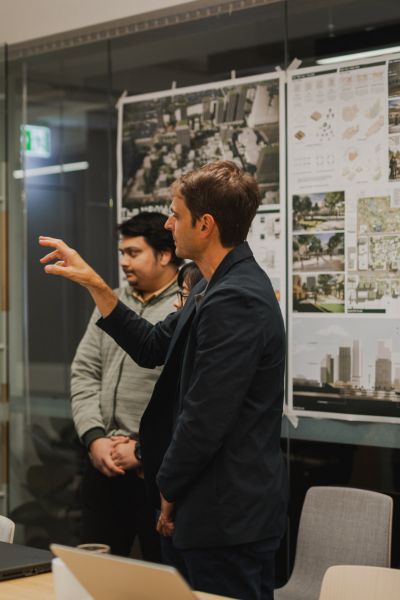
As such, they require a unique blend of imagination, analytical thinking, social consciousness and a deep understanding of community needs. While similar to urban planning (often referred to as city or town planning), urban design is a more hands-on role. It focuses on designing the elements that comprise cities, including; public spaces, infrastructure, transport, landscapes and community facilities.
In urban design, you engage not just with a city, but with the world.
Urban designers focus on planning the elements of city structures such as policies, zones, neighbourhoods, infrastructure, standards, urban guidelines and codes. The questions they face every day are the most compelling questions of a city. What it looks like, how it functions and what it means to its citizens.
Case in point: Melbourne
Take the City of Melbourne for example. Melbourne is one of the world’s most liveable, and one of Australia’s most populous cities and we are lucky to see great examples of how urban design here has been done right.
There are lots of things we love about our city.Walkable streets and laneways, beautiful public parks and gardens, a thriving arts scene, historically significant heritage sites and architecture, and an enviable cafe and bar culture.
But it wasn’t always like this.
We’ve evolved from a city that emptied out after work hours into an internationally recognised hub of culture, nightlife and connection. Our CBD is not just a centre for production. It also represents far-sighted and creative investment in the public realm of our city.
Melbourne is also a great student city – voted by the QS Best Student Cities Rankings 2025 as number one in Australia and number five in the world. We take it for granted, but lots of cities around the world don’t have the luxury of design that has been so purposeful. Our city’s urban designers have generally done a magnificent job and Melbourne is now positioned to help other cities learn from us in terms of functionality, aesthetics, and sustainability.

Build your own story
Based on our beautiful Parkville campus on the edge of Melbourne’s CBD, the Master of Urban Design at the University of Melbourne prepares urban design graduates who can understand the city as possessing both spatial and historical elements that interplay in a complex system.
In addition to planning subjects, half of the course curriculum is focused on developing skills through practical based design studios. So it’s ideal for students with interests in both policy and creativity to broaden their professional skillset.
And because the course is embedded in the University’s Melbourne School of Design – incorporating a wide range of built environment disciplines including architecture, urban planning, urban and cultural heritage, landscapes, construction and property – it gives students opportunities to create their own story around their personal areas of interest.
The qualification provides graduates with accreditation from the Planning Institute of Australia, one of the few courses to do so. And, urban design has recently been recognised as an occupation by the Australian Government in the standard classification for occupations (OSCA) as further acknowledgement of urban design as a profession.
There will always be a need for graduates to understand the big picture. Our design courses are very invested in our city. But we also take an international view, combining global elements that constitute the very best of urban design.
Urban design – shaping our lives
The urban designers of tomorrow will face the questions: is it all build, build, build? Or do we need to start thinking about reusing and transforming what we already have? Let's build cities that adapt to climate change . Are universally accessible. Have been designed for ageing populations, liveability, wellbeing and social connectedness.The way we design and build our cities has a massive impact on our lives.
Urban designers shape our cities at a physical level, not just changing the way it looks but how it is used and the value it provides our communities.
Our shared public spaces are a particularly important marker of humankind and our progress; especially significant as we face the unmitigated pace of urbanisation.
Dr David Mah is a Senior Lecturer in Urban Design and Architecture at the Melbourne School of Design, The University of Melbourne. His work focuses on the intersection of urban design and health, exploring how the built environment shapes well-being through research, teaching and creative practice.