In Conversation: Salad Dressing Landscape Architecture
Goh Yu Han and Chang Huai Yan from Singapore-based landscape architecture practice Salad Dressing visited the Melbourne School of Design as part of the Dean’s Lecture Series in August, 2022. During their visit, they spoke with Master of Landscape Architecture students Keren Maina and Terren Shi about their thoughts on their design processes, inequalities, and pop culture.
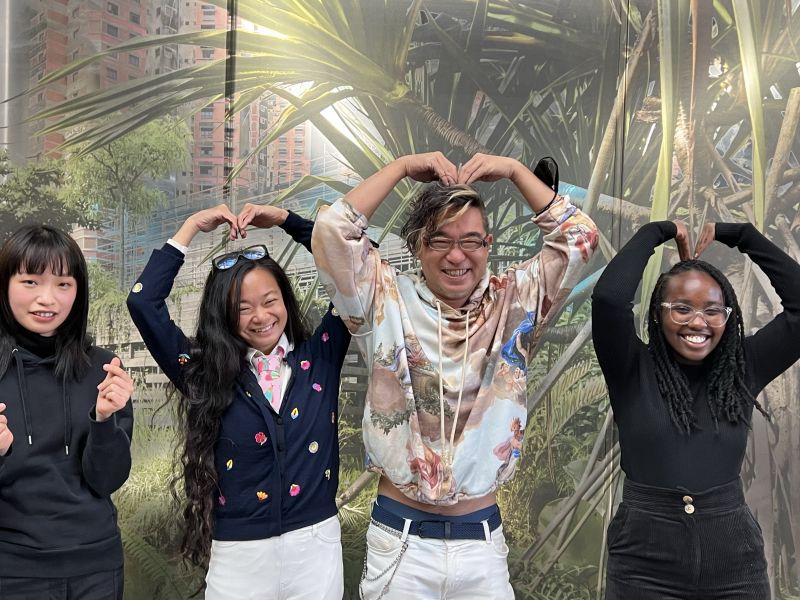
Image: Landscape architects Yu Han and Huai Yan with students Keren Maina and Terren Shi.
By Terren Shi and Keren Maina
Meeting Yu Han and Huai Yan of Salad dressing is a unique experience in itself. You first notice their youthful, quirky clothing and inviting demeanour. Reading about them and meeting them are two distinct experiences. I daresay, nothing prepares you for it. However, their appearance is very much a reflection of their work. It goes beyond the norm and is a mark of individuality and self-expression: much needed traits in the cut-throat world of design.
We began our interview with conversation oscillating from serious issues affecting humanity, such as nature deprivation, to many light-hearted moments. Here is how the interview unfolded.
Keren: Your Dean’s Lecture on Rewilding the Sky was fascinating. What are your thoughts on human- wildlife conflict?
Yu Han: As we spoke about in the lecture you can minimise how much you interact with them through design. However, we must remember that cities are not wildlife habitat, therefore conflict cannot be completely avoided, but allowances must be made for wildlife within cities.
Huai Yan: Sometimes human- wildlife conflict tends to be blown out of proportion. We spoke about rewilding which has been our main interest lately. What we wanted to achieve in this exploration of rewilding is to better understand both animals and plants so that we can design to accommodate them in urban environments. Without this, we will always have conflict in expanding urban environments.
Terren: What do you think of the typology of green infrastructure Salad Dressing uses to rewild cities? Can it be applied in other parts of the world ?
Huai Yan: There are different urgencies in different countries. In Singapore, we are such a dense city and a city-state, which is quite special. It is an experimental ground for us to integrate with other beings and encourage Posthumanism. What’s more important are the generational gaps. My mom will not understand what I am saying because she thinks cities are for humans. Rewilding is not about typologies but values, and generation is where values change. We are promoting different values but not imposing those values onto others. Your generation grew up in a time when people have been somewhat deprived of nature, and life is occupied by technologies. Furthermore, your generation is more prone to accept changes and negotiation. Rewilding will be accepted by you much more easliy.

Image: Green Tunnel, Pang Sua Masterplan, by Salad Dressing Landscape
Keren: Would you mind sharing your design process?
Huai Yan: Do YOU have a design process?
Keren: laughs I’m still figuring it out
Huai Yan: I always did well in school not because I am hardworking but because there is a system. The key to creativity and design is to understand the system and logic. Once you do this, then you have the ‘hack’. Most things are already discovered but the designer needs to cross the boundary. This is the ‘hack’.
For example, when you are asked to design a water system, don’t be satisfied with what everyone is doing; everyone is doing phytoremediation. Think from other perspectives. Even in design, you are still doing business, there needs to be something in your idea that you can sell. For us, in the Pang Sua Masterplan project , it was fireflies. For the fireflies to thrive, you require a whole ecosystem; a constantly wet environment for the firefly eggs to be laid, mangrove trees, and algae (that only grows on the mangrove) for the larvae to feed on. Once they develop into adult fireflies, they need a habitat which is higher up in the mangroves. With these components, you can then start to design, but rest assured that your client will be most interested in the fireflies!
It is also important to be self-aware. A designer must know when they are productive and what they’re good at. We need to acknowledge that we cannot work alone. You can solve even the most difficult problems when you collaborate with others and do what you are good at!
Terren: What is the lived experience of being a young, Asian, female landscape architect?
Yu Han: I grew up in a conservative family in Malaysia, and went to a Chinese independent school, which made me a person deeply rooted in my culture. I read a lot of books; it helped me to expand my worldview. The working experience in Salad Dressing enables me to be exposed to a completely different environment: the office provides chances for everyone to voice up and explore ideas. When I just started my career, during the meetings clients would inevitably put on another pair of glasses to look at me. But what’s important to me is to always remember what you want.
Huai Yan: You will need to know what you want to tolerate things, and these inequalities are always there. Everything is formed by the long history of culture and conflicts that cannot be solved by a single generation.
Yu Han: Things take time. Instead, use time wisely to build yourself and in the end prove to the world what you deserve. It doesn’t matter who you are (young, Asian, or female), everyone needs to find what they’re passionate about and work towards it.
Huai Yan: But I must say every generation is getting better.

Image: Palm Walk, Pang Sua Masterplan, by Salad Dressing Landscape
Keren: I noticed that you had a lot of film- references in your presentation. What role does film play in your work?
Yu Han: I think film is so important to design and life. I draw inspiration from films because they show possibility. When I watch films, I like to study the set design and the environments in which they shoot them. I’m also inspired by film directors who are able to dream up new worlds and go to great extents to bring them to fruition. Some of my favourite film directors are Werner Herzog, Andrei Tarkovsky, Akira Kurosawa, Steven Allan Spielberg; the list is endless.
Terren: How do you achieve work-life balance?
Yu Han: I believe design thinking never stops at the office. Sometimes when I get home, I will suddenly have an idea I want to explore - you will never be away from your work. Inspiration indeed comes from daily life. Let life shape your design. Go travelling and see new things
Huai Yan: Yes, definitely go and travel if you can! Take chances but also accept failures.
Watch Salad Dressing's Dean's Lecture Rewilding the Sky here: