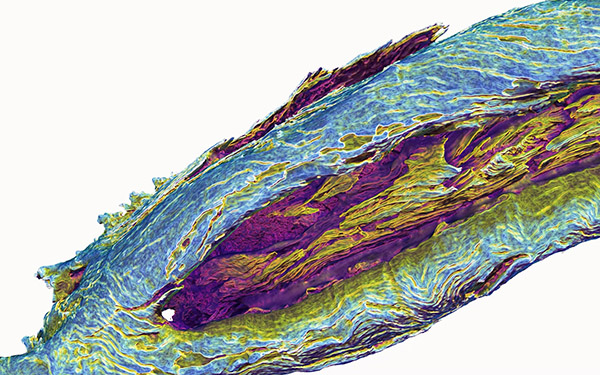
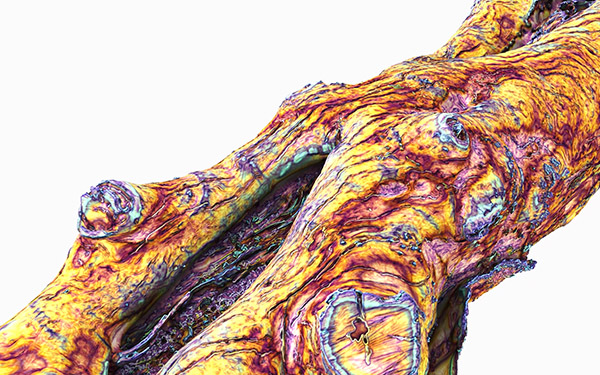
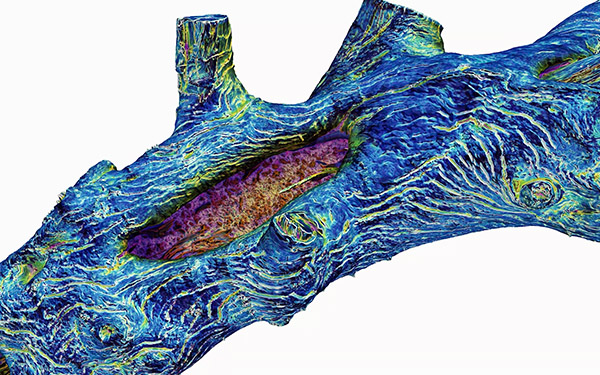
This project uses computational imaging and analysis to amplify the voice of a single tree on behalf of all plant life by examining the marks created by nonhuman beings and Indigenous Australians who harvested bark for practical purposes.
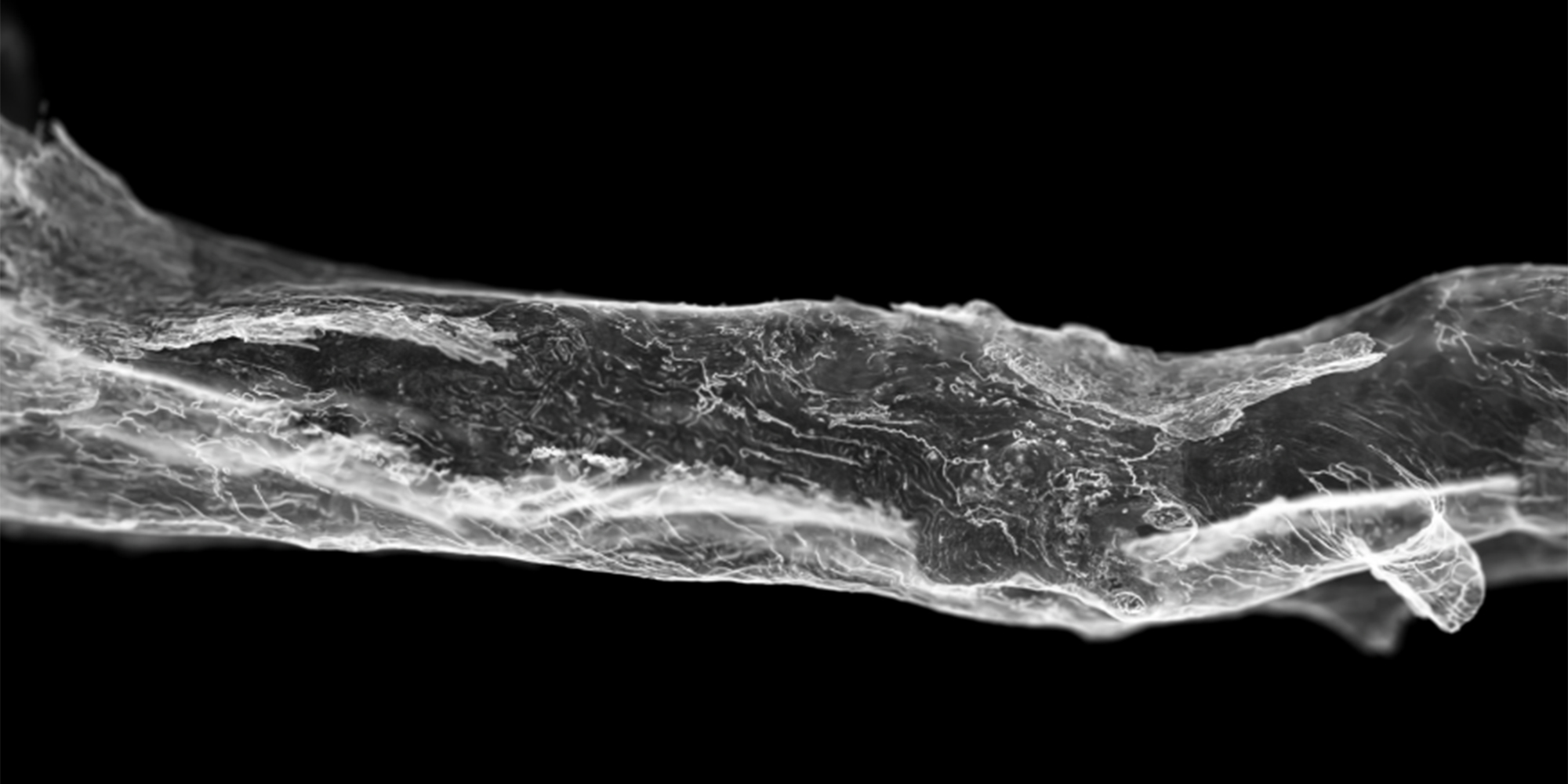
This project introduces an approach aimed at amplifying the voices of trees through innovative applications of spatial data. To address this objective, we focus on a specific tree located in southern Australia, near Melbourne. The ancient trunk of this tree bears scars left by Indigenous Australians, who once harvested its bark to craft essential tools and objects. Our project seeks to listen to this tree as a representative of plant life. Plants, while capable of sustaining themselves, also support other living beings. Their ecological contributions are essential for the survival of complex life forms, yet human understanding of trees remains limited and often anthropocentric.
To deepen this understanding, our research combines scientific and Indigenous knowledge with a more-than-human perspective, treating trees as educators who can guide humans toward more sustainable practices. Our approach to human-tree collaboration involves extracting meaning from detailed laser scans and transforming these scans into animated digital representations, designed to engage diverse audiences.
We presented the work at a prestigious venue in the Melbourne Museum during an exhibition dedicated to exploring the meaning and contributions of trees across cultures. The exhibition drew large audiences, received multiple press reviews, and earned the Medium Project of the Year award from the 2023 Victorian Museums and Galleries Awards, administered by the Australian Museums and Galleries Association (Victoria), Public Galleries Association (Victoria), and Creative Victoria. Additionally, the project received a “highly commended” nomination from the Waterhouse Natural Science Art Prize and was selected for a national tour organized by the South Australia Museum.
Research Grants:
Prosthetic Nest Sites: An Ecological Alternative for the Powerful Owl, William Stone Trust Fund, Melbourne.
Prosthetic Habitats: Designing Urban Nests for the Powerful Owl, Melbourne Sustainable Society Institute, Lord Mayor's Charitable Foundation, Melbourne, AU.
Place and Parametricism: Provocations for the Rethinking of Design, Australian Research Council, DP170104010, AU.
Outputs:
Briggs, C., Tournier, D., Martin, B., Rutten, J., Holland, A., & Roudavski, S. (2023). Kummargi Gadhaba Yulendj Tarrang [The Knowledge of These Trees Is Rising Up] [Lidar scans, data analysis and visualisation, computer simulations, digital compositing, digital video]. More Than a Tarrang (tree): Memory, Material and Cultural Agency, Melbourne Museum, Bunjilaka Aboriginal Cultural Centre. <
Stanislav Roudavski @ Academia.edu
Deep Design Lab
Project Contact:
Dr Stanislav Roudavski (CI), Senior Lecturer in Digital Architectural Design, University of Melbourne
Dan Parker, PhD Candidate, University of Melbourne
Co-authors: N’arweet Carolyn Briggs, David Tournier, Brian Martin, Stanislav Roudavski, Alexander Holland and Julian Rutten