Catriona Li Bisset received her Master of Architecture from the Melbourne School of Design after seven years of part-time study. Defying the expectations of a standard academic trajectory, Catriona chose to balance her career as a professional athlete alongside her studies. Working at her own pace, she competed in the Tokyo Olympics, the World Championships and the Commonwealth Games, graduating in 2023 with high distinctions in both her Master of Architecture and her diploma in Chinese language.
She shared her advice with us on advocating for yourself and honouring your skills outside the classroom, while acknowledging that taking time away from studying is a privilege not everyone has access to.
Tell us a bit about your education journey?
I did my bachelor’s degree [in architecture] at UNSW. Then, I worked full time for two years in Sydney in architecture firms before I moved to Melbourne to start my masters full time.
I’d always been a keen runner as a kid. When I started full-time work it meant that I had a bit more routine and I could pick up the running again, but I had no real aspirations for where it would go.
It was definitely a real shock and identity shift for me in the second year of my masters when I was given the opportunity to become a professional athlete. I think in some ways, why I really embraced the athlete’s life [was because] I didn’t really know what I was doing.
How did you find juggling your personas as a runner and an architect?
I felt like I was an architecture student, and then I was a professional runner, and then I had to figure out that I was both of these things. I wasn’t just two separate people.
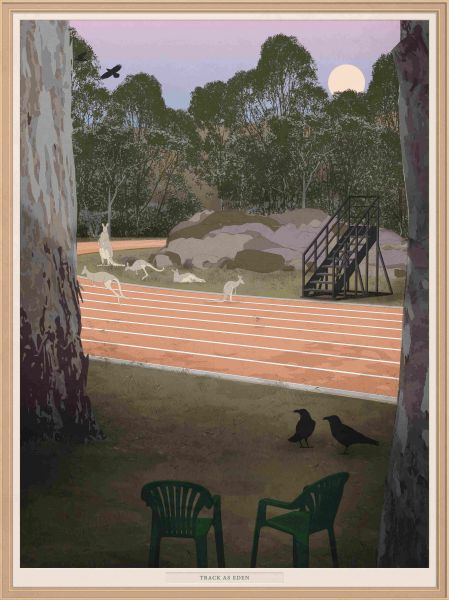
I think my thesis, which I did on athletics tracks, was a really interesting culmination of all these years of this push and pull. I had to overcome this internalised stigma of not wanting this to be a gimmick and actually acknowledge all of my important expertise as a sports person.
Tell us about your thesis.
I studied athletics tracks around the world and in Melbourne. There’s so much thinking and research around the mega infrastructure of the Olympics and these big spectacle events but I found very little [around] community sport, particularly athletics tracks. I spoke to my long-term supervisor, Hannah Robertson, [about] how can I use this thesis as a way of becoming the architect that I want to be in the rest of my life.
I’m really passionate about participatory design. I love interviewing people and asking people about their experiences of space. I had this amazing privilege of [having] access to this massive network of Olympians, Paralympians, people across the world.
What role did your running play during your studies?
I feel like the running offered me this outlet of competition and fulfilment. And then also just the obvious lifestyle benefits of moving your body, which is not something that’s prioritised like academic pursuits [are].
Over those couple of years, I guess I shifted from being a student who did casual running to being a professional runner who did part-time uni.
What are your reflections on choosing to study over an extended period?
I got to mature. I [didn’t] put all of my self-worth into the outcomes of my assignments. I think a lot of students really struggle if they don’t have that balance to separate themselves from their work. You put a lot of yourself into creative subjects and it is really hard to not take things personally.
And because it is subjective in a lot of ways, it is also really hard with a creative field to be really strong in your own beliefs and feelings, [and] how you want to do things. I think [running] gave me that sort of courage and independence outside of the studies to really think about how I wanted to do things as an architect.
What advice would you give to students thinking about slowing down or taking time off?
It’s a really tricky one because I don’t think I really consciously made a lot of the choices that I did. [People] think there’s this magic moment where you suddenly become elite enough or smart enough or special enough that you can take a break or can do something different.
But whose permission are you looking for? I think that was such a big thing for me that I tell a lot of my friends as well. No one needs to give me permission.It’s literally me standing in the way of doing the thing I want to, and so that was a huge one for me. I just have to advocate for myself.
Perhaps it’s understanding that asking to step away for a bit isn’t as scary as students might think it is?
It does feel really scary. [Higher education] feels like it’s this big machine that you have to fight against, but I think the culture of the uni in general is becoming a lot more accommodating to people wanting to do different things.
The language around mental health is getting a lot better and people are being more educated around that. I would validate anyone’s feelings of fear. It’s a really big ask for a lot of students, especially if English is a second language.
I just want to reinforce everyone has a different approach and if you just want to go through your degree and bang it out, go for it. I think that is completely valid. I don’t think there’s any one right way of doing it.
You can ask for other things, but there is a degree of privilege that comes with that, whether that’s being very articulate or very good at advocating for yourself.
What’s next for you?
I’m preparing for the Olympics. Looking into collaborating with artists and other architects around installation projects that we can do at athletics tracks and other community sport venues – exploring those ideas around sport and public space and how we can better support that relationship between the private and public within the sporting context.
I don’t think I would have been ready to become the architect that I’m looking to be now if I hadn’t spent that large amount of time exploring these other parts of my life.