The architects, designers and academics who made the Glyn Davis Building possible come together to reflect on the building’s creation, its legacy, and what it means ten years on.
The Faculty of Architecture, Building and Planning places its commitment to Indigenous knowledge and engagement at the heart of its work and curriculum, so it’s only fitting that we acknowledge that prior to colonisation, the site of the Glyn Davis Building was a wetland that belonged to the traditional owners, the Wurundjeri people of the Kulin Nation.
Since colonisation, the site has borne witness to generations of change and white settler interventions, from which the Building is not exempt. In the 1930s, the imposing facade of a Bank of New South Wales, originally designed by Joseph Reed at the height of the gold rush, was transplanted onto the site. In 2012, both the Old Commerce Building and the Architecture Building were demolished to make way for the new design. Fast forward to 2014, the Glyn Davis Building was unveiled, heralding a new era in architectural education. At all points, we acknowledge that sovereignty was never ceded.
Originally named the Melbourne School of Design Building, it was renamed after former Vice-Chancellor Glyn Davis. Brought to life by John Wardle Architects and NADAAA, the internationally acclaimed architectural team was tasked with designing a building that met four exacting requirements: make every discipline within the Faculty visible (literally); create an outstanding place to work and carry out research; provide world-class learning environments; and deliver on environmental performance. Not only did the design team achieve what they set out to accomplish, they created an iconic structure that has solidified its status as a landmark in innovative and sustainable design.

Seeing is believing
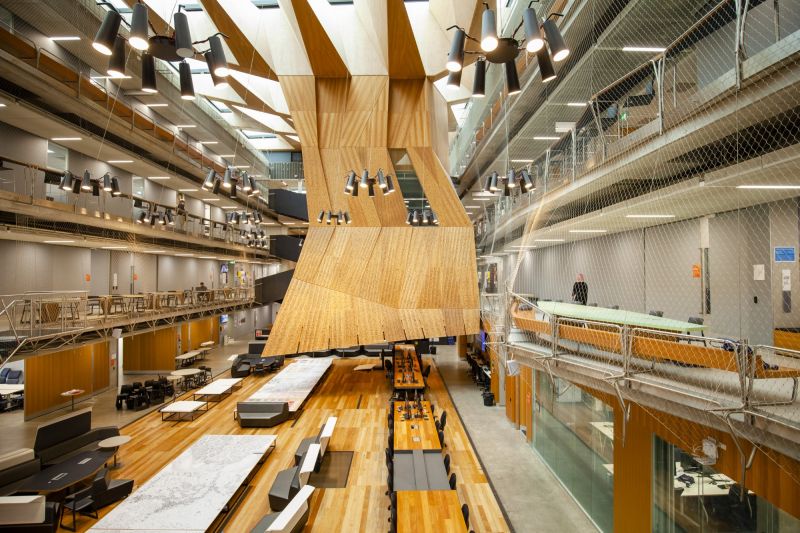
The Glyn Davis Building’s open and transparent design was conceived to serve as a living, breathing educational tool.
“One of the key briefing elements given by our [former] Dean, Tom Kvan, when the building was in its design stages, was that the building should be a pedagogical instrument. It should teach people. And what better place to teach architecture and construction,” says Professor and Chair of Architecture Philip Goad who was embedded in the building’s transformation process.
Ian Steedman, Design Manager at international construction contractor Multiplex, adds, “The Glyn Davis Building was a huge undertaking, not just in scale but in its ambitious features. The atrium, with its hanging studio and elaborate roof construction, is a testament to innovative design.”
Looking back, Claire Martin, an Associate Director with Oculus Landscape Architecture and Urban Design, emphasises the importance of creating outdoor spaces that not only knitted the building into its surroundings but provided external spaces for members of the Faculty to study and relax in. “Our role was to stitch the building into the campus, considering the movement and trajectories. It was about creating outdoor rooms and spaces that enhance the building’s functionality.”
Sustainability at the heart
From its inception, the Glyn Davis Building was designed with sustainability in mind. Achieving a 6 Star Green Star rating, it incorporates numerous climate-first features. “The building proposal started as a 5 Star, but we elevated it to 6 Star. It’s among the first dozen buildings in Australia to achieve this rating,” Steedman explains. This includes a million-liter rainwater tank, solar hot water systems, and a mixed-mode ventilation system that reduces energy consumption.
Professor Julie Willis, Dean of the Faculty of Architecture, Building and Planning emphasises the building’s green credentials. "The sustainability aspects were crucial from the start, and the building has set a standard for the university’s future projects."

Spaces that inspire
The Glyn Davis Building was designed to foster collaboration and innovation. Ten years on, the structure hasn’t wavered from delivering on this promise. “The atrium is a place where students and staff can interact and see what’s going on. There’s an energy that runs through the building every day,” Willis says.
The flexible design allows for seamless transitions from classrooms to exhibition spaces, enhancing the learning experience. 06 Martin elaborates on the thoughtful landscape design that brings learning and research outside the building and into its many exterior spaces. “We created spaces for hands-on making to the north, and more formal courtyards to the south, integrating both structured and informal learning environments.”
Robert Crawford, Professor in Construction and Environmental Assessment, highlights how the building is used a pedagogical tool to this day. “Students can see how the building goes together, from the exposed services to the structural components. It’s a practical teaching resource,” he explains.
Meanwhile, the building’s integration of advanced technologies has ensured it remains at the forefront of architectural education. “We teach a subject on prefabrication, integrating learnings from the building’s construction. This approach has become a key part of our curriculum,” says Crawford.
Beyond Faculty to community
More than a piece of architectural design, the Glyn Davis Building has become a hub of activity. “It’s a place where students feel at home. They come to work, interact, and be inspired. The building has this amazing ability to bring people together,” says Willis.
Martin adds, “The ongoing legacy of the building is the learning environment it has created, and the way it has changed how people learn and think about design.”
“It’s one of the places on campus where students like to come and collaborate and often they’re not our students. You can look over someone’s shoulder and they might be from accounting or science,” adds Goad.
Reflecting on its impact on the University culture, Crawford remarks, “The significance of the Glyn Davis building lies in its ability to unite students and the broader community in a single, dynamic space.”

Living heritage
With its commitment to innovation, sustainability, and community, the Glyn Davis Building continues to inspire future generations of architects, planners and designers, setting a benchmark for educational facilities worldwide.
Willis leaves us with this reflection on the future of the site: “I hope that the Glyn Davis Building stays as a piece of design that’s complete; that when we look after it, we look after it as though it is a piece of heritage.”
Learn more about ten years of the Glyn Davis Building