Dwiyanti Kusumaningrum
Doctor of Philosophy candidate
Urban planning, Human geography
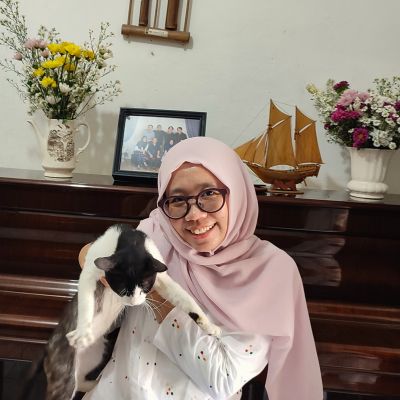
Biography
Dwiyanti Kusumaningrum is a PhD candidate at the Faculty of Architecture, Building and Planning, The University of Melbourne and a researcher at the Research Centre for Population, The National Research and Innovation Agency of the Republic of Indonesia. She earned her undergraduate degree at Department of Geography, Universitas Indonesia, followed by master double-degree at The Graduate School of Universitas Gadjah Mada and University of Twente. She is engaged in human geography, especially topics related to extended urbanisation, gentrification, geography of settlements, and socio-cultural dynamics of kampung in Indonesia. Her works have appeared in both Indonesian and international journals such as Masyarakat Indonesia, Journal of Property Research and Journal of Urbanism. Her writings are also published in scholarly media such as The Conversation, Indonesia at Melbourne, and The Malay Archipelago. She is a member of the Society of Architectural Historians, Australia and New Zealand (SAHANZ) and part of the 21st Singapore Graduate Forum (2026 cohort) held by the Asia Research Institute, National University of Singapore.
Thesis
A city in the villages: Understanding geographies of urban encroachment and its socio-spatial consequences on kampung in the hinterland of Jakarta
This study aims to investigate urban processes through new town development in Tangerang, the western hinterland of Jakarta and examine the socio-spatial consequences of the process on kampung, the pre-existing vernacular settlements remain in the region. Among other hinterlands of Jakarta, Tangerang has been known as hotspots for new towns or kota mandiri such as Lippo Karawaci, Gading Serpong, Alam Sutera, and Bumi Serpong Damai (BSD City).
By using historical geography as approach, this research will reconstruct past geographies to understand how Tangerang has gradually urbanised, resulting in a new urban system characterised by the coexistence of kampung and private cities. This study uses multitemporal GIS analysis, in-depth interviews, archival analysis, field and digital observations to investigate urban processes in the middling landscape, the in-between city and countryside, which is now highly connected to the contemporary global urban economy.
The existence of gentrifying urban forms such as world-class universities, golf courses, hospitals, and ubiquitous consumption places highlights the urbanising landscape of Tangerang which polarise pre-existing centralities and collective sense of place of the kampung dwellers. This study calls for new conceptualisation of the unprecedented scale, connectivity, and morphology of contemporary urban processes in the contemporary desakota. This research will highlight kampung as an important spatial entity which Indonesian government should take into account in spatial planning and urban policy making, to create a better socially equitable urban environment, towards spatial justice and rights to the city for everyone.
Contact
- Email dwiyanti.kusumaningrum@student.unimelb.edu.au
- LinkedIn Profile LinkedIn profile
- ORCID Profile ORCID