Digital Design, Data & Monitoring
Design & the Digital World
Landscape architects have a much bigger role to play in working with digital technologies. It was no accident that Ian McHarg informed the development of Geographic Information Systems (GIS). GIS has transformed the way we design and plan our world. Shifts in technology continue taking place rapidly. Landscape architecture as a profession will need to participate in these growth trends. Spatial mapping and digital design as well as virtual reality are demanding user interfaces and spatial design considerations. Engineers are increasingly involved in delivering these environments and applying the technologies.
How can landscape architects contribute and expand this area of expertise? In one sense, we represent the users of these spatial tools. We should also be pushing how they are being developed and used, and in particular, using the design process to expand the scope and application of digital design tools. We should be guiding engineering and modelling, such as the digital twins being developed for cities to fit across the socio-political, ecological and civic spaces that we design and build, and we should be informing the use of digital twins for maintenance and management.
Urban ecologists are the first to point out the limitations in our current knowledge around the ecology of cities. It is critical to teach design students not only about the knowledge we have, but also about the uncertainty of the science and the extent to which particular experiments and the associated analysis can be applied to distinct situations.
Designed Experiments

Designers need to be educated by ecologists about ecology. The issue with designers teaching ecology is that designers typically focus on how science guides design. Focus is on the outcomes of the research and how it informs design. This limits the relationship between the designer and ecologists into a one-way communication flow. Working to establish a two-way communication channel between designers and ecologists is valuable. Connecting designers directly to experiments that ecologists set up to study urban environments is a prime example. Coined ‘Designed Experiments,’ this approach brings ecologists and designers together to formulate design and implement experiments as urban design intervention.

The idea of Designed Experiments (DeX) is to design and build real-world, urban projects that incorporate research experiments, in order to study, adapt, and reshape human settlements and their associated biological and socio-ecological systems. Essentially, it’s a framework for the scientist to collaborate directly with designers towards developing a product. And that product is both a work of urban design and a research experiment.
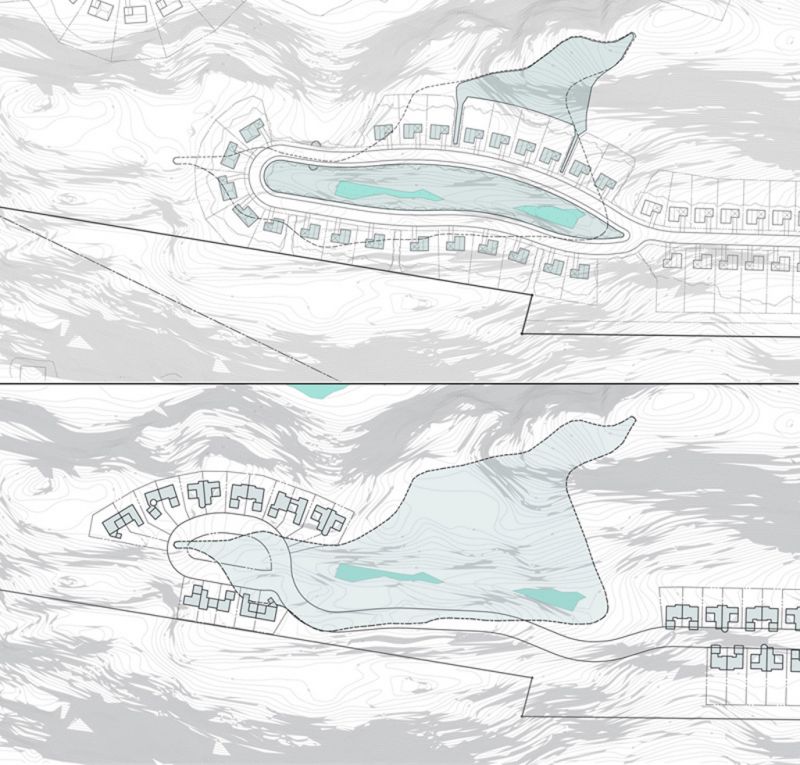
A project located in Tuxedo, New York, illustrates the real-world positioning of DeX. The development of 900 residential units was planned for a 1200-acre greenfield site north of New York City. It created an opportunity for ecological expertise to be inserted at the site analysis phase - early enough in the design process to inform the layout of road locations and housing lot locations. The research itself was a means to an end, and it reflected this shift in attitude as to what the ecologist’s position is in a design process. It’s also a shift in attitude for the developer as to what the value of scientific research can be when negotiating with a local planning board around environmental issues. In this project, the design team included an amphibian migration study and larval density study to document existing wildlife on the development site in greater detail than was required for the environmental impact assessment or other habitat assessments. The results directly informed the layout of the development, and illustrate ways of using experimental research on wildlife to guide planning and design.
The UEDLAB received the National Science Foundation Building Innovation Capacity grant which culminated in the Thermogreenwall (tGW) project. The research was co-led by Alex Felson, James Axley and Graeme Berlyn, and focused on academic-industry partnerships with the purpose of creating interdisciplinary work. We used bio-technologies and constructed ecoSystems to design symbiotic interactions between infrastructure, public spaces, and users.
For the Thermogreenwalls project we integrated active heat rejection into a native wetland planted green wall as a distributed HVAC (heating, ventilation and air-conditioning) system. We worked with physicists, plant and soil ecologists and water chemists to study thermodynamic functions, ecosystem services, strategic water use, and aesthetics as well as plant health metrics. This included building outdoor prototypes and developing design drawings for representative tGW applications to allow evaluation of first costs, operational costs, and benefits of the design proposals.
