Andrea Pianella, Andre Stephan and Nancy Mase
Line of enquiry
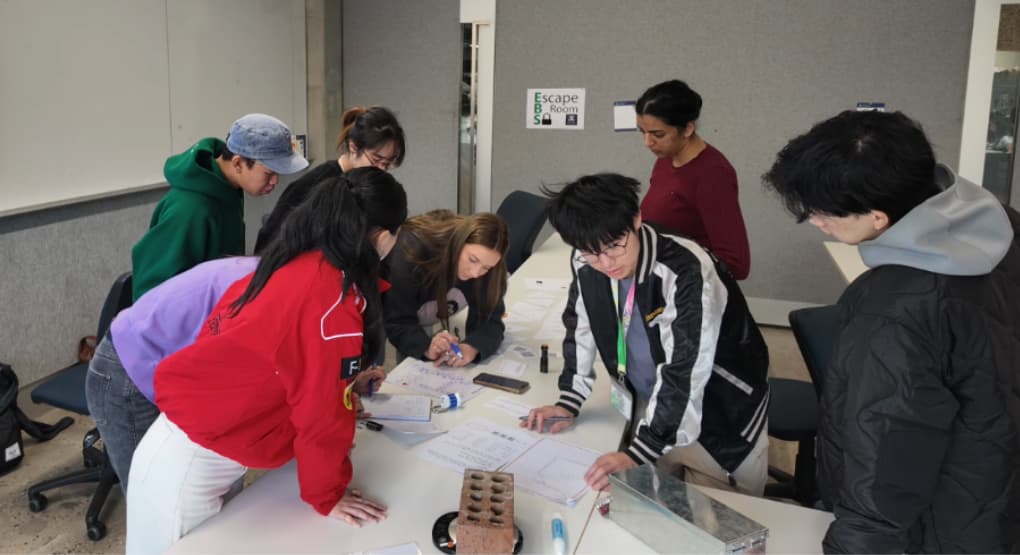
This project explores how educational escape rooms—a form of game-based learning—can enhance student engagement and active learning within the built environment disciplines. Student engagement is recognised as a key driver of academic success, yet many traditional lecture-based approaches struggle to sustain interest and interaction, particularly in technically dense subjects. Escape rooms, by contrast, offer immersive, collaborative, and time-bound problem-solving experiences that encourage teamwork, critical thinking, and practical application of knowledge.
Scholarship & Expertise
This project draws on scholarship in gamification and playful learning in higher education to inform both its line of enquiry and pedagogical approach. In particular, it is grounded in research demonstrating that game-based learning strategies can enhance student motivation, engagement, and collaborative problem-solving, while supporting deeper learning outcomes (Fotaris & Mastoras, 2019; Nicholson, 2018). These principles directly informed the design of the educational escape room as an alternative to passive revision formats. Additionally, the project is informed by literature on student wellbeing and assessment-related anxiety, which highlights the role of innovative, low-stakes, and interactive learning environments in building student confidence and reducing stress prior to performance-based assessments (Cain, 2019).
Exploration
This project evaluated the pedagogical effectiveness of an educational escape room as an active learning strategy in built-environment education. By examining whether an immersive, puzzle-based activity could enhance student engagement more effectively than traditional lecture formats and help with reviewing key subject content.
The objectives were to:
- Assess how the escape room supported learning by requiring students to apply course concepts, collaborate, and problem-solve in a time-bound, experiential environment.
- Measure multidimensional engagement (behavioural, emotional, social, and cognitive) using an adapted MSSEC survey.
- Explore learning transfer and reflection, including how students connected puzzles to learning objectives and identified knowledge gaps.
- Gather student and staff perspectives on the escape room’s strengths and limitations as a teaching tool.
- Develop evidence-informed recommendations for incorporating playful, experiential learning activities into ABP subjects.
Evaluation
A mixed-methods approach combined post-activity surveys with semi-structured interviews involving students and teaching staff. The data is provisional and will form the baseline for continued data collection in the coming years to build a more robust evidence base.
Feedback from students was consistently positive. Survey responses and interview comments highlighted strong behavioural, emotional, and cognitive engagement. Students reported that the escape room helped them apply course concepts, collaborate effectively, identify knowledge gaps, and deepen their understanding in preparation for assessments. Many also noted increased confidence and enjoyment compared to traditional revision methods.
The findings enhanced subject delivery, informed future curriculum innovation, and promoted pedagogical approaches aligned with ABP’s goals for creativity and evidence-informed teaching.
Recognition
This project was awarded an ABP Designing Future Education grant in 2025. It received formal recognition through a Teaching Innovation Award in February 2025, reinforcing the value of creative, student-centred methodologies within technically rigorous built-environment subjects. The project also resulted in wider scholarly and professional engagement. It led to an invitation to participate in the Teaching Conversations Series, in a session focusing on gamification, translating teaching into Scholarship of Teaching and Learning, and creative modes of secure learning.
An abstract arising from the project was presented at the SoTL Showcase organised by CSHE on 30 October 2025, where preliminary findings were shared. This presentation generated interest among colleagues across the University. Subsequently, the team was invited to deliver a lecture in EDUC90516 – Assessment Design and Practice on 20 February 2026. The project also initiated a new collaboration with Melbourne Law School. Colleagues from Law engaged with the team to co-develop an escape room for one of their subjects, which was successfully implemented on 5 May 2026.
Dissemination (planned or complete)
In progress
References
Cain, J. (2019). Exploratory implementation of a blended format escape room in a large enrolment pharmacy management class. Currents in Pharmacy Teaching and Learning, 11(1), 44–50. https://doi.org/10.1016/j.cptl.2018.09.010
Fotaris, P., & Mastoras, T. (2019). Escape rooms for learning: A systematic review. European Conference on Games Based Learning, 235–243.
Nicholson, S. (2018). Creating engaging escape rooms for the classroom. Journal of Educational Technology Systems, 47(2), 171–190. https://doi.org/10.1177/0047239518786783