25 Playspace Design Primer
Observation
Compared to other landscape typologies, playspaces are unique due to its nature: they are spaces designed specifically for school-age children and teenagers to have fun. It is a space designed to actively engage users, providing a risk-free ground for the youngsters to develop their physical, cognitive, sensory and social skills. In these spaces, the users can challenge themselves physically and practice their bodily coordination, to simulate their senses and creativity, embark their own journey in the small little worlds they created, and more importantly, a relax space for them to bond outside the dull classroom. By spending time in playgrounds and play, we prepare ourselves for our adult life.
"It is better to risk a broken leg than a broken spirit. A leg can always mend. A spirit may not." - Lady Allen of Hurtwood, English landscape architect and early advocate of adventure playground
Theory
There are no definite rules on designing a playspace as the space is all about creativity, engagement, and fun! The only rule that applies to playspace design is the safety regulations, as the space is meant to be a risk-free environment where children can play without inflicting major injuries.
Here are some starters which a designer can think about when designing playspaces:
- Context – Is the playspace locate in natural/rural environment or urban environment? This determines the availability of the materials and themes. For the natural playspace, its theme can be tied into the surrounding landscape, be it physical (e.g. plant species of forests) or cultural (e.g. folklore), and it can be constructed with the materials available on site (e.g. tree stumps in the forest). For the urban playspaces, there is more restrictions as they are often found in the more confined areas amidst the dense buildings. Yet, this can be compensated by giving an lightened and interesting theme to the playspaces, such as aquariums, ships, animals, and castles.
- Theme – It is important to have one theme which is consistently applied to the play elements. This keeps the little worlds intact and allows the children to take on their own adventure without confusion.
- Colour – It is crucial to attract the children’s attention and interest with bright colours, and to stimulate their visual senses. Colours are especially useful to set the urban playspaces apart from the dull residential buildings.
- Texture – Mixing different materials can add interest to the playspace and help stimulating the children’s sense of touch.
- Terrain - For a flat land, complex arrangements of elements can be done easily as compared to an undulating terrain since the latter prevents elements scattering around. Yet, an undulating terrain provides a natural slope for slides and climbers, creating a seamless playspace.
Other useful resources:
Design for Play: A guide to creating successful play spaces by Play Australia:
Everyone can play: A guideline to create inclusive playspaces by NSW Government:
The concept of “Play City” introduced by the Brimbank City Council
https://yoursay.brimbank.vic.gov.au/west-sunshine-20-minute-neighbourhood
Precedents
1) Pod Playground, Canberra - by Taylor Cullity Lethlean
https://tcl.net.au/projects-item/pod-playground/
2) Nature Play at Royal Park, Melbourne - by City of Melbourne https://www.aila.org.au/AILAWeb/Australia_Best_Playground/Nature_Play_at_Royal_Park.aspx

3) Blaxland Riverside Park Playground, Sydney - by JMD Design
https://jmddesign.com.au/projects/blaxland-riverside-park/
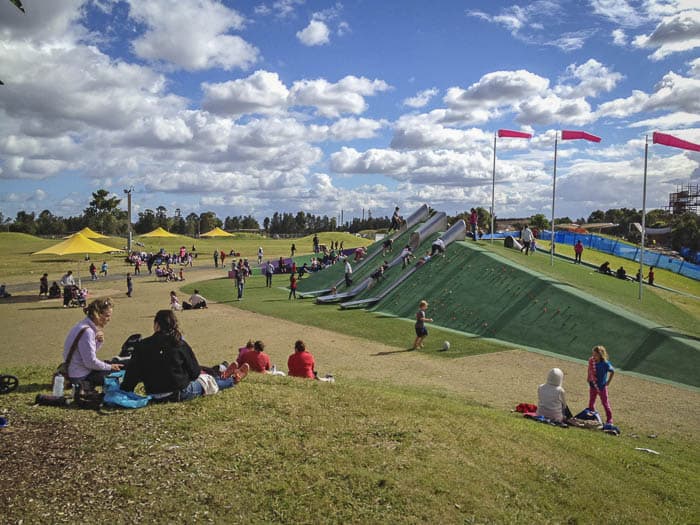
4) MonstroCity, City Museum, St Louis
https://playgroundprofessionals.com/playground/monstrocity-one-cooler-playgrounds-youll-ever-see
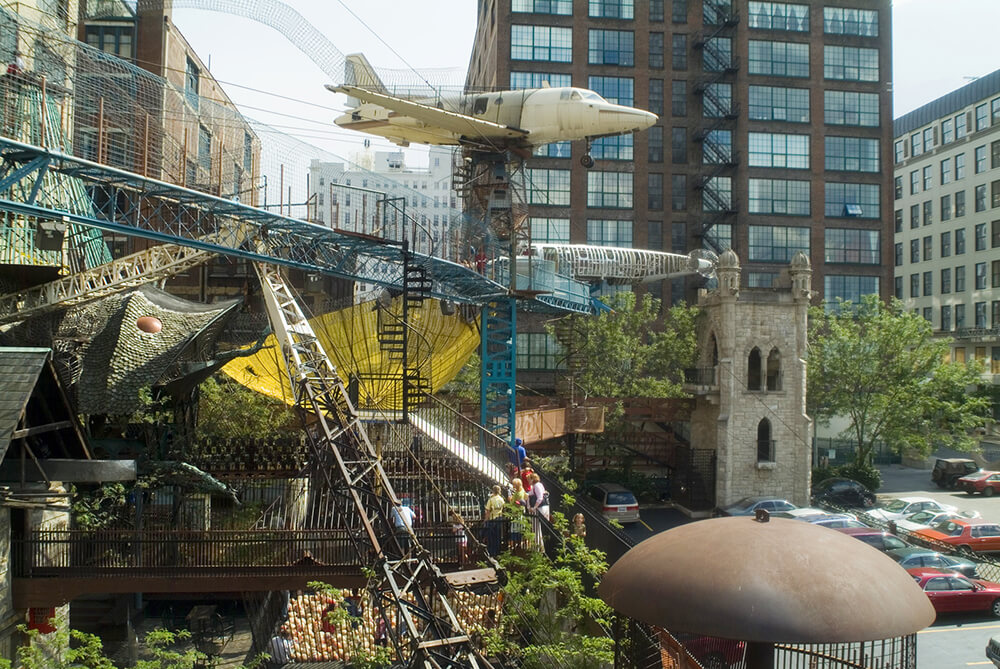
5) Nishi-Rokugo Park, Tokyo
https://jigsaw-japan.com/2019/07/07/never-get-tired-of-recycling-at-nishi-rokugo-park/

6) Para Wirra Nature Playspace, South Australia - by Taylor Cullity Lethlean
https://tcl.net.au/projects-item/parra-wirra-nature-playspace/
7) Children's Bicentennial Park, Santiago de Chile - by ELEMENTAL
https://www.archdaily.com/461315/children-s-bicentebnnial-park-elemental
