29 Landscape Narratives
Observation
“We live within worlds of stories, and we use stories to shape those worlds.” -James Purinton & Matthew Potteiger, Landscape Narratives : Design Practices for Telling Stories (1998), p.3
It is easy for us to disregard unfamiliar places when they are being razed, but to care deeply about our birthplaces, hometowns, and places which we spend our every single day. Some people will even throw themselves in front of the bulldozers just to protect their important places. This is because these places are no simple physical space, but filled with our memories. We acknowledge the places through our connections and attachment to them, and they become part of our identities – how we see ourselves.
Contrary to the popular belief, landscape narratives are very common and can be found nearly in all places. It is difficult to find a place where no one can tell us something about it: even the isolated landscape have their own lores in the civilizations. The narratives are usually invisible as they are inherent, deeply embedded in our minds (or subconsciousness). However, it is possible to materialize them through the design strategies, allowing them to reveal themselves to everyone, including those who are strangers to the places.
Design Theory
Landscape narratives can be presented in many formats, both subtle and explicit. To start with, the most explicit (and easiest to be understood) typologies are museums, exhibitions and memorials, since the main purposes of these places are to record stories and (re)telling them through visual experience.
According to Purinton and Potteiger (1998, p.11), there are nine types of landscape narratives, which are:
- Narrative experiences
Narratives are presented by tours, rituals, reenactments and routines happened (across several places), e.g. the Hajj in Mecca, the Via Dolorosa in Jerusalem - Association and References
Elements which embody the narratives themselves through history and experience, e.g. Survivor Tree in Oklahoma City, Atomic Bomb Dome in Hiroshima - Memory Landscapes
Places as the focal points of the memories, which are often monuments and memorials, e.g. 9/11 Memorial in New York, the Shrine of Remembrance complex in Melbourne, the National Mall in Washington D.C., Memorial to the Murdered Jew of Europe in Berlin - Narrative Setting and Topos
General spaces serving as a backdrop to hint something may happen, like mountaintops for epiphanies and roads for chance meetings - Genres of Landscape Narratives
Places shaped by culturally defined narrative forms or legends, such as Monument Valley and the American West, Shibuya and the Cyberpunk cities, etc. - Processes
Narratives are told through actions or events in flux, often applied to natural processes - Interpretative Landscapes
Programs designed that reenact the events happening in a place, performed by the users, literally or figuratively, such as 1000 Steps in Dandenong Ranges, the Stuart Highway in the SA and NT, the reenactment of the Oregon Trail - Narrative as Form Generation
Using narrative sequences as a design device, although the narrative does not necessarily remains in the final outcome, such as Bernard Tschumi’s Parc de la Villete - Storytelling Landscapes
A landscape that is designed to tell stories explicitly through direct, literal visual representation, e.g. themed gardens, memorials, Disneyland
As we can see, some narratives are well-disguised as they do not necessarily present themselves as a solid piece of land. Therefore, it is crucial for the designers to take up the role as storyteller/narrator, harnessing the essence of the stories and turn them into visible depictions.
For the design strategies, we can start by using the five main ways stated by Purinton and Potteiger (1998, p.73):
- Naming: “The abbreviated stories of discovery, biography, and identity”
Names are powerful as it is very provocative. The imagination of the people can be triggered simply by seeing and knowing the names. E.g. Death Valley in California, Inaccessible Island in South Atlantic Ocean - Sequencing: “The ordering of names, trees, paths, and other elements, events, and characters, structures meaning”.
Deciding the progression of the narrative will make storytelling more effective. It is like reading a book or watching a movie where it begins with an introduction, followed by the elucidation, climax, and ending. - Revealing & Concealing: “Concealing and revealing information, weather in a decipherable sequence or all at once, creates drama, suspense or surprise that engages the reader with a story”
With designers being the narrators of the landscapes, it is their job to reveal the plot bit by bit in order to build up the atmosphere for the targeted emotional response (e.g. shock, awe, relief). It’s like the spoiler – we do not want to jump into the climax straight from the start, but to slowly build up the flow. - Gathering: “Narratives are also a way of gathering or drawing together broader experience into a tangible and cohesive place”
Instead of having stories from a single person, the narrative can be created from a collection of discourses to inform the full picture, increasing its substance and strengthening its convincement. - Opening: “Opening involves ways of creating places responsive to cultural and natural processes”
Narratives can be reshaped and reformed by allowing people to interact with their physical medium or associated actions, constantly creating new stories.
Other Sources:
Jamie Purinton and Matthew Potteiger (1998). Landscape Narratives : Design Practices for Telling Stories. New York: J.Wiley.
Matthew Potteiger, & Jamie Purinton. (1997). Landscape narratives: crossing realms. Landscape Review, 4(1), 16–26.Landscape as narrative, by Azzura Cox : https://www.foreground.com.au/culture/landscape-as-narrative/
Precedents
1) Wootten Road Reserve Grassland, Tarneit - by GLAS Landscape Architecture
https://glasurban.com/?portfolio=experiencing-grasslands
https://www.landscapearchitectureprojects.com/projects/wootten-road-reserve
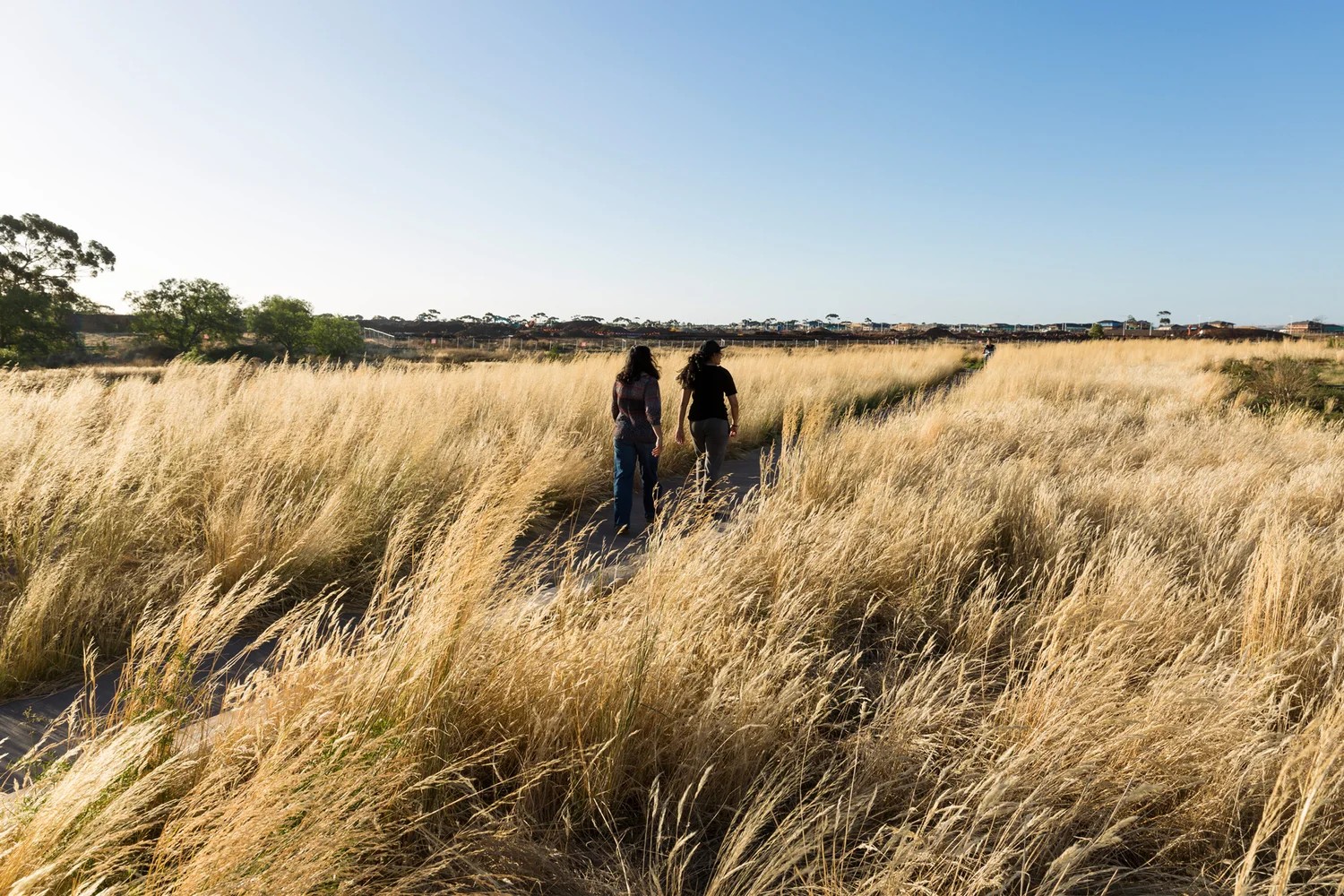
2) Australiab Garden, Cranbourne - by Taylor Cullity Lethlean
https://tcl.net.au/projects-item/australian-garden/
3) National Arboretum, Canberra - by Taylor Cullity Lethlean
https://landscapeaustralia.com/articles/the-national-arboretum-canberra-2/
https://tcl.net.au/projects-item/national-arboretum/
4) Mud Island River Park, Memphis
https://www.atlasobscura.com/places/mud-island-river-park

5) Superkilen, Copenhagen - by TOPOTEK 1 & BIG Architects & Superflex
https://www.archdaily.com/286223/superkilen-topotek-1-big-architects-superflex
https://www.topotek1.de/openSpaces/superkilen-2/

6) Renaturation of the River Aire, Geneva - by Atelier Descombes Rampini & Superpositions
http://landezine.com/index.php/2016/06/renaturation-of-the-river-aire-geneva/
7) National September 11 Memorial and Museum, New York - by Michael Ara & Peter Walker (PWP Landscape Architecture)
http://www.pwpla.com/national-911-memorial
http://landezine.com/index.php/2013/03/national-911-memorial-by-pwp-landscape-architecture/

8) Vietnam Veterans Memorial, Washington DC - by Maya Lin
https://www.asla.org/guide/Site.aspx?id=35782
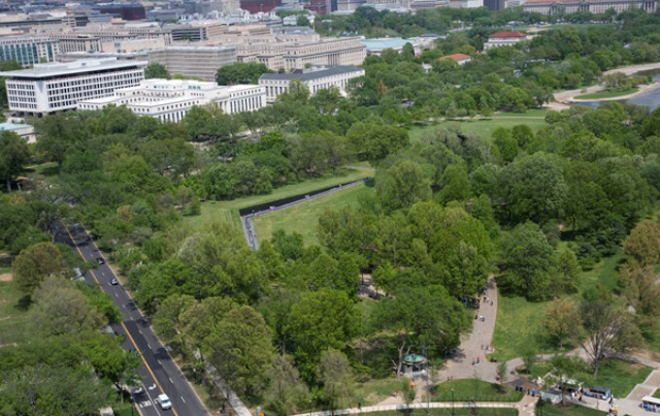
9) Time Landscape, New York - by Alan Sonfist
https://www.nycgovparks.org/parks/greenstreet-mz31/history
https://www.publicartfund.org/exhibitions/view/time-landscape/
