Thesis Studio/03
Connective Social Infrastructure
Natalie Miles
Studio Description
What is social infrastructure?
Schools, libraries, childcare, museums, sports facilities, playgrounds, galleries... these are all examples of social infrastructure. So, how can these different programs and spaces be connected to form a social infrastructure network?
Social infrastructure was included in the Australian Infrastructure Audit for the first time in 2019 (Infrastructure Australia, 2019), reasoning that its inclusion "responds to the growing recognition of the role effective social infrastructure assets and networks play in supporting our nation's wellbeing" (p. 388). Throughout the report, social infrastructure networks are referred to frequently, yet without definition or explanation. It seems logical to think about social infrastructure as a network, but how do these networks occur in practice?
The studio takes its name from a report published by the Greater London Authority looking at social infrastructure ecosystems. The ‘ecosystem’ implies a highly integrated, interactive and interdependent system of facilities, services, organisations and communities. We will consider together what types of facilities contribute to the ecosystem in our study area, and what connects these facilities together in a network. We will also interrogate what roles can Architects and Urban Designers play in creating and fostering these ecosystems.
We will discuss how theory can assist us in considering how the network operates, discussing qualities such as: boundaries and borders / relationships and connections / movement and flows.
Studio Outcomes
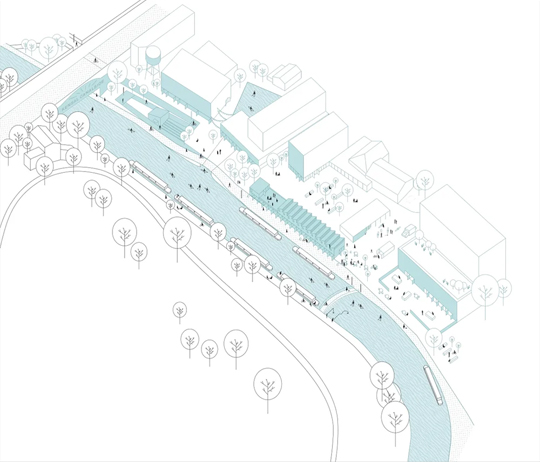
This studio will begin with mapping existing, and potential, social infrastructure networks in the City of Melbourne (Docklands). We will start the semester with a site visit to include observations in our mapping exercise. Social infrastructure networks are under researched, so this mapping exercise will enable us to better understand what connections exist in a network of social infrastructure. We will use mapping as a form of knowledge production, as well as a form of representation.
Students will then develop their own project brief in response to the network research: What is missing? The proposed project should add to the existing network, and act as a connecting piece of social infrastructure. The site, brief, and design strategy will be developed by students as their own response to the research phase.
Studio Leader
Natalie Miles is a registered architect and has practiced in Victoria and NSW, most recently as a sole practitioner and as an Associate at Austin Maynard Architects.
Natalie is now a PhD candidate at the University of Melbourne researching social infrastructure networks, including schools. Natalie’s PhD is associated with the ARC Linkage project Building Connections: Schools as Community Hubs at LEaRN, MSD.
Readings & References
- Cleveland, D. B. (2016). A school but not as we know it! Towards schools for networked communities. 11.
- Corner, J. (1999). The Agency of Mapping: Speculation, Critique and Invention (pp. 213–252).
- Delanty, G. (2018). Community: 3rd edition. Routledge. https://doi.org/10.4324/9781315158259
- Dovey, K., Pafka, E., Ristic, M., Pafka, E., & Ristic, M. (2017). Mapping Urbanities: Morphologies, Flows, Possibilities. Routledge. https://doi.org/10.4324/9781315309163
- Gleeson, B., & Sipe, N. G. (Eds.). (2006). Creating child friendly cities: Reinstating kids in the city. Routledge, Taylor & Francis Group.
- Greater London Authority. (2020). Making London Child-Friendly. Designing places and streets for children and young people. Greater London Authority www.london.gov.uk.
- Greater London Authority. (2020). Connective Social Infrastructure. Greater London Authority www.london.gov.uk. https://www.london.gov.uk/sites/default/files/connective_social_infrastructure_0.pdf
- Infrastructure Australia. (2019). Australian Infrastructure Audit 2019 | Infrastructure Australia. https://www.infrastructureaustralia.gov.au/publications/australian-infrastructure-audit-2019
- Klinenberg, E. (2018). Palaces for the people: How social infrastructure can help fight inequality, polarization, and the decline of civic life (First Edition). Crown.
- McShane, I. (2006). Community facilities, community building and local government – an Australian perspective. Facilities, 24(7/8), 269–279. https://doi.org/10.1108/02632770610666125
- McShane, I., & Wilson, C. K. (2017). Beyond the School Fence: Rethinking Urban Schools in the Twenty-first Century. Urban Policy and Research, 35(4), 472–485. https://doi.org/10.1080/08111146.2017.1310098
- Miles, N. (2020). Integration of Schools and Community Infrastructure: A Network Analysis. https://doi.org/10.26188/13291526
Schedule
Lecture Thursdays 17:15-18:15 in MSD B121 (Malaysian Theatre) in Weeks 1, 2, 3, 5, 6, 7, 8, and 10
Studio Tuesdays and Thursdays 12:00-15:00 in MSD Room 240
Off-campus Activities
Week 1 / Docklands
Need enrolment assistance?
Stop 1 provides enrolment and other support to Bachelor of Design, Bachelor of Environments and Melbourne School of Design students.