Caretaker Studio
CARETAKERS: Care and Repair for Non-Human Futures
Rochus Hinkel
Studio Description
Can we imagine a post-colonial framework inspired by Indigenous concepts of relationship to Country that overcomes land as commodity? The Caretakers studio positions architects as caretakers rather than extractors, focusing on care and repair for native species – both animals and plants.
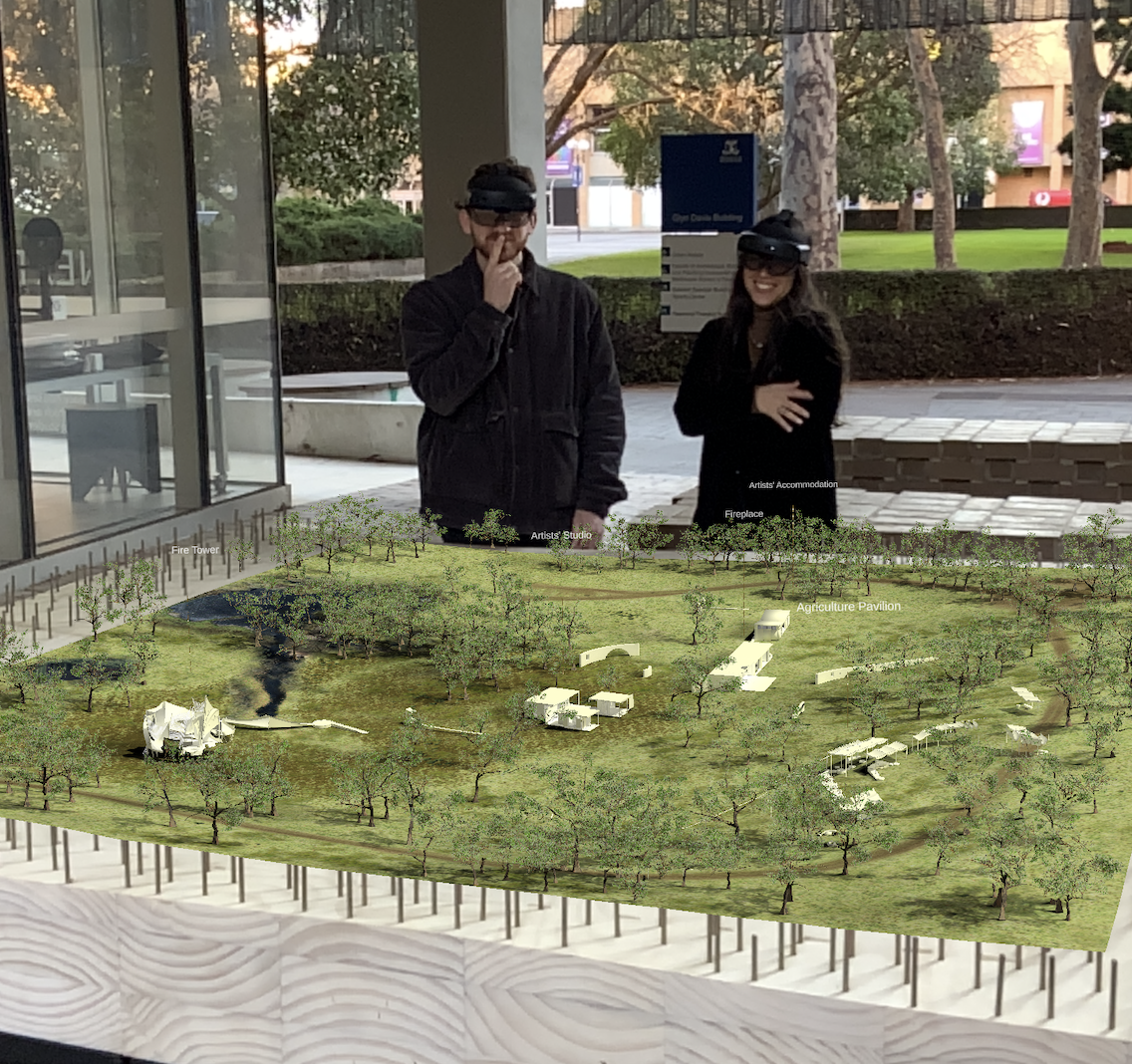
We will work with collected site data recorded by drone technology, including point cloud models, topographical surveys, and multispectral recordings to e.g. analyse plant and soil health. Using a physical site model and AR technology, you will design and discuss proposals for either a seed bank and testing facility for native plants in food production, or a sanctuary for endangered native animal species; both supported by facilities for volunteer workers.
Ideally, pairs of students collaborate to create integrated care programs recognizing the inseparability of botanical and zoological health, signing collectively as co-authors responsible for the overall program.
Drawing from 60,000+ years of Indigenous Aboriginal understanding of Country – encompassing all species – this studio asks: Can architecture help us tackle contemporary crises and imagine regenerative futures?
Studio Outcomes
Students develop comprehensive design proposals that integrate ecological research, Indigenous knowledge systems, and advanced visualization technologies. Through investigative research, including readings, diagramming, lectures, and AR presentations. You are asked to imagine an alternative model for a utopian future.
Prerequisites:
- Rhino Software capabilities necessary for design and use of Augmented Reality
Deliverables include:
- Site analysis utilizing available data sets, including point cloud, topographical, and multispectral data
- Historical research about the area around Daylesford, e.g. the Victorian gold rush and its impact on the local landscape
- Identify native species and study specific care programs addressing conservation, propagation, or recovery
- Presentation using AR technology overlaying digital designs onto site models
- Architectural representational drawings communicating the research, the site’s future and the overall and detailed design
Learning outcomes:
- Develop design methodologies centering non-human needs
- Integrate traditional ecological knowledge with contemporary technologies
- Employ advanced data tools and augmented reality in design development
- Learning from other disciplines (Landscape Architecture/Science) to create holistic ecological interventions
- Propose spatial typologies challenging extractive relationships between architecture, land, and species
Studio Leader/s
Rochus Hinkel joined the Melbourne School of Design in 2020, having previously taught architecture, interior architecture, furniture design, and industrial design at institutions in Europe including OTH Regensburg, Germany, and Konstfack University of Arts, Craft and Design, Stockholm.
He is founder and co-director of the Advanced Digital Design + Fabrication (ADD+F) research hub at MSD and co-convenes the Politics and Utopia in Architecture conversation series. Since 2021, he coordinates the Digital Design and Fabrication electives, exploring digital technologies across MSD's Fab_Lab, R_Lab, DF_Lab, Si_Lab, and Ex_Lab facilities.
Rochus's pedagogical approach explores creative and utopian proposals addressing biodiversity loss, species extinction, industrial food production, and climate crisis while learning from Indigenous knowledge systems. Current research includes collaborations with Royal Children's Hospital Melbourne and the Olkola Aboriginal Corporation at Cape York.
Readings & References
Zoos Victoria: Healesville Sanctuary
UoM School of BioScience: Coastal and Estuarine Adaptation Lab
MSD Rochus Hinkel & Peter Raisbeck: Politics and Utopia in Architecture Conversations (videos):
Habitat Prototyping:
Design Practice Example: Ants of the Prarie
R_Lab Elective Designing for More-Than-Humans
DF & SI_Lab Elective More-Than-Human Urban Design
Schedule:
Tuesdays 10am-1pm and 2pm-5pm
Off-site Activities:
TBA
Need enrolment assistance?
Stop 1 provides enrolment and other support to Bachelor of Design, Bachelor of Environments and Melbourne School of Design students.