Flats
Flats
Kate Finning
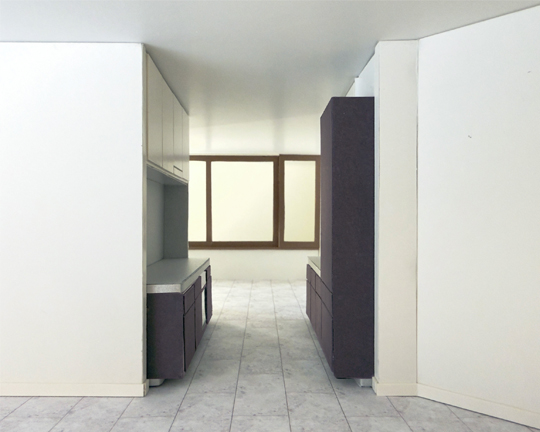
Image: Case Study Model Photo by Jiajin Chen, S2 2025.
Studio Description
In recent times there has been a particular emphasis on the minimum dwelling. Born of a specific historical concept that was entwined with Soviet communitarian ideals and post-war European housing policies, the model reflected the ideas of existenzminimum, and sought to define the minimum area and services required to live. Today the minimum dwelling is celebrated as an emancipated housing model by architects, developers and modernist-housing enthusiasts alike. At the same time, Australian dwellings rate as the largest new dwellings in the world at an average size of 245sqm.
Between this dichotomy, the studio will instead seek a longer view of the architecture of housing. We will look to adapt the model of the 19th-century family apartment through precise use of architectural elements as a way to neutralise the floorplan beyond specific demographics. So too, our projects will assert that the architecture of housing is the basis of the city and will seek to give quality to the spaces of the city through their volumes and facades.
Studio Outcomes
Students will work in pairs on a project comprising two blocks of flats: one existing and one proposed. The project will begin through the close study of exemplar domestic floor plans underlined by the conviction that a strong spatial determinacy in housing ensures use beyond its first residents. To this end, our projects will begin with the room.
The second half of semester will shift the focus to the volume and facade. Here the expression of the building will follow an understanding of existing architectural languages as well as the resolution of a construction detail. Our volumes will attempt to frame the spaces around the building and propose a balanced facade composition that responds to existing building languages.
Projects will be documented through physical models and orthogonal drawings.
Studio Leader
Kate Finning is an architect practicing in Melbourne. She recently co-edited the publication Five Good Swiss Plans (Quart Publishers, 2025) with Guillermo Fernández-Abascal.
Readings & References
Bates, Stephen. Tent Poles in the Ground. Lucerne: Quart Publishers, 2025.
Beigel, Florian and Philip Christou.“Room Non-Room: Peter Märkli Atelierhaus Weissacher.” Quaderns d arquitectura i urbanisme, no.265 (2013): 36-41.
Diener, Roger and Martin Steinmann, The House and the City. Basel: Birkhauser Verlag,1995.
Tschanz, Martin ed. Esch Sintzel Architekten: Buildings and Projects. Zurich: Park Books, 2025.
Mosayebi, Elli and Christian Inderbitzin, “La porte, une échelle de l’habitat” [The Door, a Scale of Habitat], Matières, 13 (2016): 86-97.
Rowe, Colin and Robert Slutzky. “Transparency: Literal and Phenomenal...Part II.” Perspecta, Vol. 13/14 (1971): 287-301
Schedule:
Tuesday 1pm-4pm
Friday 3pm-6pm
Off-site Activities:
East Melbourne Flats
Contact Handbook
Need enrolment assistance?
Stop 1 provides enrolment and other support to Bachelor of Design, Bachelor of Environments and Melbourne School of Design students.