Design Studio E
Light Industry
Mark Ng
| Studio Structure | |
|---|---|
| Is the site determined? | Yes |
| Is the program determined? | No |
| Is the user(s) determined? | No |
| Is the concept determined? | No |
| Is the approach determined? | Yes |
Studio Description
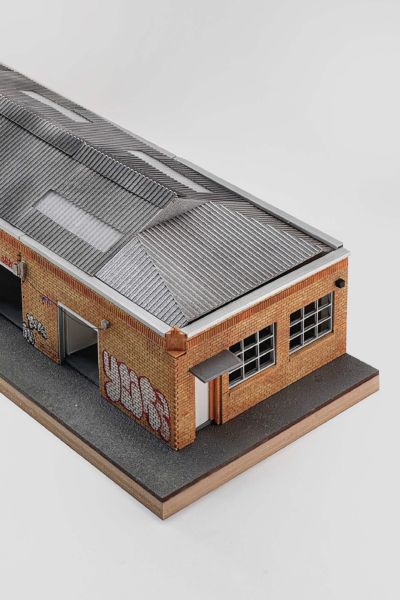
Light industry uses support the development of sustainable neighbourhoods by providing local jobs, products and services to a diverse range of residents with ease of access. They do this with lower environmental impacts than heavy industry, and at a scale that has greater potential to support convivial relations between workers, consumers and the community at large.
Conviviality, commonly understood as the quality of being friendly and lively, is the subject of Ivan Illich’s 1973 book, Tools for Conviviality. Here, he expands the definition to describe the virtues of interdependent autonomy and creativity in the face of increasingly industrialised societies where individuals are reduced to mere consumers.
This studio will explore how the design of light industrial buildings in the inner-Melbourne suburb of Brunswick might facilitate conviviality through environmentally responsive interventions.
Studio Outcomes
The studio aims to develop a nuanced approach to designing with consideration of culture, history and ecology. At the same time it will build skills in dealing with practical constraints such as constructability, access and servicing, which are inextricably tied to the social/cultural position of the project.
Being based on a speculative brief, the studio also aims to build initiative to propose self-determined projects that may be provocative, but which are well-informed, sensitive and respectful.
Through its methods of designing and representation it aims to build skills in drawing, (both digital and hand), photography, model-making and graphic design, with a strong emphasis on elegant, well-curated presentation.
Studio Leader
Mark Ng is a multi-disciplinary creative working in architecture, design teaching, graphic design, music and art. He is currently a studio leader in Studio Delta and Studio Epsilon in the Bachelor of Design program, and has led past Masters studios such as Nightingale Night School, the Future Homes Competition, The New Third Place, and An Ephemeral Frame, Sydney Road Opera House and Space For Hire.
In practice, Mark has worked with practices including Breathe and Freadman White on a wide range of sustainable, socially-conscious projects with a culturally sensitive approach. Some of these include the winning proposal for a Market Pavilion at Queen Victoria Market, the Nightingale Village precinct, and Paramount House Hotel.
Readings & References
- Conviviality at the Crossroads: The Poetics and Politics of Everyday Encounters, Hemer, O., Povrzanović Frykman, M., & Ristilammi, P.-M. (Eds.). (2020). Conviviality at the crossroads: The poetics and politics of everyday encounters. Palgrave Macmillan. https://doi.org/10.1007/978-3-030-28979-9
- Ivan Illich on the Convivial & Industrial Society, Carman, S. A. (2021). Ivan Illich on the convivial & industrial society. Dignitas. http://cbhd.org/dignitas-articles/ivan-illich-on-the-convivial-industrial-society
- Light Structure Examples for Industrial Architecture
Ferrer F. Et al. (2007). Light structure examples for industrial architecture. International Association for Shell and Spatial Structures (IASS) - Moreland Industrial Land Strategy 2015–2030, City of Moreland. (2016). Moreland Industrial Land Strategy 2015–2030 (MILS). Moreland City Council. https://www.merri-bek.vic.gov.au/globalassets/areas/strategic-planning/merri-bek-industrial-land-strategy-adopted-july-2016.pdf
- Small Is Beautiful: A Study of Economics As If People Mattered, Schumacher, E. F. (1973). Small is beautiful: A study of economics as if people mattered. Blond & Briggs.
Tools for Conviviality, Illich, I. (1973). Tools for conviviality. Harper & Row.
Schedule:
Monday 9am - 12pm
Thursday 4pm - 7pm
Need enrolment assistance?
Stop 1 provides enrolment and other support to Bachelor of Design, Bachelor of Environments and Melbourne School of Design students.