Open Studio: Worlding
Open Studio: Worlding
Laura Martires
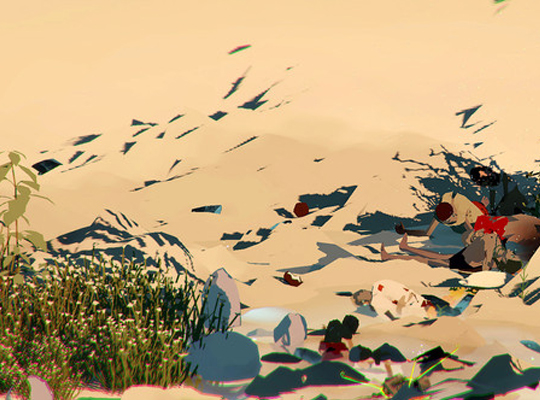
| Studio Structure | |
|---|---|
| Is the site determined? | No |
| Is the programme determined? | No |
| Is the user(s) determined? | No |
| Is the concept determined? | No |
| Is the approach determined? | Yes |
Studio Description
‘The future is inside us / It’s not somewhere else’ (Radiohead, "The Numbers")
It ‘cannot be experienced directly, but only through images, thoughts, feelings and the multiple ways these are subsequently expressed in the outer world’ (Slaughter, "Two Fine Additions to the futures literature" . Foresight, 444)
‘Architecture in a traditional sense is a discipline on fire’ (Young, "All Possible Worlds: Liam Young on Dreaming Future Cities"). The establishment of architecture as a service-oriented profession in the 20th century served the interests of the middle and upper classes while securing the continuation of the profession and the architect as the expert lead consultant in designing and delivering buildings. As our cities struggle to adapt to the radical shifts in how we live, work and relate while adjusting to a world in crisis, the profession is at a crossroads in which we either reinvent ourselves or peril if style wins over substance.
This studio will ask students to take control of the world they would like to see, design and care for through a process of world building and speculative architecture design. Inspired by the question ‘what kinds of worlds are needed at this time of ecological crises?’, Donna Haraway coined the term ‘worlding’ to mean ‘making worlds together’ or the co-making of worlds’. (Haraway, 'Worlding', Common Worlds - Organizing Concepts.) By examining and questioning their physical and ephemeral surroundings, students will be asked to construct a narrative for an architecture that has yet to be supported, constructed or imagined. As students realise ‘the built world as it is known, tells a single story’ (Boghossian, "Architecture is the Art of Worldbuilding"), they are tasked to consider alternative possibilities of what these world constructs might be and look like.
The studio will require students to design the role they think architects can play as they broadcast projects to a broader audience, utilising their skills and tools of drawing, modelling and immersive visualization. Through the means of speculating stories about space, students will be asked to co-opt mediums of popular culture such as music, social media, film, video games, etc, while asking specific architectural questions. Whether students care about housing, the environment, health or social justice, this studio will allow students to explore, imagine and visualise an alternative reality.
Studio Outcomes
Students will spend the first four weeks of the studio drafting their research statement and designing a return brief. This is a critical time to think, read and write, but equally a time to begin architectural investigation and production. Referencing key provided texts, students will begin to ask simple questions to draft their origin stories, and then move on to contextual ones, as they develop a plausible narrative for each project.
As conceptual and theoretical frameworks are refined, students will work on their chosen project site and build up their proposition in a series of incremental scalar documentations and architectural interventions that start to build up a plausible and believable scenario. Concurrently students will develop specific representation methods for rendering their architecture visible. Developing and curating a critical exhibition of each project, evocative of the ideas explored and enabling the audience’s immersion is critical as we suspend disbelief and are taken to a different place altogether.
Students are expected to drive their own programmatic brief, but all proposals must engage with a medium scale building focused on a number themes provided. This is a drawing and modelling intensive thesis studio with a heavy focus on design production as a model for a contemporary design research practice. While final projects will be architectural in nature, the way they are exhibited and rendered visible requires students to engage with a broader audience and final artefacts must be curated with the intent of being a multi-media display. (Game, Video, Podcast, TikTok, etc).
Ultimately, students will play to their own strengths and develop a repertoire of drawings, manuscripts, objects, games or virtual reality experiences that allow us into their architecture and their constructed world.
Studio Leader
Laura Mártires is an Education Fellow in Architectural Design at the University of Melbourne and a Partner in Melbourne based architecture practice Common Architecture Design & Research.
Laura is interested in cities and how urban infrastructure, form or fabric can inform particular design processes. Her current investigations focus on emerging design, modelling and visualization techniques utilising gaming engine software to explore how we might change the way we represent architectural ideas in a digital and/or virtual environment.
These ideas have been pursued at different scales through practice where each project is seen as a unique opportunity to create spatial complexity from seemingly abstract notions of urbanity, cohabitation or socio-economical factors. The goal as a practitioner is always to create unique, complex and beautiful spaces that work as a connective platform between the context they're inserted in and they're occupants.
Readings & References
Betsky, A., (2022). The Monster Leviathan: Anarchitecture, Cambridge, MA: MIT Press.
Candy, S. & Young, L. (2019). I design worlds, Journal of Future Studies’ 23(3), 113-118.
Dunne, A., & Raby, F. (2013). Beyond Radical Design, Speculative Everything: Design, fiction, and social dreaming, Cambridge, MA: MIT Press.
Dunagan, J., Warburg-Johnson, B., Falcon, R., Harris, D.E., (2013). Governance Futures Lab: An Inventor’s Toolkit, Institute for the Future.
Foucault, M. & Miskowiec, J. (1986). Of Other Spaces. Diacritics, 16(1), 22-27.
Lewin, R., Constable, J., So, V., Serpentine Gallery, book producer, publisher., Koenig Books, F. publisher., Fondazione Sandretto Re Rebaudengo, book producer., & Distributed Art Publishers, distributor. (2018). Emissaries guide to worlding : how to navigate the unnatural art of creating an infinite game by choosing a present, storytelling its past, simulating its futures, and nurturing its changes. Serpentine Galleries.
Lim, C., & Liu, E. (2011). Short Stories: London in Two-and-a-half Dimensions.
McDowell, A. (2019). Storytelling Shapes the Future, Journal of Future Studies’ 23(3), 105-112.
Stålenhag, S. (2015). Tales from the loop (N. Karlén, Ed.; M. Dunelind, Trans.; First edition). Design Studio Press.
Tan, S. (2018). Tales from the inner city (First edition). Arthur A. Levine Books, an imprint of Scholastic Inc.
Ghotmeh, L., Kara, H., Matsipa, M. Jacob, S. (2023). How to architect alternative futures and beyond…?, La Biennale di Venezia, Youtube.
Further resources will be provided throughout the course of the semester.
Schedule:
Monday 9am-11am
Thursdays 1pm-5pm
Off-site Activities:
Need enrolment assistance?
Stop 1 provides enrolment and other support to Bachelor of Design, Bachelor of Environments and Melbourne School of Design students.