Design Thesis
Building Myths
Hannah Zhu
| Studio Structure | |
|---|---|
| Is the site determined? | Yes |
| Is the program determined? | No |
| Is the user(s) determined? | No |
| Is the concept determined? | No |
| Is the approach determined? | Yes |
Studio Description
Architecture has long been understood as a means of separating humans from the uncertainties of the world—offering enclosure, protection, permanence, and control. Yet the environmental realities shaping contemporary life increasingly challenge this assumption.
This studio invites students to investigate architecture as a dynamic relationship between environmental forces and cultural behaviours. Fire and water have shaped architecture since the first hearths and settlements, yet contemporary practice often treats them as hazards to be managed through the concepts of risk, engineering, and regulation.
Students will examine the cultural, technical, environmental, and regulatory dimensions of these forces, exploring them as active architectural collaborators across scales: from interiors to landscapes, infrastructures, and territories. ‘Myths’ here refer not only to elemental forces, but to architecture’s narratives of safety, permanence, progress, and control.
Projects are to be sited by students within Victoria, Australia. Engaging histories of environmental transformation across the waterways and bushfire terrains, students will identify a specific site and program aligned with their individual interests and conceptual directions. The studio emphasises film and model-making as key modes of architectural inquiry and representation.
Ultimately, the studio asks how architecture might move beyond simply solving problems towards cultivating new ways of living with uncertainty, complexity, and an increasingly entangled world.
The dissolving of myths means building new ones of your own.
Studio Outcomes
Students will develop a thesis project centred on an original research question concerning the relationship between architecture and elemental systems. By the end of the semester, each student will produce:
- An architectural design proposition appropriate to their research agenda;
- A coherent body of analytical and speculative drawings;
- Physical models, or material experiments;
- A presentation communicating the project's conceptual, technical, and cultural ambitions.
Studio exercises will support students in:
- Research, site analysis, and conceptual positioning;
- Understanding regulatory frameworks and environmental systems;
- Representational experimentation with an inter-disciplinary approach;
- Positioning architectural thesis as a contribution to emerging conversations on climate resilience, regulatory constraints, and imagination within a professional setting.
Studio Leader
Hannah Zhu is an architect, artist, and sessional academic. Her research on nomadic ecology and new media techniques, spanning architecture, public art, film, and writing have been exhibited, awarded, and archived internationally at TU Delft (Netherlands), Parsons School of Design (USA), and the Venice Biennale.
On the lands of the Kulin Nation, Zhu works as a project architect at Architecture Associates, and has realised public art projects for the City of Melbourne and the University of Melbourne, exhibitions with Blindside Gallery, 3553 Gallery, and Melbourne Design Week. She has taught at RMIT for the past five years across undergraduate, master’s, and thesis programs.
Readings & References
- Bachelard, Gaston. The Psychoanalysis of Fire. Beacon Press, 1964.
- Fernández-Galiano, Luis. Fire and Memory: On Architecture and Energy. MIT Press, 2000.
- Pyne, Stephen J. Flammable Cities: Urban Conflagration and the Making of the Modern World. University of Washington Press.
- Steffensen, Victor. Fire Country. Hardie Grant, 2020.
- Gammage, Bill & Pascoe, Bruce. Country: Future Fire, Future Farming, 2021.
- Birch, Tony. Ghost River. University of Queensland Press, 2015.
- Bachelard, Gaston. Water and Dreams. Pegasus Foundation, 1983.
- Neustupny, Marika. Water + House Thesis, University of Queensland, 2019.
- Rod Giblett. Postmodern Wetlands, 1996.
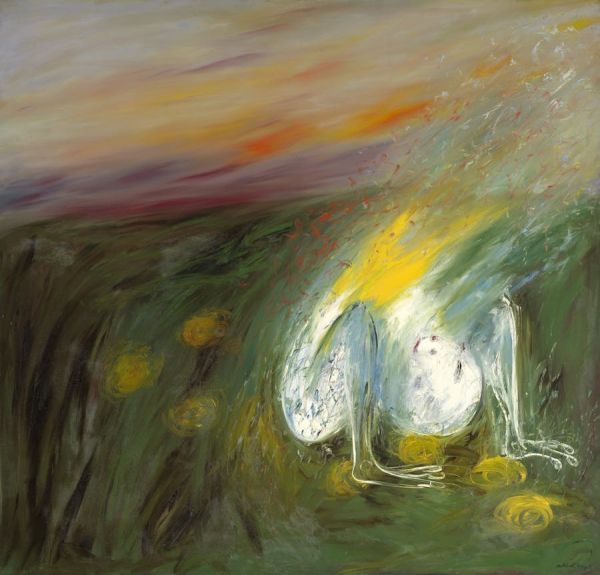
Image Credit: Arthur Boyd, Nebuchadnezzar fallen in a field on fire, 1967–68.
Schedule:
Monday 5.30pm - 8.30pm
Thursday 5.30pm - 8.30pm
Need enrolment assistance?
Stop 1 provides enrolment and other support to Bachelor of Design, Bachelor of Environments and Melbourne School of Design students.