Design Thesis
Counter-Museum
Rory Hyde
| Studio Structure | |
|---|---|
| Is the site determined? | Yes |
| Is the program determined? | Yes |
| Is the user(s) determined? | Yes |
| Is the concept determined? | No |
| Is the approach determined? | No |
Studio Description
In this thesis studio we will imagine a new kind of museum.
Behind the grand facades and blockbuster exhibitions, the museum has a dark history. Many of the objects it contains were acquired through conflict, and many of the stories it tells are intended to reinforce this dominant colonial view.
What if we could imagine a new kind of museum? A museum founded not on extraction and plunder, but on community and inclusion? A space to imagine new futures and reconnect with our pasts? A place where people can tell their own stories through objects? This new kind of museum would be almost opposite of the museum as we know it today – a counter-museum.
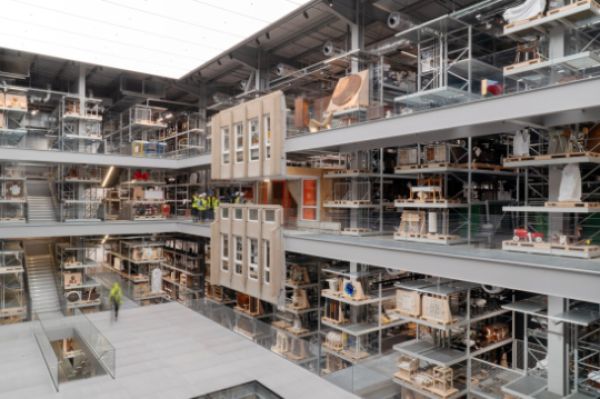
This instance of this studio will focus in particular on museum storage. We will work closely with the University’s Museums and Collections department, and be working with real data on the university’s challenge in accommodating all of its collections. How might we imagine ways of making this hidden collection public? And of new kinds of architecture that can host new kinds of encounters?
Studio Outcomes
We will learn about the history of museums, as institutions, as places of memory, and as pieces of architecture. We will be guided by talks from curators, visits to galleries, readings on new curatorial practice and museum design, as well as our own experiences of museums.
This studio will require a high degree of independence and creativity. Students will be given a site in Melbourne, as well as a museum object, as a starting point. From there they will develop their own design brief and concept.
The format of the studio is driven by collective exploration, with an emphasis on peer critique. We will be running various group exercises, workshops, and presentations, to create a supportive and collaborative space of experimentation.
This is a live practice project. Students will have the opportunity to undertake on-site research and fieldwork, interact with key stakeholders, and gain a deeper understanding of First Nation perspectives.
Studio Leader
Rory Hyde is Associate Professor in Architecture, Curatorial Design and Practice at the MSD, and coordinator of Design Thesis.
He was previously the Curator of Contemporary Architecture and Urbanism at the Victoria and Albert Museum in London, where he curated and designed numerous exhibitions, and worked on the major new museum V&A Storehouse, which opened in 2025.
He has worked extensively in practice internationally, including for OMA/AMO, MVRDV and ARM. He is the author a number of books, including Future Practice (2013) and Architects After Architecture (2020).
This studio will be supported by Charlotte Day, director of the Potter Museum, and by Julie Banks, head of collections at the University of Melbourne.
Readings & References
- Marcia Langton & Judith Ryan, 65,000 Years: A Short History of Australian Art, Thames & Hudson, 2024
- Francoise Verges, A Programme of Absolute Disorder: Decolonizing the Museum, Pluto Press, 2024
- Alice Proctor, The Whole Picture, 2020
- Andras Szanto, Imagining the Future Museum, Hatje Cantz, 2022
- Andras Szanto, The Future of the Museum, Hatje Cantz, 2020
- Charles Saumarez Smith, The Art Museum in Modern Times, Thames & Hudson, 2021
- Michael Brand, The Sydney Modern Project, AGNSW, 2022
- Claire Bishop, Disordered Attention: How We Look at Art and Performance Today, Verso, 2024
- Brook Garru Andrew & Jessica Neath (eds), Marramarra: Indigenous Artists Making History Visible, NewSouth, 2024
- Dan Hicks, The Brutish Museums, 2020
- Mati Diop, Dahomey, feature film, 2025
- Jeremy Deller, Art is Magic, 2023
- Julian Lucas’ writing in The New Yorker
Schedule:
Tuesday 1pm - 5pm
Thursday 12pm - 2pm
Need enrolment assistance?
Stop 1 provides enrolment and other support to Bachelor of Design, Bachelor of Environments and Melbourne School of Design students.