Landscape Studio 4: Strategies
Botanica
Elliot Summers
Studio Description
Planting plays a crucial role in shaping the built environment, influencing the aesthetic, functional and experiential qualities of urban space. As the impacts of climate change becomes more pronounced, how we use plants as tools of biodiversity, amenity and cultural expression is balanced against the need to plan for an increasingly hostile and unpredictable environment in the future.
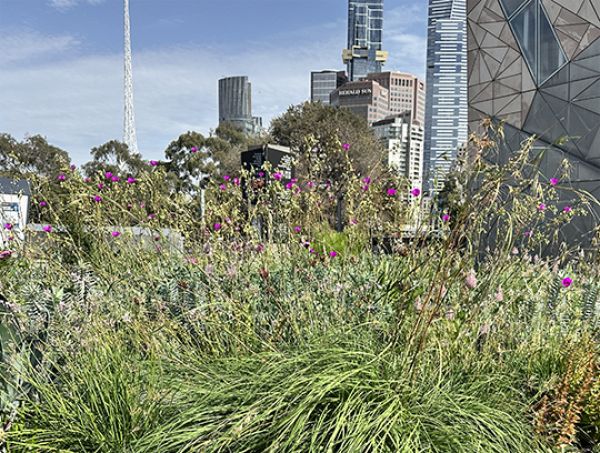
This studio will focus on using plants as a driver of design and explore foundational strategies for planting design. This will be developed through local, accessible sites that offer multiple microclimates, unique site conditions and a range of open-space typologies. These varied contexts will serve as a foundation for developing site-specific planting strategies.
This studio asks you to consider the complex relationship between plant selection and site conditions, develop evidenced criteria and strategies, and graphically articulate these as creative design responses with technical planting documentation.
Studio Outcomes
The aim of this studio is to deepen your understanding of planting design strategies within the broader context of landscape architecture and develop an approach to site planning that integrates planting design with long-term environmental and ecological considerations.
Key learning objectives include:
- Developing strategies for assessing critical site conditions and building criteria to inform plant specification
- Develop an understanding of how to use planting design to create sustainable, resilient public spaces
- Develop a process of recognising how a site may function as part of a larger environmental, social and cultural system
- Develop an understanding of planting design as part of a complex system from multiple perspectives such as ecological, social, cultural and temporal.
- Develop large-scale planting strategies across multiple micro-climates and unique site conditions balancing aesthetic and thematic goals with practical planting requirements.
- Develop a palette of plants, references & representational techniques
Studio Leader
Elliot Summers is an Education Fellow at the University of Melbourne. He combines academic work with his design practice focused on educational and public spaces and has a particular interest in how planting strategies can foster passive engagement and influence expectation. He has collaborated on award winning garden designs (MIFGS 2023) amongst other projects, gets into the garden where anyone will let him and has too many plants at home, which is a good problem to have.
Subject Coordinator – Siqing Chen
Readings & References
The following list should lead down a rabbit hole:
- Clarke I, Lee H. Name that Flower: The Identification of Flowering Plants: 3rd Edition. Melbourne: Melbourne University Publishing; 2019
- Hitchmough, J & Fieldhouse, K. Plant User Handbook – A Guide to Effective Specifying. Blackwell Science, 2004
- Raxworthy J. Overgrown: Practices between Landscape Architecture and Gardening. MIT Press, 2021;
- Thompson P. Australian Planting Design. CSIRO Publishing, 2012
- (Anything in the library from 712-715 thereabouts. Pick a book! You’re guaranteed to learn something new...)
- Farrell C, Livesley SJ, Arndt SK, Beaumont L, Burley H, Ellsworth D, et al. Can we integrate ecological approaches to improve plant selection for green infrastructure? Urban Forestry & Urban Greening. 2022;76.
- Williams, K. People Are Blind to Plants and That’s Bad News for Conservation, www.theconversation.com, Sept 14th 2016
- Rayner JP, Williams CC. Learning from failure: evaluating plant performance in urban landscapes. Acta Hortic. 2016 Feb;(1108):220–6.
- https://www.whichplantwhere.com.au/
- https://www.rhs.org.uk/plants
- http://anpsa.org.au/study.html
Schedule:
Thursday 9am - 3pm
Off-site activity:
TBC
Need enrolment assistance?
Stop 1 provides enrolment and other support to Bachelor of Design, Bachelor of Environments and Melbourne School of Design students.