Studio 17
What you left, when you left.
Marijke Davey
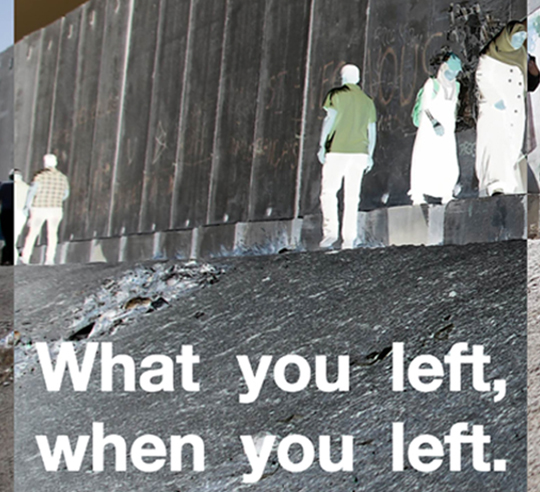
Studio Description
You looked at me once. We were at dinner, you ordered for both of us, the ordering of food was too much for my limited grasp of the language. Instead, with smile, watching you interact with strangers. Their eyes, your eyes, the shift in tone, the breakout of a laugh. It never felt like an interview, but there was constant desire for your answers, your ideas, they were everything. The food came, we ate, laughing, holding, you told me everything, with words, looks, hands, silences. It was recorded. I never forgot, even for a second, every word you said that night.
It was recorded. I never forgot, even for a second, every word you said that night.
Over the centuries, war and acts of control have erased countless cultures. These acts of war take many forms; eviction from land, denial of the use of native languages, exploiting truths, and the destruction of buildings and place. In war, ‘shattered buildings are not merely “collateral damage” but rather calculated acts of cultural annihilation.’¹
War has long been considered as one waged from one human upon another, based on a series of differences: land, beliefs, wants, needs. Acts of genocide are calculated in the number of lives lost. Casualties of war, however, reach beyond the human and into the built environment. The architecture of a place represents a culture, a way of life, where you meet friends and family for a hot drink, to worship, the streets you walk to get to your house, their removal creating scars in history and time, running across the landscape.
Studio Outcome
This studio investigates human rights violations using methods of Forensic Architecture ² - an emergent field of architecture developed by Eyal Weizman and his team through Goldsmiths University, London. By examining a series of crimes that have, and continue to take place across The Middle East, the studio will define crimes against culture, both conceptually and within a specific case. Approaching research and representation forensically, and using languages of architecture, mapping, physical and 3D modelling, drawing, diagramming, as well as universal techniques of writing, imagery, narrative, and debate, the studio will develop in-depth case files for each criminal event chosen.
By framing the Event and Aftermath as a cultural and political artefact, the studio will document acts of war, crimes against culture and place, and will ask what can be done with Facts of War once they are gathered and displayed? Within the studio, a small, responsive piece of architecture will be designed and will require a delicacy and empathy that reacts to the conditions identified within the forensic research.
Studio Leader
MARIJKE DAVEY is a graduate of architecture from RMIT. Marijke’s teaching practice focuses on the humanistic and humanitarian potential of architecture. Across various fields of research and practice, her interests lie in the hope of architecture to act in inclusive, empathetic and rehabilitative ways.
Readings & References
- Abboud, S. N. (2016). Syria. Cambridge, UK: Polity Press.
- Berger, J. (2009). About looking. London: Bloomsbury.
- Borri, F. (2015). Syrian dust: Reporting from the heart of the war. New York, NY: Seven Stories Press.
- Byrne, G. (2016). Borders, barriers, walls. Place of publication not identified: Monash University Museum.
- Chomsky, N., PappeÌ, I., & Barat, F. (2015). On Palestine. London: Penguin Books.
- Dam, N. V. (2017). Destroying a nation: The civil war in Syria. London: I.B. Tauris.
- Danahar, P. (2015). The new Middle East: The world after the Arab Spring. London: Bloomsbury.
- Darke, D. (2016). My house in Damascus: An inside view of the Syrian crisis. London: Haus Publishing.
- Dufour, D., & Delage, C. (2015). Images of conviction: The construction of visual evidence. Paris: Le Bal.
- Ehrenreich, B. (2017). The way to the spring: Life and death in Palestine. London: Granta.
- Glass, C. (2015). Syria burning: ISIS and the death of the Arab Spring. New York: OR Books.
- Halasa, M. (2014). Syria speaks: Art and culture from the frontline. London: Saqi Books.
- Hammond, M. (2014). Arabic poems: A bilingual edition. London: Alfred A. Knopf.
- Hinkinson. J. et al. (2017). Security, Terror, Panic. ARENA journal, Number Forty-Seven/Forty-Eight, North Carlton: Arena Publications.
- King, R. (2014). Democratic desert: The war in Syria. Amsterdam: Schilt Publishing.
- Lahoud, A. (2010). Post-Traumatic Urbanism.Architectural Design, 80(5), 14-23. doi:10.1002/ad.1128
- Littell, J. (2016). Syrian notebooks: Inside the homs uprising. Brooklyn, NY: Verso.
- Malek, C., Hoke, M., & Carp, A. (2014). Palestine speaks: Narratives of life under occupation. San Francisco: McSweeney's Books.
- Pinchbeck, C. (2016). When silence falls. Sydney, N.S.W.: Art Gallery of New South Wales.
- Sahner, C. C. (2016). Among the ruins: Syria past and present. London: Hurst & Company.
- Salamandra, C. (2005). A new old Damascus: Authenticity and distinction in urban Syria. Bloomington, IN: Indiana University Press.
- Shehadeh, R. (2018). WHERE THE LINE IS DRAWN: Crossing boundaries in occupied Palestine. S.l.: Profile Books.
- Silva, C., Drake, D., Jarvis, R., Smalley, U., & Williams, V. (2016). Garden state: The politics of planting in Israel/Palestine. Cardiff: Ffotogallery Wales Limited and The Mosaic Rooms, A.M. Qattan Foundation.
- Statement of the Prosecutor of the International Criminal Court, Fatou Bensouda, at the opening of Trial in the case against Mr Ahmad Al-Faqi Al Mahdi. (2016, August 22). Retrieved November 10, 2017, from https://www.icc-cpi.int/Pages/item.aspx?name=otp-stat-al-mahdi-160822
- Tamdgidi, M. H., (2009). "If I touch the depths of your heart … ": The Human Promise of Poetry in Memories of Mahmoud Darwish, Human Architecture: Journal of the Sociology of Self-Knowledge, Volume 7, Issue 5. Belmont. MA: Okcir Press. Available at: http://scholarworks.umb.edu/humanarchitecture/vol7/iss5
- Vet, A. D. (2007). Subjective atlas of Palestine. Rotterdam: 010 Publ.
- Virilio, P., & Polizzotti, M. (2006). Speed and politics: An essay on dromology. Los Angeles, CA: Semiotext(e).
- Weizman, E. (2012). Forensic architecture: Notes from fields and forums. Forensische Architektur: Notizen von Feldern und Foren. Ostfildern: Hatje Cantz.
- Weizman, E. (2017). Forensic Architecture: Violence at the threshold of detectability. Brooklyn, NY: Zone Books.
- Weizman, E. (2017). Hollow Land. S.l.: Verso Books.
- Weizman, E., Tavares, P., Schuppli, S., & Studio, S. (2010). Forensic Architecture. Architectural Design, 80(5), 58-63. doi:10.1002/ad.1134
- Wood, G. (2018). WAY OF THE STRANGERS: Encounters with the islamic state. S.l.: Penguin Books.
Schedule Mondays 12:00-15:00 in Room 140; Thursdays 15:15-18:15 in Room 240
Travel Week 10 | $10
Need enrolment assistance?
Stop 1 provides enrolment and other support to Bachelor of Design, Bachelor of Environments and Melbourne School of Design students.