Studio 27
OUTPOST
Ariani Anwar & Nick Roberts
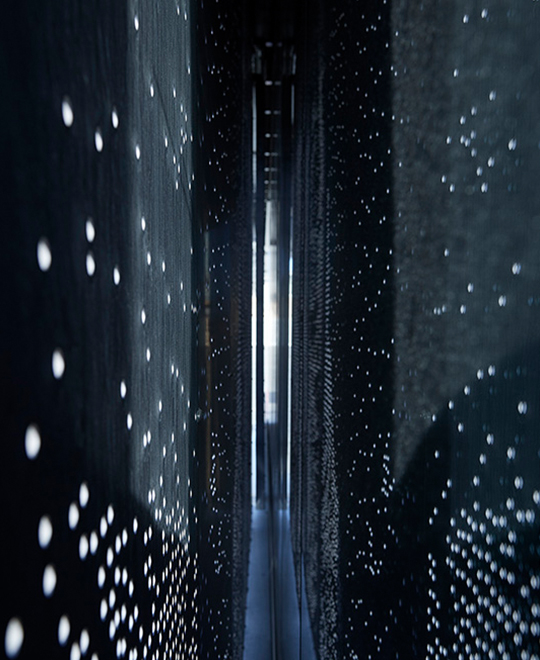
Studio Description
Outpost is an exploration of the peripheral, in the hope that it may eventually become central. Commonly deployed by cultural and academic institutions, Outposts are speculative by nature and represent a desire to evolve cultural values and experiment with emerging forms of knowledge. They can be defined by a geographical location, a philosophical position, a commercial model or a new medium of artistic expression. By operating at a distance, the Outpost is a site to promote new ideas, identities, and modes of representation.
This studio proposes a new Outpost - the Museum of Extinction - to be located at periphery of the Royal Botanic Gardens, Melbourne. This hypothetical brief will combine a museum and learning space, with a seed bank storage facility and DNA laboratory. As a hybrid building type, the Outpost will be a place for community engagement, experimentation and collaboration. The studio will encourage students to consider notions of scarcity, contemporary art practice, public education and civic generosity, in order to develop an evocative design concept that will be presented to community representatives.
The ideas for this studio arose from an acknowledgment that now, more than ever, we need to appreciate the rapid decline of flora and fauna globally. The Outpost will showcase and share Australia's existing contribution to the international Millennium Seed Bank Project (UK) through the Australian Seedbank Partnership located in Botanic Gardens across the country.
Studio Outcome
Before proposing new models for cultural buildings, this studio begins by posing new questions. This approach promotes a habit of mind where questioning is celebrated as a central act of the design and research process. The studio's emphasis on sustained questioning will give students the conceptual tools to develop a Return Brief that challenges a received functional one. Students will be encouraged to develop their own individual research position at the start of semester.
The half of the semester will give students exposure to industry practitioners to build their design and presentation skills in sketching, drawing, model making whilst exploring their research and design proposal. Note. it is assumed that students will have prior software knowledge in 3D digital modelling, drawing and physical model making.
The second half of the semester will be focused on refining a design proposition. Students will be able to participate in workshops with architects, community representatives and engineers to further develop their design.
Studio Leaders
As a practice-led studio,"Return Brief: Outpost" will be guided by John Wardle Architects (JWA) studio leaders, Ariani Anwar and Nick Roberts, and will involve workshops with JWA Principals and staff. The studio will operate across two sites: the Melbourne School of Design, and JWA Collingwood office. The purposeful bridging of academia and practice will promote a fluid exchange between industry expertise, experimentation and discourse. The peripatetic nature of the studio will extend beyond academy and office to include site visits to select cultural institutions across Australia.
ARIANI ANWAR has been employed at John Wardle Architects for over four years, primarily working on the design and conceptual development of large-scale civic buildings. Key projects that she has recently been involved in include: the Melbourne Conservatorium of Music, for the University of Melbourne and the Southern Highlands Botanic Gardens Visitor Centre in Bowral, NSW. Ariani graduated with her Master of Architecture from the Melbourne School of Design and the University of Technology, Delft. She has a long-standing interest in the threshold between research and design and was a founding editor of Inflection, the internationally published, student-run, journal of the MSD.
NICK ROBERTS currently works for John Wardle Architects on the design of civic, educational and infrastructure projects. Previously, Nick was based in Amsterdam at UNStudio. In addition to a broad range of international projects, he co-authored and edited the monograph Knowledge Matters and collaborated with Ben van Berkel to develop and run the Harvard GSD studio "On Health". Independently, Nick's writing has appeared in the UK based REAL Review and ArchitectureNZ amongst others, while his collaborative work notably includes the Awaroa Lighthouse - exhibited at the 2016 Venice Biennale, and the competition winning entry for the Lodge on the Lake, a new residence for the Prime Minister of Australia.
Readings & References
FAST
- Hal Foster, 2015. "After the White Cube", London Review of Books. 19th March
- Rosalind Krauss, 1990. The Cultural Logic of the Late Capitalist Museum, The MIT Press
- James Graham, 2017. The Whitney Consensus, The Avery Review: New York
MEDIUM
- Beatriz Colomina and Mark Wigley, 2016. Are We Human? Lars Muller Publishers
- Marshall McLuhan & Quentin Fiore. 1967. The Medium is the Massage: An Inventory of Effects, Penguin Books.
SLOW
- John Wardle Architects, 2016, This Building Likes Me. Melbourne: Thames & Hudson
- John Berger, 1972. Ways of Seeing, Penguin Books
- Guy DeBord. 1970. The Society of the Spectacle, Michigan: Black & Red
- Hal Foster, 2011. The Art-Architecture Complex. London: Verso
Additional readings will be provided throughout the semester
Schedule Mondays 18:15-21:15 in Room 244; Thursdays 18:15-21:15 at John Wardle Architects
Need enrolment assistance?
Stop 1 provides enrolment and other support to Bachelor of Design, Bachelor of Environments and Melbourne School of Design students.