Studio 34
Contested States and the Architecture of the In-Between
Heather Mitcheltree & Majdi Faleh
Studio Description
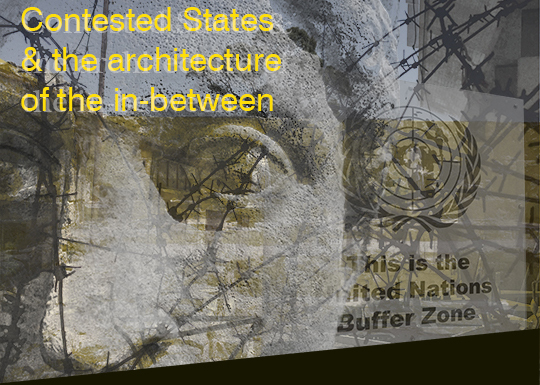
This studio serves as an exploratory testing ground through which to reframe sites of contestation, thresholds and boundaries. Focusing primarily on the UN buffer zone in Cyprus, students will explore how architecture might be utilised to frame the politics of boundary conditions, spatial manifestations of memory, and socio-political narratives of identity, conflict, and the in-between.
These contested spaces serve as a symbolic locus in which individual and collective memory, trauma, place and temporality coalesce. Within this studio, students will be encouraged to re-envisage the process of creative production – utilising uncertainty, disruption, realignment and conflict as mechanisms through which to transgress boundaries and explore identities of difference.
Studio Outcome
Within this studio students will undertake: 1. Research and conceptual framing In the first stage, students are asked to analyse the historical, political, and socio-spatial context of their chosen site. Through a range of analytical tools, students will explore the spatial tensions and socio-political constructs within demilitarised zones, borders and contested spaces. 2. Experimental propositions Students will explore how through interdisciplinary practice we might re-read, re-imagine, and re-make contested spaces. Drawing on a range of interdisciplinary frameworks, students will be asked to produce experimental propositions that question traditional boundaries. 3. Design proposition and development During this phase, students will propose and develop a design intervention for their site - to reinvest the ‘no man land’, and activate cultural and social boundaries. During this phase students will develop design strategies to navigate complex emotive histories, re-frame the politics of boundary conditions, and explore spatial manifestations of memory and loss.
Studio Leaders
Heather Mitcheltree Heather holds a Bachelor of Arts, Bachelor of Science, Bachelor of Planning and Design (Architecture), and a Master of Architecture. With her broad interdisciplinary qualifications and knowledge base, Heather brings a unique cross-disciplinary insight and skill set to her work. In addition to research and teaching, Heather engages in private design work, creative design collaborations, and research consultation. She is a founding partner of Atelier North Design Collective, and has had her work exhibited at the Museum of Contemporary Art in Sydney, the Melbourne International Fringe festival and published in Landscape Architecture Australia.
Dr Majdi Faleh is a polyglot, architectural designer, researcher, artist, and activist, Dr. Faleh holds a PhD from the University of Western Australia and a Master of Architecture from Ball State University in Muncie, Indiana. His research interests include architecture and globalization, architecture and art in the Islamic world, interactive design, ethics and aesthetics in architecture, civilizations and the destruction of heritage, and public spaces and protest. In addition to teaching, Majdi also runs his own design firm MWBM Architects.
Readings & References
- Charlesworth, E. R. (2006). Architects without frontiers: war, reconstruction and design responsibility: Amsterdam; Boston; London: Architectural Press, 2006.
- Collins, C. A., & Opie, A. (2010). When places have agency: Roadside shrines as traumascapes. Continuum: Journal of Media & Cultural Studies, 24(1), 107-118.
- DeTurk, S. (2017). Memory of absence: Contemporary counter-monuments. Art & the Public Sphere, 6(1/2), 81.
- Dovey, K. (2008). Framing places: mediating power in built form (2nd ed. ed.): London; New York: Routledge.
- Hadjri, Karim, Ozersay, Fevzi and Chatzjichristou, Christos.(2014).Healing the liminal space: a student project on the Nicosia buffer zone. GAU Journal of Social and Applied Sciences, 6 (10). pp. 412¬427.
- Odenthal, H. V. (2013). The Green Line, Cyprus: A Space of Exception or an Exceptional Space?
- Schmidt, L. (2017). TRAUMA ARCHITECTURE AND ART: BOROS BUNKER BERLIN. Scope: Contemporary Research Topics (Art & Design), 14, 15-25.
- Tumarkin, M. (2005). Traumascapes: the power and fate of places transformed by tragedy: Carlton, Vic.: Melbourne University Publishing, 2005.
Schedule Mondays 12:00-15:00 in Room 138; Thursdays 18:15-21:15 in Room 138
Travel Week 8 | $2900
Need enrolment assistance?
Stop 1 provides enrolment and other support to Bachelor of Design, Bachelor of Environments and Melbourne School of Design students.