Studio 35
Hacking Design: Evolving Artefacts, Scavenging Space
Fjalar de Haan & Camilo Cruz
Studio Description
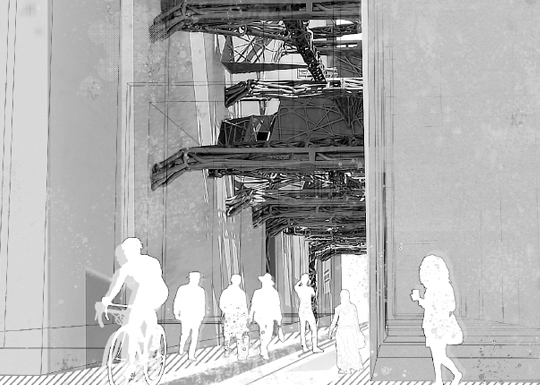
Hacking Design's general task will be to explore ways in which left-over urban space can become a vehicle for positive change. The premise is that regardless of the transient character of urban life, infrastructures are persistent. Then, the questions become, how can these conditions be capitalised for positive change? Which spaces are suitable to particular transformations? What kind of change can be triggered? And finally, how can the interventions adapt do the change of their supporting environment? We approach design from the perspectives of transitions research, algorithmic thinking and evolutionary concepts, thus understanding the dynamic character of both designed artefacts and their context.
Studio Outcome
- Participants will familiarise themselves with the requirements of the project, as well as with the relevant concepts of transitions, algorithmic thinking and evolutionary design.
- Participants will be introduced to design as a complex endeavour that is not only about the object being produced, its practical and cultural implications, but also about how it fits into a larger system.
- Participants will develop practical skills in parametric design and scripting, as tools for the generation and exploration of design spaces.
Studio Leaders
Fjalar de Haan is a transitionist. He develops theory and other tools for understanding sustainability transitions and societal transformations. Modelling is one of his favourite tools and he would say that modelling helps to accelerate the interactions between theory and empirical work towards better understanding. Fjalar has an MSc in theoretical physics and a PhD in transitions research. Fjalar has been exploring the frontiers of transitions theory and modelling in a variety of contexts, as part of international, interdisciplinary teams, project-based with industry, and in curiosity-driven solo projects. Fjalar works at the Melbourne School of Design.
Camilo Cruz is an architect and researcher in evolutionary design and design theory. Before coming to Melbourne, Camilo served as full time lecturer at the Faculty of Architecture and Urbanism of the Universidad de Chile (2012-2014), as associate at Office of Adrian Phiffer and Office Normal, in Toronto, Canada, and as a design manager at Eliash Arquitectura y Urbanismo, a Santiago based architecture studio, focused on institutional, educational and urban design projects around South America. Camilo completed his PhD at The University of Melbourne (2018), and also holds a Master's degree in Urban Design from the University of Toronto (2011) and bachelor and professional degrees in Architecture from Pontificia Universidad Catolica de Chile (2006).
Readings & References
- Mark Burry. Scripting cultures: Architectural design and programming. John Wiley & Sons, 2013. isbn: 1119979277.
- Bill Hillier and Julienne Hanson. The social logic of space. Cambridge university press, 1989.
- Bryan Lawson. How designers think: The design process demystified. Second Edition. Routledge, 1990.
- HW Rittel and Melvin M Webber. "Planning Problems are Wicked Problems". In: Polity 4 (1973), pp. 155-69.
- W. Axl Rose. \November Rain". In: Use Your Illusion I. Geffen, 1992.
- Michael A Rosenman. \An exploration into evolutionary models for non-routine design". In: Artificial Intelligence in Engineering 11.3 (1997), pp. 287-293.
- Donald A Schon. "Designing as reflective conversation with the materials of a design situation". In: Knowledge-based systems 5.1 (1992), pp. 3-14. issn: 0950-7051.
- Lebbeus Woods. Radical Reconstruction. Princeton Architectural Press, 1997.
Schedule Mondays 09:00-12:00 in Room 241; Thursdays 15:15-18:15 in Room 141
Need enrolment assistance?
Stop 1 provides enrolment and other support to Bachelor of Design, Bachelor of Environments and Melbourne School of Design students.