Studio 04
The Game
Laura Mártires | Cities + Process Focus
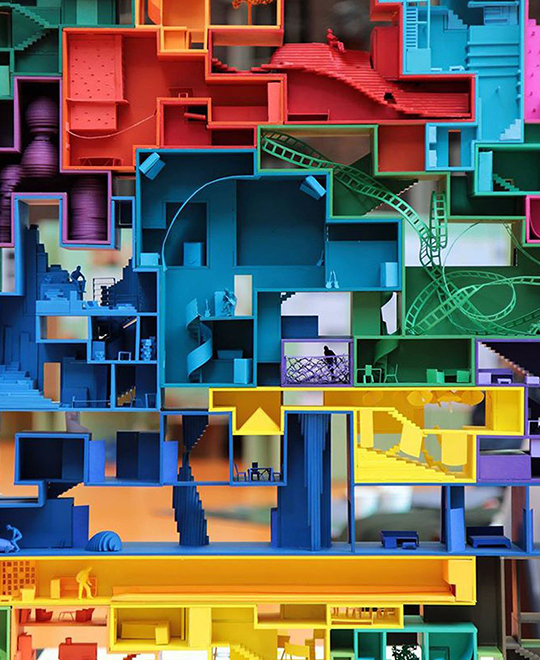
This studio is available to students enrolled in ABPL90142 Studio C, ABPL90143 Studio D, and ABPL90115 Studio E.
Studio Description
Conventional architectural and urban design strategies generally view the city as static, when in fact the urban environment is a dynamic field of interrelated elements that are in a constant process of change, resulting in the continual production of new hybrid architectural types and forms.
The studio will examine the relationship between the architectural object and the urban field, and begin to test how the concept of gamification can result in the production of new architectural and urban types that challenge a conventional city making approach.
This will be tested by the introduction of contingency, the uncertain or the unknown, The studio will challenge the designer to work through acts of ingenuity or negotiation in an incremental fashion rather than the authoring of a single big idea, or the choreographing of a process. The process ‘gameplay’ has the potential to add a temporal dimension to design processes. Although design is often a non-linear process, there is an expectation that it will proceed from a process of certainty to resolution.
In gameplay everything is fluid and remains interchangeable while the game remains live, allowing for players to move back and forth between states. To extend this to architectural design we can imagine a model where the design of precincts through a gamified platform of negotiation might lead to not just the optimisation or consolidation of program but also in building spatial types within an open access sharing platform.
Rather than urban model of block design where each proposal is imagined as a self-contaiend island, through a process of negotiation/ exchange a sharing or access model might form in which it is possible to create a fully integrated urban block that shares amenities, shares public space, shares frontage etc.
The success of the final outcome will be judged by the successful cooperation among players and how one decides to engage, or otherwise, with the contextual field surrounding a proposal.
The studio will be situated in Melbourne. We will engage with processes of gameplay and gamification, and begin to speculate on game based techniques for the production of new versions of the city in which negotiation and cooperation is key. These ideas will be tested through the design of a mixed use urban block dealing with issues of urban living within medium to high density environments. More broadly the studio will examine emergent design technique, both digital and analogue as a means of working with and acting upon existing fields of matter and material – both through editing the existing and speculating through the urban element to the scale of architectural typology.
Studio Outcome
The studio aims to establish strategies for negotiation and exchange within design. It is aimed at providing skills for understanding how a discrete design might sit within an urban field, rather than a stand alone.
In an initial phase the studio will run a series of ‘game’ based scenarios that progressively introduce students to the subject area, design and drawing technique and negotiation skills. Each ‘game’ will require students to gather information and develop a technique that responds to a particular set of constraints/ challenges. Students will develop an urban area as a team and it is expected that at the culmination of the first half of the studio students will have assembled a series of urban and architectural prototypes that they can draw on to develop their final project. Students will be encouraged to continue designing through the use of their gaming toolset, augmenting these through further research and negotiation while considering design as a multi-valent process, much the same as the city, where form emerges as a field accretion of localised actions, rather than a single response. The studio will reward rigorous and bold experiments in architectural ideation but also smart negotiation and team-playing. Risk taking is encouraged but also a critical understanding of the underlying urban issues facing cities nowadays and how observation and projective urbanism can become tools to intervene in urban space to create novel forms of architecture. Well crafted drawings and a focus on design process are key.
Studio Leader
LAURA MARTIRES: As an individual I have always been interested in cities and how urban infrastructure, form or fabric can inform a certain design process. I believe architecture isn't formed in a vacuum and cities constitute an endless and rich field for research and design experimentation. These ideas have been pursued at different scales through my practices, MartiresDoyle (together with John Doyle) and NAAU (with John Doyle, Edmund Carter and Ben Milbourne). In both of these practices each project is seen as a unique opportunity to create spatial complexity from seemingly abstract notions of urbanity, cohabitation or socio-economical factors. The goal as a practitioner is always to create unique, complex and beautiful spaces that work as a connective platform between the context they're inserted in and they're occupants.
Readings & References
- Allen, Stan, Trace Elements in Tracing Eisenman, pp.49-65
- Lynn, Greg, The Proto-Functional potential of diagrams in architectural design in El Croquis 72, pp 16-31
- Li Han, A Little bit of Beijing;
- Tsukamoto Architectural Laboratory & Atelier Bow-Wow, Pet Architecture Vol.2;
- Corner, James, The Agency of Mapping: Speculation, Critique and Invention;
- Allen, Stan, Practice: Architecture Technique + Representation, II_Notations + Diagrams: Mapping the Intangible;
- Allen, Stan, Field Conditions I +II.
Supplementary reading and references will be provided throughout the semester
Schedule Mondays and Thursdays 18:15-21:15 in MSD Room 239
Need enrolment assistance?
Stop 1 provides enrolment and other support to Bachelor of Design, Bachelor of Environments and Melbourne School of Design students.