Studio 30
Travelling Studio Indonesia
Amanda Achmadi and Sidh Sintusingha | Civic + Cities + Living + Process Focus
This studio is available to students enrolled in ABPL90143 Studio D and ABPL90115 Studio E only.
This studio is taught as ABPL90260 Travelling Studio (Indonesia)
Studio Description
This studio facilitates synergies between research, teaching and practice in the fields of architecture, urban design and landscape architecture. It is built on an interdisciplinary teaching and learning approaches, bringing together the staff and students of the Melbourne School of Design, Bandung Institute of Technology (Indonesia), and the University of Stuttgart’s Faculty of Architecture and Planning (Germany), three academic institutions with established expertise on the topic of informal urbanism. The three institutions’ collective international engagements will expose students to cross-cultural and global discourses on the topic and their translations in design engagement. This exposure will assist our students in understanding and responding to informal urbanism
as a global phenomenon. In the studio students will undertake two interrelated activities:
- firstly, a survey and analysis of key contested urban riverscapes in three Indonesian cities which have showcased contrasting developments in dealing with informal urban formations, ranging from forced eviction, relocation/resettlement, to the more inclusive in-situ upgrading;
- secondly, a design project focusing on one of these locations.
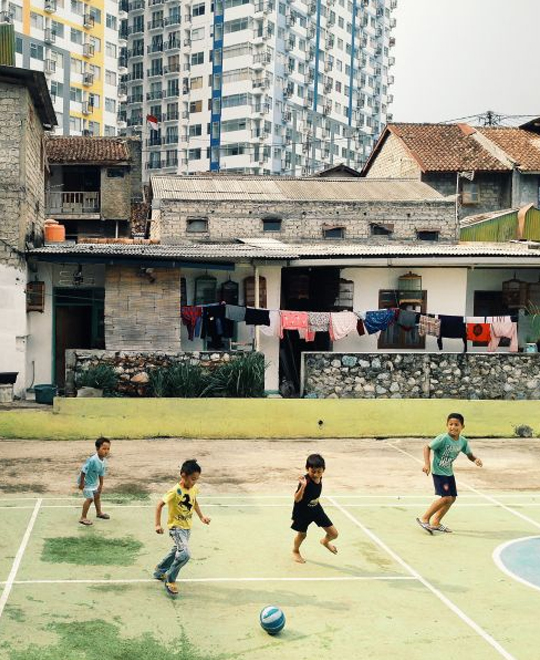
In the survey stage, students will critically observe and map contrasting urban morphologies and conditions that are situated along the urban riverscapes of the city of Jakarta, Bandung and Yogyakarta where formal and informal urban developments have long co-existed. The three cities are located in Java, the most urbanized island in the world and one with a long and rich cultural history. The design project will focus on Bandung, the provincial capital of West Java where intensifying urban renewal and gentrification have gained momentum in recent years. These have situated riverside informal settlements, public green open space, tourist development, and high density upper middle-class housing developments as seemingly competing urban ingredients.
The studio will then address the question “How can we envision the in-between city?” The design project will explore how a more inclusive urbanism can be created or initiated through considered spatial and constructed configurations in selected sites along the
contested Cikapundung riverscape, a prominent green urban corridor lined with dense informal settlements, by integrating architectural, urban design and landscape architecture interventions. Anticipated ranges and scales of design intervention:
- Mixed use building (residential and appropriate commercial program);
- Civic building (library/market/community centre/educational facility);
- Neighbourhood activations (green and communal open space infrastructure);
- Network of public open space and urban amenity.
All design interventions will be considered, developed, and refined as a material, social, and environmental system.The studio attracts students who are interested in urban architectural and landscape design, urban design thinking, Asian urbanism, urban informality and socio-cultural sustainability. Expertise on these aspects is not mandatory but desired. Basic information and communication of principles related to such fields will be covered in the pre-fieldwork component of the studio.
How to Apply
For further details, including how to apply, please see https://edsc.unimelb.edu.au/graduate/subject-options/travelling-studios/2019-ts-subjects/indonesia
Travel Indonesia | 27 September - 10 October 2019
Schedule [TBC]
Need enrolment assistance?
Stop 1 provides enrolment and other support to Bachelor of Design, Bachelor of Environments and Melbourne School of Design students.