Studio 02
Ready Salted
Mark Gillingham, with Phil Harkin, and Edward Silveira
Studio Description
This studio is about water and land development. It will investigate salt water and fresh water conditions and the in-between to consider the ecological, development and social potentials for the Fisherman’s Bend precinct. Housing the site of the University of Melbourne’s newest campus, Fishermans Bend is envisaged as ‘a thriving place that is a leading example for environmental sustainability, liveability, connectivity, diversity and innovation.” By 2050, it is expected to house and employ approximately 80,000 people.
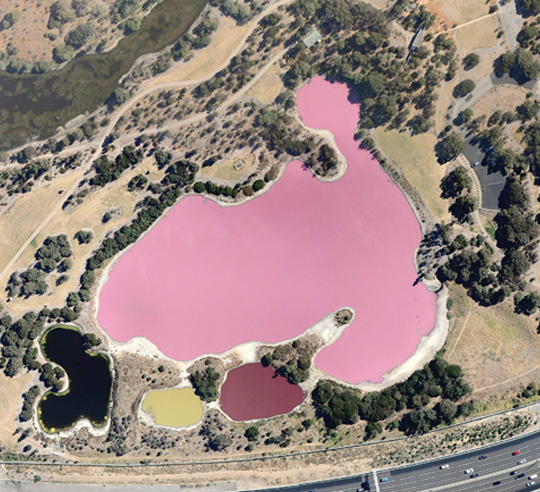
Nearby West Gate Park will act as a living laboratory for the studio to investigate the wide range of restored natural ecologies present. For example the salt lake of West Gate Park’s sometimes turns pink in late summer as the algae in the water responds to warm water. This natural phenomenon brought on by specific ground and water table conditions offers valuable clues to the design of water within the Fishermans Bend precinct.
Studio Outcome
With a very high water table, designing water conditions is critical to the success of this new precinct. The studio has three components.
Part 1 Mapping: documenting the fresh/saline ground water gradient stretching from the Yarra River to the Bay and understanding its relationship to surface land use.
Part 2 Precedents: investigating innovative water design precedents from around the world and understanding how the differing values of engineering, development, ecological and flood mitigation influence the design of form and systems.
Part 3 Design Speculation: drawing on site documentation and precedent research, designing a water based system which creates a landscape space for Fishermans bend that embraces specific water qualities and provides social amenity for the new population.
Studio Leaders
Mark Gillingham is director of GLAS. He is a registered landscape architect in Australia with fifteen years of professional experience ranging from large scale masterplanning to small scale public spaces working for renowned landscape design offices on projects in Australia, Europe, Asia and the Middle East. He has a particular interest in strategic water systems and how these relate to the endemic and future ecology of the place.
Phil Harkin is a Landscape Architect at GLAS and graduate of UoM with over four years experience in landscape architecture. Prior to studying, Phil ran a landscape contractor business and as a result he brings sound knowledge of construction and horticulture which will help students with design construction ideas.
Edward Silveira is a Senior Landscape Architecture at Glas Landscape Architects with over eight years experience working for landscape design practices in Melbourne including JBLA and Oculus and Karres en Brands in the Netherlands. Eddie has direct experience of working on landscape water systems in the low lying land of the Netherlands and has an expertise in systems mapping and will be crucial to teach the research and understanding of water systems.
Readings & References
- Fishermans Bend: Fishermans Bend Framework, October 2018 by State Government of Australia
- Fishermans Bend water and water policy:Integrated and Innovative Water Management, 7th March 2018 by Ramboll
- Fishermans Bend, A Water Sensitive Community by South East Water, 2019
- Total Water Mark – City as a catchment 2014, by City of Melbourne
- Designing with water De Meulder, B & Shannon K; Water Urbanisms East, 2013
- Saunders W, Designed Ecologies: The Landscape Architecture of Kongjian Yu, Birkhauser 2012
Need enrolment assistance?
Stop 1 provides enrolment and other support to Bachelor of Design, Bachelor of Environments and Melbourne School of Design students.