Studio 03
S, M, L, X Laneways
Miza Moreau
Studio Description
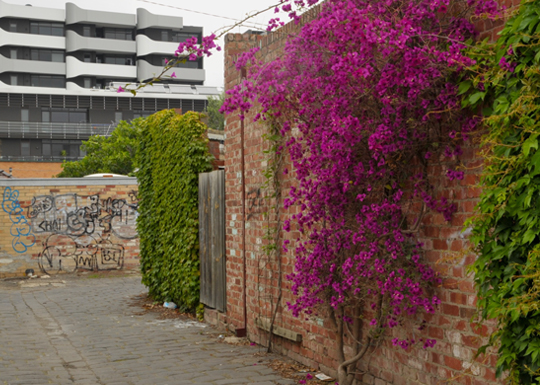
This studio investigates ways to appropriate undervalued urban space into public open space. The sites for this investigation are residential laneways in Melbourne’s inner suburbs. These laneways are leftover sewage infrastructure from 19th century and possibly the last remaining undervalued reserve of public land in densely populated suburbs. Currently, they are regarded as de facto vehicular rights-of-ways and are under threat of unchecked in-fill developments.
The studio will operate as a catalyst lab for testing new design scenarios for social, cultural, and environmental potential for residential laneways. The aim is to investigate their prospects as diverse public space(s) that operate at multiples scales. From this investigation, student will be produce proposals for New Public Space for Melbourne competition, which is a part of the International Festival of Landscape Architecture in 2019.
Studio Outcome
First weeks of the semester will lay out the foundations for engaging with laneways as a unique urban landscape and examining them at various scales, from a single laneway to metropolitan network. Guest lectures and relevant support materials will provide a crucial knowledge base to aid students in:
- selecting the location and scale of their design sites;
- strategies and tactics for achieving desired objectives, and
- possible social, cultural and environmental impacts of appropriating laneways into a new kind of public open spaces.
External guest critics consisting of practitioners, researchers, artists, community members, and/or councils’ staff will provide valuable feedback for reflecting on proposals for laneways’ prospects.
Studio Leaders
Miza is a landscape architect who recently completed her PhD titled 'Re-appropriation of Residential Laneways in Melbourne.'
Readings & References
- Cranz, G 2016, Ethnography for designers, Routledge, London & New York.
- Franck, KA & Stevens, Q (eds) 2007, Loose space: possibility and diversity in urban life, Routledge, London & New York.
- Kullman, K 2013, ‘Green-networks: integrating alternative circulation systems into post-industrial cities’, Journal of Urban Design, vol. 18, no. 1, pp. 36-58.
- Quayle, M & Driessen van Der Lick, TC 1997, ‘Growing community: a case for hybrid landscape’, Landscape and Urban Planning, vol.39, no. 2-3, pp. 99-107.
- Reed, C & Lister, NM 2014, Projective ecologies, Harvard University GSD & Actar Publishers.
Need enrolment assistance?
Stop 1 provides enrolment and other support to Bachelor of Design, Bachelor of Environments and Melbourne School of Design students.