Studio 01
Disturbanism in Coupled Urban and Natural Systems
Justyna Karakiewicz & Theo Blankley
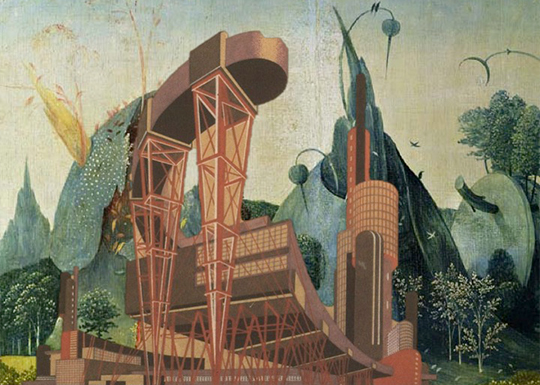
Studio Description
Studio 5 will look at emergent opportunities that bring manufacturing (including food production) back into the urban areas. The question we will be asking is whether manufacturing can have positive impact not only in term of economic returns, diversifying employment, and increasing innovation but also have a positive impact on the environment. To this end, we will focus on waste, both production and recycling, turning trash to more than cash. Minimising waste is an obvious benefit to the environment, but there may be other benefits; it is this we will explore during this studio. We will start with mapping residual space in sectors of Melbourne (CBD, Arden, Hume) where most waste is generated and consider form of manufacturing could take place. How might this change a city sector? We will identify the most appropriate interventions and their location to illustrate how this intervention could have a gradual but significant effect on the whole urban system. We will collaborate with other disciplines, such as biologists, computer scientists, chemists, social scientists and engineers, in order to translate our findings into realisable outcomes in the near future.
Studio Outcome
With a particular lens considering the introduction of modern manufacturing techniques as part of the waste chain, we will model positive and negative consequences of our actions. We will examine the proposition that problems we are facing today are not only related to manufacturing, production, and consumption, they are also heavily influenced by design. You will learn new theories and new skills as well as modelling techniques both physical and digital.
Studio Leaders
Professor Justyna Karakiewicz researches urban design and architecture through design in practice globally and by publication, including numerous design awards and an extensive record of exhibitions. Her work in sustainability was recognised by the Royal Institute of British Architects in 2008 in the Housing Design Awards 2008 Historic Awards for the design of Spinney Garden, constructed in 1986. Her book Promoting Sustainable Living: Sustainability as an Object of Desire, (Routledge, 2015) and Making of Hong Kong: From Vertical to Volumetric (Routledge, 2011) extend her work in this field. Her most recent co-edited book, Urban Galapagos: Transition to Sustainability in Complex Adaptive Systems in the Springer Social and Ecological Interaction in the Galapagos Islands Series (2019) considers the opportunities in coupled natural urban systems, engaging computer, social and economic sciences with design.
Theo Blankley has been professionally engaged extensively across multiple discourses ranging from Architecture, Urban Design, Furniture and Textiles Design, Hospitality and Retail Design, Fashion Design, and Landscape. Having worked both internationally and domestically for a variety of clients at various scales, his current position at the University of Melbourne working for Professor Alan Pert as Project Coordinator is the culmination of several years of teaching, practical, and theoretical experience in design studios, travelling studios, theoretical subjects and practice.
Readings & References
- https://www.rotterzwam.nl/
- https://ecovativedesign.com
- Hunt, J (2015) Known Unknowns, RSA 21st century enlightenment, Number 5561, Issue I, 2015 (pp. 10-15).
- Fry, T. (2008) Designing Futuring: Sustainability, Ethics and New Practice. Berg Publishers.
- Kvan, T. and Karakiewicz, J. (2018) Urban Galapagos: Transition to Sustainability in Complex Adaptive Systems. Cham, Switzerland: Springer Nature.
- Karakiewicz, J. Sustainability as an Object of Desire, Routledge.
- Anderson, C. Makers. Random House
- Jacob, J. System of Survival. Vintage
- Hawken, P. The Ecology of Commerce. Collins
- Alberti, M. Advances in Urban Ecology. Springer
- Ibanez, D. Grounding Metabolism. Harvard University Press
- Reed, C. Projective Ecologies. Actar
and many more depending on your project
Schedule Thursdays 09:00-15:00 in Room 240
Please note: this studio is also offered as Master of Architecture CDE Studio 5
Need enrolment assistance?
Stop 1 provides enrolment and other support to Bachelor of Design, Bachelor of Environments and Melbourne School of Design students.