Studio 05
Interspecies Design Studio
Stanislav Roudavski and Dan Parker | Environmental Futures Focus
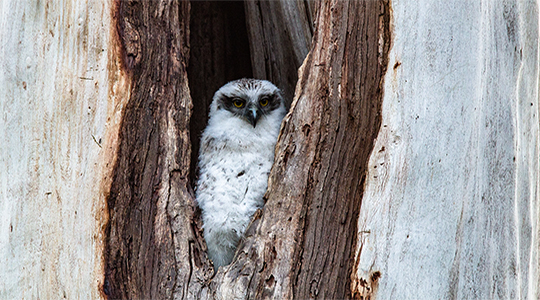
Image credit: Nick Bradsworth
Studio Description
The objective of this studio is to develop designs for places that can foster human and nonhuman cohabitation.
Existing approaches to design preference human needs. However, human health, wellbeing and future survival are impossible without other forms of life. All life happens in concrete places. The primary task of architecture is to imagine future places. This task cannot succeed unless design involves nonhuman lifeforms and their abiotic environments.
The studio will ask:
- How can design contribute to the reinterpretation of places as more-than-human phenomena?
In response to this question, the studio will test the following possible answer (or hypothesis):
- Design can help to reinterpret places as more-than-human phenomena by proposing, prototyping, playtesting and assessing interspecies-design experiments.
Students will:
- Conceptualize the city as a more-than-human place.
- Research interspecies design capabilities.
- Conduct interspecies design experiments.
- Create persuasive visions of future places.
Studio Outcome
Students will produce the following structured outcomes:
- Location report: an environmental history of the site, site as a more-than-human place, future dynamics, opportunities for design interventions.
- Agent report: biology, ethology and life histories of a chosen species. Capacity to live in the future environments.
- Interspecies culture report: histories of past and present interactions with humans and other species, scenarios of future cohabitation.
- Design proposals:
a) Macro: speculative designs enabling possible future scenarios (urban-scale maps and diagrams).
b) Midi: proof-of-concept proposals for integration into existing urban fabric (architectural drawings, renderings and project narratives).
c) Mini: fabricated designs (fully realized functional design prototypes demonstrating fabrication, assembly, installation, deinstallation, reuse and recycling).
- Assessment report: playtesting of proposed designs, critical analysis, risk/benefit evaluation, feedback from potential stakeholders and experts.
Studio Leaders
An architect, artist and researcher at the MSD, Dr Roudavski studies and designs technologically sustained places, with specific emphasis on more-than-human design. His research integrates organizational techniques of architecture, unpredictability and richness of performative situations, creative capacities of computing, visual languages of the moving-image arts, dramaturgy and spatial narrative. He is a leader of Deep Design Lab creative-research unit. See http://unimelb.academia.edu/StanislavRoudavski for details.
Dan Parker is a designer and researcher at the MSD. He works at the FabLab, teaches in design subjects and participates in a cross-disciplinary Deep Design Lab. Dan holds a Bachelor of Environments and Master of Architecture from the University of Melbourne, and is currently investigating radically inclusive design measures for non-human animals in urban environments. Other research interests include generative and parametric design, digital fabrication, mixed reality, geographical information systems and interdisciplinary collaboration.
Readings & References
Collard, R.-C., J. Dempsey, and J. Sundberg. 2015. “A Manifesto for Abundant Futures.” Annals of the Association of American Geographers 105 (2): 322–330. DOI:10/gftcks.
Garrard, G. E., N. S. G. Williams, L. Mata, J. Thomas, and S. A. Bekessy. 2018. “Biodiversity Sensitive Urban Design.” Conservation Letters 11 (2): e12411. DOI:10/gfsqmw.
Glikman, J. A., and B. Frank. 2019. “Human–Wildlife Conflicts and the Need to Include Coexistence.” In Human-Wildlife Interactions: Turning Conflict into Coexistence, edited by B. Frank, J. A. Glikman, and S. Marchini, 1–19. Cambridge: Cambridge University Press.
Parris, K. M., M. Amati, S. A. Bekessy, D. Dagenais, O. Fryd, A. K. Hahs, D. Hes, et al. 2018. “The Seven Lamps of Planning for Biodiversity in the City.” Cities 83 (December): 44–53. DOI:10/gfsp47.
Roudavski, S. 2016. “Notes on More-than-Human Architecture.” In Undesign: Critical Practices at the Intersection of Art and Design, edited by G. Coombs, A. McNamara, and G. Sade, 24–37. Abingdon: Routledge. DOI:10/czr8.
Van Dooren, T., and D. B. Rose. n.d. “Storied‐Places in a Multispecies City.” Humanimalia 3 (2): 1–27.
Wolch, J. R. 1996. “Zoöpolis.” Capitalism Nature Socialism 7 (2): 21–47. DOI:10/dww337.
Schedule Mondays 12:00-18:15 in MSD Room 125
Need enrolment assistance?
Stop 1 provides enrolment and other support to Bachelor of Design, Bachelor of Environments and Melbourne School of Design students.