Studio 11
difference
Ammon Beyerle and Jonathan Daly | Urbanism Focus
Studio Description
Pluralism. Agonism. difference. Agency. Practise.
’Multicultural’ is a catch cry for Melbourne. While trying to navigate the complexity of increasing ethnocultural diversity, urban cores face real challenges of population growth, particularly in developing inter-active civic functions and sustainable liveability. Public spaces are crucial settings for encounter and interaction between differences.
Unfortunately, rational ideals of integration and coherence – long-proselytised by theories and practices of architecture, urban design, land developers and governments – often clash with the convivial reality and mundane mess of everyday life, people and stuff.
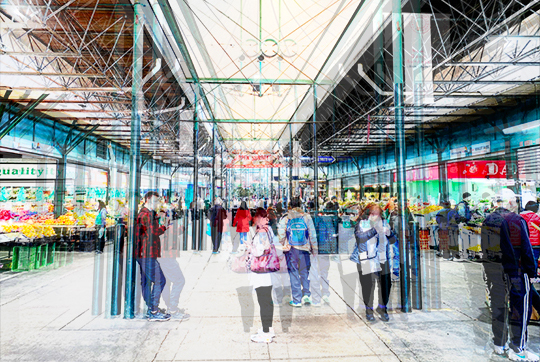
The Preston Market Precinct redevelopment in the City of Darebin, is a prime example of actual tensions – characterised by the layering of old and new diversities, contrasting needs and expectations, an asphalt carpark, crisp buttery croissants for less than $3 and spicy Sri Lankan street food and, accessible public transport, jobs and services – it is a desirable site for new homes, and civic participation.
Studio Outcome
‘Intercultural’ interior and exterior public spaces – key settings of encounter with difference, contested space, and mutual learning – will be the focus of this studio.
Students will learn to consider the design of interactions of different voices, environments, and experiences in public spaces. Reading political and social theories of diversity, community and pluralism, we will study international ‘multicultural’ precedents, and provide a critical review of the first year of the Preston Market Precinct project – now into its third phase of community consultation.
Three scales of design work and thinking will be expected as architecture – a developed civic programme; a strategic urban plan; and a social process. This studio is about multiplicity. How these outcomes are defined (and developed) will be up to each Masters student, but for working each week at multiple scales – big and small; overlapping formats – plan and section; and resolving both abstract and technical concerns – empowerment and structure.
Studio Leaders
Ammon Beyerle is a registered architect and director of Here Studio, an architectural practice of community activists based in Melbourne. Here Studio is focused on Participatory Design of community-orientated projects, and Affordable Everyday Architecture, and have undertaken a number of challenging public projects. Ammon recently completed a PhD “Architecture and Participation: agonism in practice”, under Karen Burns and Kim Dovey – studying architecture and German at the University of Melbourne, (and Paris-Val-De-Seine, and T-U Berlin). Ammon has taught architecture, landscape architecture, construction technology and urban design since 2005, focussing on sustainability, adaptive reuse, and community design.
Jonathan Daly is an urbanist and environmental psychologist with more than 17 years experience working across Europe, North America and Australasia delivering a range of projects in the built environment covering transport, architecture and urban design. Jonathan is a director of UB-Lab, a design research practice for the built environment, based in Melbourne. UB-Lab’s work combines ethnographic research and behavioural science in architecture, urban design and social change to resolve relationships between people and the environment. Jonathan is 3/4 through a PhD regarding public space and ethic cultural difference, under Kim Dovey. Jonathan teaches in Urban Design.
Readings & References
- Basar – “Professional Amateur”
- Beyerle – “Agonistic Participation”
- Bishop – “Collaboration”, “Participation”
- Carter – “Migrant Place-Making”, “Creative Research” Cliostraat
- Daly – “Human–nonhuman relations”
- De Solà-Morales – “Weak Architecture”
- De Certeau – “Practice of Everyday Life”
- Edensor – “Indian Street”
- Flyvbjerg – “Rationality, Conflict and Power”, “Foucault and Habermas”
- Franck, and Stevens — “Loose Space”
- Gibson – “Affordances”
- Gruppo A12
- Guattari – “Chaosmosis”, “Three Ecologies”
- Hall – “Hidden Dimension”
- Hill – “Occupying Architecture”
- Hinkel – “Urban Interior”, “Atmospheres”
- Ingraham – “Burdens of Linearity”, “Architecture, Animal, Human”
- Kahn – “Site as object of desire”
- Kossak, et al – “Agency” “Uncertainty”
- Latour –“Actor Network Theory”
- Lefebvre – “Right to the City”, “Production of Space”
- Lokko – “Responseability”
- Lynch – “Control” *Miessen, and Mouffe – “Violating Consensus”
- Muf
- Nancy “Inoperative Community”
- Pardy – “Kant comes to Footscray Mall”, “Urban Renewal”
- Petrescu – “Losing Control, Keeping Desire”, aaa
- Rapoport – “Nonverbal Communication”
- Rendell – “Critical Spatial Practice”, “Parresia”
- Rosler – “Culture Class” *Sennett – “Flesh and Stone”, “Open City”
- Stalker
- Till – “Impure Community”, “Negotiation of Hope”
- Whyte – “Small Urban Spaces”
Schedule Thursdays 15:15-18:15 in MSD Room 448 and 18:15-21:15 in MSD Room 228
Need enrolment assistance?
Stop 1 provides enrolment and other support to Bachelor of Design, Bachelor of Environments and Melbourne School of Design students.