Studio 13
and beneath that, and beneath that.
Marijke Davey | Global Socio-Political Focus
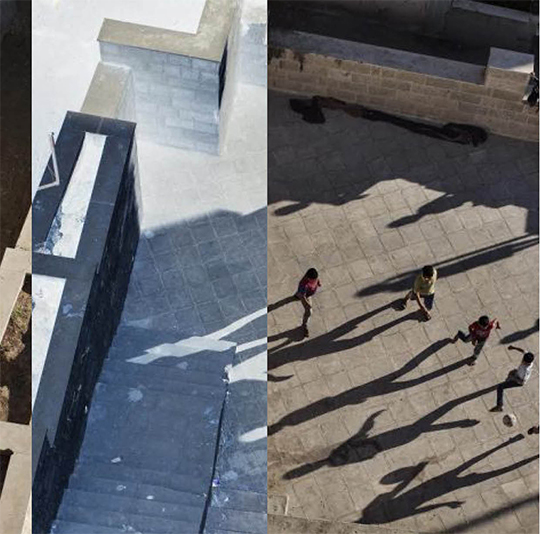
Studio Description
I asked you why.
It is better.
It is better this way.
Why? What is better?
Battles for land are nothing new. We, as a species, have the desire to own, control, occupy, places, people, history. We read about events, shocked at how we could ever commit such atrocities, swear we will never do it again… and here we are. We repeat. Our pain becomes the pain we inflict on others. Justified. An eye for an eye. Your eyes, they are just like mine, looking at me, beyond the wall, just out of sight, in your sight, pixels on your screen.
Studio Outcome
And beneath that, and beneath that will look closely at the events that are currently occurring in and around Palestine. The studio will examine, forensically, a hand holding a magnifying glass, the events, the land, the people, that are living, occupying, and leaving the region. How did this happen. Again. How can a culture be preserved, hold on to you, when a land has disappeared, the connection to place removed, exiled.
And beneath that, and beneath that will question everything, will ask everything, will listen to everything. How many rocks can you look under, how many pages can you turn, how many people, how many opinions. There is no such thing as fiction. Show us what you learn. Contribute to this conversation.
Taking on the ambitions and methodologies of Forensic Architecture - an emergent field of architecture developed by Eyal Weizman and his team through Goldsmiths University, London. Architectural techniques such as mapping, 3D modelling, physical modelling, drafting, will be used to converse about issues that appear, at first glance, to sit outside the traditional vocabulary of Architecture.
‘The public is a space that is given to people by structures of power, whereas al masha¹ is a space created by the interaction of people. Public space can exist without people. Al masha only exists if people are constantly producing it.’²
- The Arabic term al masha refers to communal land equally distributed among farmers. Masha could only exist if people decided to cultivate the land together. The moment they stop cultivating it, they lose its possession. It is possession through a common use.
- Permanent Temporariness, Sandi Hilal + Alessandro Petti
Studio Leader
MARIJKE is a graduate of architecture from RMIT. Marijke’s teaching practice focuses on the humanistic and humanitarian potential of architecture. Across various fields of research and practice, her interests lie in the hope of architecture to act in inclusive, empathetic and rehabilitative ways.
Readings & References
- Abboud, S. N. (2016). Syria. Cambridge, UK: Polity Press.
- Berger, J. (2009). About looking. London: Bloomsbury.
- Borri, F. (2015). Syrian dust: Reporting from the heart of the war. New York, NY: Seven Stories Press.
- Byrne, G. (2016). Borders, barriers, walls. Place of publication not identified: Monash University Museum.
- Chomsky, N., PappeÌ, I., & Barat, F. (2015). On Palestine. London: Penguin Books.
- Dam, N. V. (2017). Destroying a nation: The civil war in Syria. London: I.B. Tauris.
- Danahar, P. (2015). The new Middle East: The world after the Arab Spring. London: Bloomsbury.
- Darke, D. (2016). My house in Damascus: An inside view of the Syrian crisis. London: Haus Publishing.
- Dufour, D., & Delage, C. (2015). Images of conviction: The construction of visual evidence. Paris: Le Bal.
- Ehrenreich, B. (2017). The way to the spring: Life and death in Palestine. London: Granta.
- Glass, C. (2015). Syria burning: ISIS and the death of the Arab Spring. New York: OR Books.
- Halasa, M. (2014). Syria speaks: Art and culture from the frontline. London: Saqi Books.
- Hammond, M. (2014). Arabic poems: A bilingual edition. London: Alfred A. Knopf.
- Hinkinson. J. et al. (2017). Security, Terror, Panic. ARENA journal, Number Forty-Seven/Forty-Eight, North Carlton: Arena Publications.
- King, R. (2014). Democratic desert: The war in Syria. Amsterdam: Schilt Publishing.
- Lahoud, A. (2010). Post-Traumatic Urbanism. Architectural Design, 80(5), 14-23. doi:10.1002/ad.1128
- Littell, J. (2016). Syrian notebooks: Inside the homs uprising. Brooklyn, NY: Verso.
- Malek, C., Hoke, M., & Carp, A. (2014). Palestine speaks: Narratives of life under occupation. San Francisco: McSweeney's Books.
- Pinchbeck, C. (2016). When silence falls. Sydney, N.S.W.: Art Gallery of New South Wales.
- Sahner, C. C. (2016). Among the ruins: Syria past and present. London: Hurst & Company.
- Salamandra, C. (2005). A new old Damascus: Authenticity and distinction in urban Syria. Bloomington, IN: Indiana University Press.
- Shehadeh, R. (2018). WHERE THE LINE IS DRAWN: Crossing boundaries in occupied Palestine. S.l.: Profile Books.
- Silva, C., Drake, D., Jarvis, R., Smalley, U., & Williams, V. (2016). Garden state: The politics of planting in Israel/Palestine. Cardiff: Ffotogallery Wales Limited and The Mosaic Rooms, A.M. Qattan Foundation.
- Statement of the Prosecutor of the International Criminal Court, Fatou Bensouda, at the opening of Trial in the case against Mr Ahmad Al-Faqi Al Mahdi. (2016, August 22). Retrieved November 10, 2017, from https://www.icc-cpi.int/Pages/item.aspx?name=otp-stat-al-mahdi-160822
- Tamdgidi, M. H., (2009). "If I touch the depths of your heart … ": The Human Promise of Poetry in Memories of Mahmoud Darwish, Human Architecture: Journal of the Sociology of Self-Knowledge, Volume 7, Issue 5. Belmont. MA: Okcir Press. Available at: http://scholarworks.umb.edu/humanarchitecture/vol7/iss5
- Vet, A. D. (2007). Subjective atlas of Palestine. Rotterdam: 010 Publ.
- Virilio, P., & Polizzotti, M. (2006). Speed and politics: An essay on dromology. Los Angeles, CA: Semiotext(e).
- Weizman, E. (2012). Forensic architecture: Notes from fields and forums. Forensische Architektur: Notizen von Feldern und Foren. Ostfildern: Hatje Cantz.
- Weizman, E. (2017). Forensic Architecture: Violence at the threshold of detectability. Brooklyn, NY: Zone Books.
- Weizman, E. (2017). Hollow Land. S.l.: Verso Books.
- Weizman, E., Tavares, P., Schuppli, S., & Studio, S. (2010). Forensic Architecture. Architectural Design, 80(5), 58-63. doi:10.1002/ad.1134
- Wood, G. (2018). WAY OF THE STRANGERS: Encounters with the islamic state. S.l.: Penguin Books.
Schedule Monday 15:15-18:15 in MSD Room 141; Thursdays 15:15-18:15 in MSD Room 240
Need enrolment assistance?
Stop 1 provides enrolment and other support to Bachelor of Design, Bachelor of Environments and Melbourne School of Design students.