Studio 01
The Architecture of the Death III
Isabel Lasala
This studio is available to students enrolled in ABPL90142 Studio C, ABPL90143 Studio D, and ABPL90115 Studio E.
Studio Description
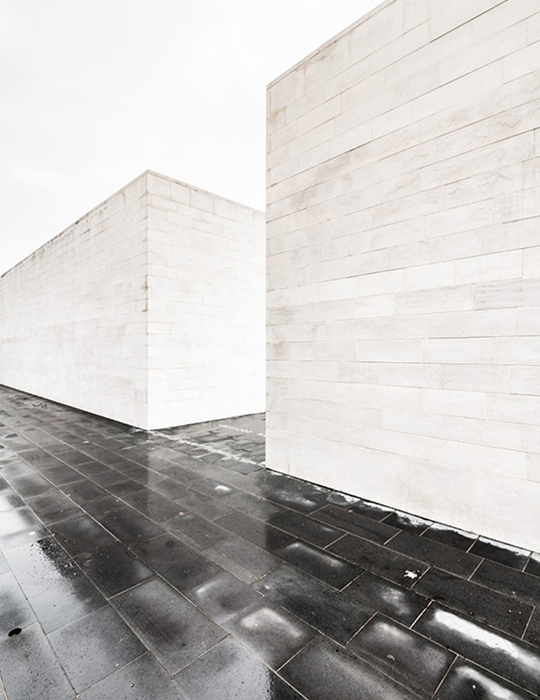
Death, even if insignificant for who has died, prompts a number of activities for those who remain living—most of them related to funeral rites and mourning, as the farewell to someone beloved is one the most intense moments human beings can experience. So had you ever thought that death (and especially dead people) also need specific spatial configurations? Funeral rites, regardless of the religion to which they belong to, require spaces where a number of highly specific activities take place. These spaces must facilitate pragmatic and efficient occupations in atmospheres where light, shadow and silence interact with spaces of timelessness and permanence.
Studio Outcome
This studio represents the opportunity to reflect upon these particular circumstances, and to design the spaces that are required at the moment of death. In this way, the studio stresses the significance of the production of appropriate spatial configurations within the full cycle of life. Specifically, students will be required to investigate and design spaces for a funeral and burial ceremony, based on the program of a temple, a crematorium and a cemetery. In this studio, students are expected to acquire the necessary skills to integrate notions of architecture and landscape architecture in a medium-scale suburban condition, generating unusual spatial configurations through the resolution of a complex program of activities
Studio Leader
Isabel Lasala is one of the Directors of Lasala & Lasala Architects, an award-winning practice with more than fifteen years of experience. Isabel holds a Bachelor of Architecture from Universidad Central de Venezuela, a Master of Architecture from ETSAB/Universitat Politècnica de Catalunya, and an MPhil in Landscape Architecture from University of New South Wales. Her practice-based research investigates new possibilities emerged at the intersection of architecture and landscape architecture. In 2014, Ediciones FAU/UCV published her book Creating Places: Exalting and Overcoming the Architectural Object in the Work of Pablo Lasala. Before settling in Australia in 2009, Isabel was a Senior Lecturer at the Faculty of Architecture and Urbanism of UCV. Here, she has taught design studios at Melbourne University, Monash University, RMIT, UNSW, and University of Technology Sydney.
Readings & References
- Carr, S, Francis, M, Rivlin, L & Stone, A 1992, Public Space. Environment and Behaviour, Cambridge University Press, New York.
- Corner, J (ed.), 1999, Recovering Landscape: essays in contemporary landscape architecture, Princeton Architectural Press, New York.
- Cosgrove, D 1999, Mappings, Reaktion Books, London.
- Galofaro, L 2002, Artscapes El arte como aproximación al paisaje contemporáneo, Gustavo Gili (Land&ScapeSeries), Barcelona.
- Grainger, H 2006, Death redesign, British crematoria: History, architecture and landscape, Spire books limited, London.
- Leatherbarrow, D 2004, Topographical Stories. Edited by John Dixon Hunt, Penn Studies in Landscape Architecture. Philadelphia: University of Pennsylvania Press Gehl, J 2001, Life between buildings: using public space, Island Press, Washington. DC
- Petschek, P 2008, Grading for landscape architects and architects, Birkhauser, Basel - Boston – Berlín.
- Ruby, I & A 2006, Groundscapes The rediscovery of the ground in contemporary architecture, Gustavo Gili (Land&ScapeSeries), Barcelona.
- Valentijn, V, Verhoeven 2018, K, Goodbye Architecture The Architecture of Crematoria in Europe, nai010 publishers, Amsterdam.
- Worpole, K 2003, Last Landscapes The Architecture of the Cemetery in the West, Reaktion books, London.
- Fisterra Cemetery / Cesar Portela. Fisterra, A Coruña, Portugal.
- Igualada Cemetery / Enric Miralles and Carme Pinós. Igualada, Spain.
- San Cataldo Cemetery / Aldo Rossi, Modena, Italy.
- Crematorium in Kakamigahara / Toyo Ito. Kakamigahara, Gifu, Japan.
- Crematorium / Architectural Bureau G. Natkevicius & Partners. Keidainiai, Lituania.
- Igualada Crematorium / Carme Pinós, Igualada, Spain.
- Bruder Klaus Field Chapel / Peter Zumthor, Mechernich, Germany.
- Chapel of St. Ignatius / Stephen Holl, Seattle, USA.
- Sliding Chapel / Kieran Donnellan, Byblos, Lebanon.
Schedule Mondays 09:00-12:00 and Thursdays 09:00-12:00 in MSD Room 240
Travel Herring island | Week 01
Need enrolment assistance?
Stop 1 provides enrolment and other support to Bachelor of Design, Bachelor of Environments and Melbourne School of Design students.