Studio 04
The Ark
Laura Mártires | CITIES + PROCESS
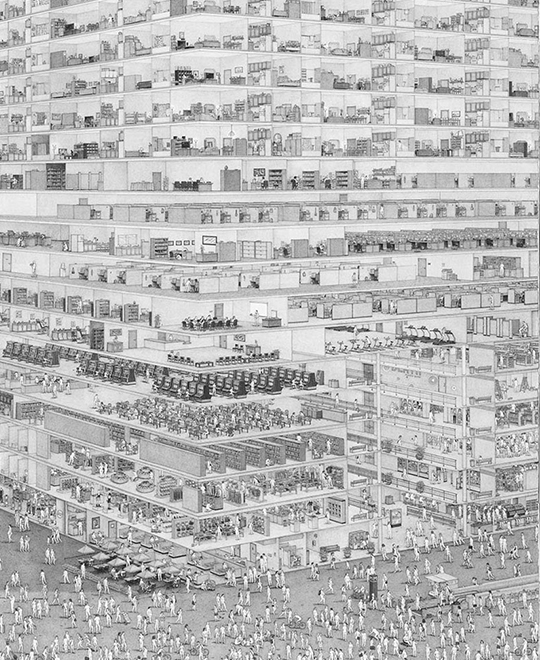
This studio is available to students enrolled in ABPL90142 Studio C, ABPL90143 Studio D, and ABPL90115 Studio E.
Studio Description
Can we live where we work? Can we work, play, make, culture, healthcare where we live? What would that look like and how would it change the way our buildings are designed?
2020 brought with it a torrent of new challenges and the highlighting of ‘old’ ones in need of urgent addressing.
We are now realising that we are all interconnected at the macro and micro level. The design of our living environments and the speculation on future architectural typologies has never been so critical. The lockdown of our cities has triggered a dramatic collapse of our urban environments, with large sections of our cities now dormant or redundant. While this presents obvious economic and social challenges, it could provide an opportunity to radically rethink our cities. If you are born, live, work, make, consume, play, heal and die in the same space, in a framework of total shared, negotiated, overlapping and fluid mixed use, there is the potential to cut the physical and environmental footprint of human inhabitation.
This studio aims to speculate on the future of our living spaces and the impact on cities if the need to leave our address is eliminated. In a world where everything is indoors, it would make sense to draw on urbanism and urban thinking as a mechanism for architectural organisation, planning and programming.
Conventional architectural and urban design strategies generally view the city as static, when in fact the urban environment is a dynamic field of interrelated elements that are in a constant process of change, resulting in the continual production of new hybrid architectural types and forms.
This studio will start here and build upon these questions to design a vertical ‘Ark’ in the city of Melbourne.
Studio Outcome
Students will be asked to work within vertical ‘containers’ and design new modes of programmatic organisations addressing questions of circulation for people, goods, waste or information within the the framework of a 'mixed-use' high rise building. Rather than focusing on questions of formal composition, the studio aims to address the systems that can be set in place to allow us to survive (and thrive) in relative ‘isolation.’
Students will be asked to develop a critical position on architectural program and to form political positions around the things that are most essential to us, what we must give away and how we structure our life around a building.
These issues will be explored through processes of negotiation and gamification, reconsidering these approaches as critical tools for speculating on new modes of living and the architectural typologies that might support them. The studio will challenge the designer to work through acts of ingenuity or negotiation in an incremental fashion rather than the authoring of a single big idea, or the choreographing of a process.
This will involve working individually and in teams throughout the semester. Final projects will be assessed against a process of negotiation established by your tutor and your peers as the semester progresses.
The Ark will be an opportunity to speculate on the future of our living environments through the lens of negotiation, gamified processes and generative experimentation.
Studio Leader
LAURA MARTIRES: As an individual I have always been interested in cities and how urban infrastructure, form or fabric can inform a certain design process. I believe architecture isn't formed in a vacuum and cities constitute an endless and rich field for research and design experimentation. These ideas have been pursued at different scales through my practices, MartiresDoyle (together with John Doyle) and NAAU (with John Doyle, Edmund Carter and Ben Milbourne). In both of these practices each project is seen as a unique opportunity to create spatial complexity from seemingly abstract notions of urbanity, cohabitation or socio-economical factors. The goal as a practitioner is always to create unique, complex and beautiful spaces that work as a connective platform between the context they're inserted in and they're occupants.
Readings & References
- Allen, Stan, Trace Elements in Tracing Eisenman, pp.49-65
- Lynn, Greg, The Proto-Functional potential of diagrams in architectural design in El Croquis 72, pp 16-31 (p) Li Han, A Little bit of Beijing;
- Tsukamoto Architectural Laboratory & Atelier Bow-Wow, Pet Architecture Vol.2;
- Corner, James, The Agency of Mapping: Speculation, Critique and Invention;
- Allen, Stan, Practice: Architecture Technique + Representation, II_Notations + Diagrams: Mapping the Intangible;
- Allen, Stan, Field Conditions I +II.
Supplementary reading and references will be provided throughout the semester
Schedule 18:15-21:15 Mondays and Thursdays
Need enrolment assistance?
Stop 1 provides enrolment and other support to Bachelor of Design, Bachelor of Environments and Melbourne School of Design students.