Studio 05
Future Cities: from Vertical (2.5D) to Volumetric (4D)s
Justyna Karakiewicz and Onur Tumturk | CITIES + PROCESS
This studio is available to students enrolled in ABPL90142 Studio C, ABPL90143 Studio D, and ABPL90115 Studio E.
Studio Description
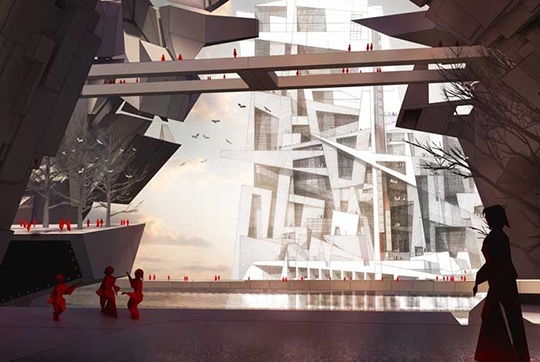
This studio will examine how we can develop ideas about not as much vertical but truly volumetric cities, where lift shafts and tunnels are replaced with rich urban experience; where the quality of experience from streets, alleys and piazzas remains as we move up and down through new forms of urban high rise; where the movement is not only limited to ground level but happens at all different levels, allowing for extensive views of the city and surrounding country side; where anyone is able to escape from overcrowding, pollution and noise, into open space, with long vistas, and even isolation. We will learn how to design truly volumetric city.
Studio Outcome
We will be asking two main questions:
- How does urban design practice accommodate multiplicity of our expectations? In Local Code by Michael Sorkin we read that well design city requires a theory of what is desirable. But what is desirable for one might not be desirable for another. If we really want to accommodate multiplicity of desires and choices, our current practices are in trouble. Therefore, we need to develop different methods and different forms of the city that could accommodate variety of expectations: from low to high density, from concrete to green jungle, from noise to silence, from confined to expanse places. And this leads us to another question.
- If the 20th century was all about mobility, will 21st century will be all about accessibility, and if yes how could we change the way we move and access things which we need and desire, can we re-think the infrastructure for the 21st century?
Studio Leaders
Professor Justyna KARAKIEWICZ, BArch(Hon) AA Dip PhD MSAI RIBA FRSA, trained as an architect at the Architectural Association. She taught at the Architectural Association, Bartlett School of Architecture, University College, London and spent 14 years as Associate Professor at The University of Hong Kong. Currently Professor at The University of Melbourne. She has exhibited work in Royal Academy (London), Venice Biennale (three times), New York, Kyoto, Barcelona, Hong Kong, Beijing, Sydney and some twenty other venues. Her numerous successes in international competitions include First Prizes in: Gateway to Mecca (1979); Crystal Palace Solar Housing Competition (1981; built); Dunkerque Waterfront (1992; partially built); Swansea Working Men’s Club (1995; built); awarded Prize at Royal Academy Summer Exhibition for the best drawing (2005); Honorable Mention and prize in Asia Front Village 39th Central Glass International Architectural Design Competition sponsored by Shinkenchikusha Co., Ltd., Prize (2004); Honorable Mention in Modern Saudi House Design Competition (2004); Honorable Mention in eVolo Annual Skyscraper Architectural Competition (2006); First prize for Spinney Garden project completed 20 years ago, Housing Design Awards 2008 Historic Awards (2008); Second Prize in the Austral Bricks Design Ideas Competition (2010). Justyna has published over 60 papers, 12 book chapters and three books: The Making of Hong Kong and Promoting Sustainable Living: Sustainability as an Object of Desire and Urban Galapagos published in December 2019.
Onur TUMTURK, M.Sc., having received his bachelor’s degree on urbanism and Master’s degree on urban design at METU, worked as a teaching assistant and participated design studios at the same university. He is currently PhD. researcher at Melbourne School of Design. He researches adaptive capacity and resilience of urban form and space through morphological investigations on grid cities. His further research interests include contemporary urban design theory, urban morphology, complexity theories and socio-ecological thinking in urbanism.
Schedule 09:00-12:00 Wednesdays, 12:00-15:00 Fridays
Need enrolment assistance?
Stop 1 provides enrolment and other support to Bachelor of Design, Bachelor of Environments and Melbourne School of Design students.