Studio 20
The shape of wine
Alberto Pugnale and Alessandro Liuti | TECH + PROCESS
This studio is available to students enrolled in ABPL90142 Studio C, ABPL90143 Studio D, and ABPL90115 Studio E.
Studio Description
In free-form architecture, the adjective “free” indicates the freedom to create architectural forms, irrespective of any composition, static or construction principle. Form-resistant structures offer an opportunity to control such freedom through a unique creative-generative process that builds on the legacy of iconic works by, among others, Heinz Isler, Frei Otto and Jörg Schlaich.
In this framework, this 9th edition of How Virtual Becomes Real will continues the research into the design-to-construction working methods for shell and spatial structures, which aims to synthesise the virtual and the real by means of both physical form-finding and numerical optimisation models.
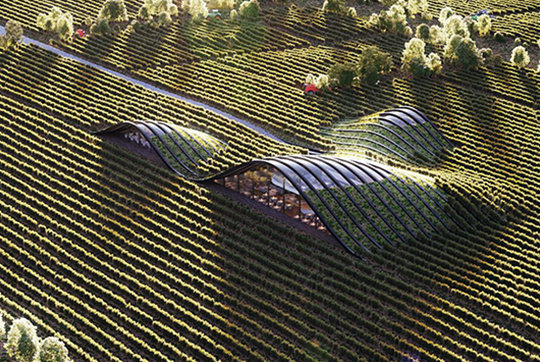
Students will explore the spatial and tectonic qualities of form-resistant structures by designing a winery in regional Victoria, therefore answering to the question: “What is the shape of wine?”
Studio Outcome
WEEKS 1-4: Weekly workshops to familiarise with the concepts of form-finding, optimisation, detailing and fabrication of shell and spatial structures. By the end of week 4, students are expected to be able to:
- generate and explore free-form geometries using Rhinoceros;
- define Grasshopper routines for design automation, such as for surface discretisation and panelling;
- perform FEM analyses using Karamba;
- prepare 3D digital models for fabrication through laser cutting, 3D printing and other digital fabrication techniques.
WEEKS 5-12: Design of a winery in regional Victoria. By the end of week 12, students are expected to be able to:
- communicate design ideas and propositions through a variety of media, including diagrams, renders and other techniques;
- present their work verbally to an external panel of architects and engineers;
- design and prototype a shell or another spatial structure at different scales (1:200 to 1:1).
ESSENTIAL PREREQUISITES: Foundations of computational design thinking and analytical thinking. Competency in Rhinoceros and Grasshopper. Strong attention to detail.
Studio Leaders
Dr Alberto Pugnale is an architect and Senior Lecturer in Architectural Design at ABP. He is the Academic Convenor of the Hallmark Research Initiative (HRI) on Bioinspiration and the Pathway Coordinator of the Architecture Major – Bachelor of Design. In 2007, he won the HANGAI Prize, an international contest of research papers that are related to the field of shell and spatial structures for young researchers under 30. He has taught in Italy, Denmark, France, and China. He is member of the “International Association for Shell and Spatial Structures” (IASS). He sits on the Editorial Board of the “Nexus Network Journal” and the “International Journal of Space Structures”.
Dr Alessandro Liuti is an architectural engineer and Project Manager at Arup. He is Arup Research Manager for the Australasia Region and has expertise in computational design, digital fabrication, and emerging technology. He has a background and passion for lightweight structures - a field in which, both in Australia and overseas, he delivered built projects, lectured, and published extensively.
Readings & References
- Adriaenssens S., Block P., Veenendaal D., Williams C., Shell Structures for Architecture: Form Finding and Optimization, Routledge, 2014.
- Engel H., Structure Systems, 3rd edition, 2007 (1967).
- Holgate A.,The Art of Structural Engineering. The work of Jörg Schlaich and his Team, Axel Menges, Stuttgart, London, 1997.
- McLean W., Structural engineering for Architects: A Handbook, Laurence King Publishing, 2014.
- Menges A., Material Computation, Architectural Design, March/April 2012.
- Nerdinger W., Frei Otto. Complete Works: Lightweight Construction - Natural Design, 2005.
- Oxman Ri., Oxman Ro.,The new structuralism, Architectural Design, July/August 2010.
- Peters B. and De Kestelier (Eds), Computation Works: The Building of Algorithmic Thought, Architectural Design, March/April 2013.
- Tedeschi A., AAD Algorithms-Aided Design, Le Penseur, 2014.
- http://www.albertopugnale.com/resources/
- https://www.albertopugnale.com/blog/
- http://www.karamba3d.com/
Further references will be provided during the semester.
Schedule 18:15-21:15 Mondays and Thursdays
Need enrolment assistance?
Stop 1 provides enrolment and other support to Bachelor of Design, Bachelor of Environments and Melbourne School of Design students.