Studio 08
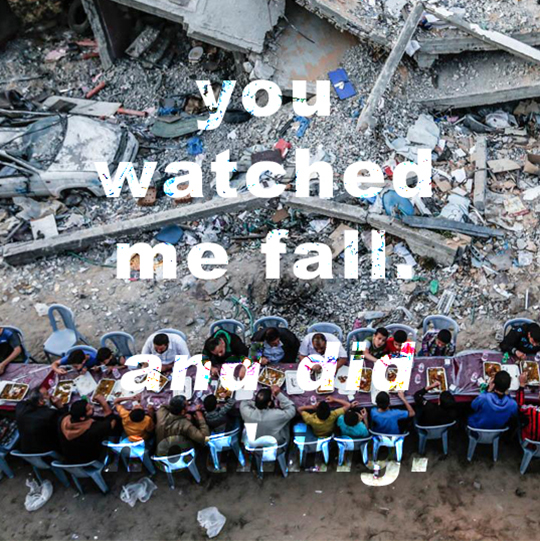
you watched me fall. and did nothing.
Marijke Davey
Studio Description
you said, your words mean nothing.
you said, words are nothing without action.
i do not believe you.
action, action, take 20. write more, do more, all the punctuation, telling us when to breathe, when to pause, when to exclaim, when to question, what to question, stop asking questions, stop telling us what to do, we breathe without you, beside you, like you.
In 2012 the United Nations made a prediction that by 2020 Gaza would become unlivable. Citing increasing population, unreliable electricity and water supply, and a lack of education facilities, as factors that contribute to unlivablity, the report outlines what needed to be done in the following eight years to ensure that life for people living in Gaza could continue.
It is now 2020.
Gaza remains under siege from Israel, controlled by Hamas, cut off from the ocean, families, resources and autonomy.
Studio Outcome
you watched me fall. and did nothing, will be heavily research based, self directed and will focus on Gaza, in Occupied Palestine.
Through different methodologies and approaches to research, the studio will develop a visual understanding of the situation in Gaza. Mapping will be undertaken, looking at more than the geographical, the way people live, the way the country lives, the food they eat, the places they gather.
What is the reality for Gaza ?
Why has nothing changed ?
Studio Leader
Marijke is an architect working in landscape architecture. She cares for pigeons, public space, and Palestine.
Readings & References
- Berger, J. (2009). About looking. London: Bloomsbury.
- Byrne, G. (2016). Borders, barriers, walls. Place of publication not identified: Monash University Museum.
- Chomsky, N., PappeÌ, I., & Barat, F. (2015). On Palestine. London: Penguin Books.
- Danahar, P. (2015). The new Middle East: The world after the Arab Spring. London: Bloomsbury.
- Dufour, D., & Delage, C. (2015). Images of conviction: The construction of visual evidence. Paris: Le Bal.
- Ehrenreich, B. (2017). The way to the spring: Life and death in Palestine. London: Granta.
- Hammond, M. (2014). Arabic poems: A bilingual edition. London: Alfred A. Knopf.
- Hinkinson. J. et al. (2017). Security, Terror, Panic. ARENA journal, Number Forty-Seven/Forty-Eight, North Carlton: Arena Publications.
- King, R. (2014). Democratic desert: The war in Syria. Amsterdam: Schilt Publishing.
- Lahoud, A. (2010). Post-Traumatic Urbanism. Architectural Design, 80(5), 14-23. doi:10.1002/ad.1128
- Littell, J. (2016). Syrian notebooks: Inside the homs uprising. Brooklyn, NY: Verso.
- Malek, C., Hoke, M., & Carp, A. (2014). Palestine speaks: Narratives of life under occupation. San Francisco: McSweeney's Books.
- Pinchbeck, C. (2016). When silence falls. Sydney, N.S.W.: Art Gallery of New South Wales.
- Sahner, C. C. (2016).
- Shehadeh, R. (2018). WHERE THE LINE IS DRAWN: Crossing boundaries in occupied Palestine. S.l.: Profile Books.
- Silva, C., Drake, D., Jarvis, R., Smalley, U., & Williams, V. (2016). Garden state: The politics of planting in Israel/Palestine. Cardiff: Ffotogallery Wales Limited and The Mosaic Rooms, A.M. Qattan Foundation.
- Statement of the Prosecutor of the International Criminal Court, Fatou Bensouda, at the opening of Trial in the case against Mr Ahmad Al-Faqi Al Mahdi. (2016, August 22). Retrieved November 10, 2017, from https://www.icc-cpi.int/Pages/item.aspx?name=otp-stat-al-mahdi-160822
- Tamdgidi, M. H., (2009). "If I touch the depths of your heart … ": The Human Promise of Poetry in Memories of Mahmoud Darwish, Human Architecture: Journal of the Sociology of Self-Knowledge, Volume 7, Issue 5. Belmont. MA: Okcir Press. Available at: http://scholarworks.umb.edu/humanarchitecture/vol7/iss5
- Vet, A. D. (2007). Subjective atlas of Palestine. Rotterdam: 010 Publ.
- Virilio, P., & Polizzotti, M. (2006). Speed and politics: An essay on dromology. Los Angeles, CA: Semiotext(e).
- Weizman, E. (2012). Forensic architecture: Notes from fields and forums. Forensische Architektur: Notizen von Feldern und Foren. Ostfildern: Hatje Cantz.
- Weizman, E. (2017). Forensic Architecture: Violence at the threshold of detectability. Brooklyn, NY: Zone Books.
- Weizman, E. (2017). Hollow Land. S.l.: Verso Books.
- Weizman, E., Tavares, P., Schuppli, S., & Studio, S. (2010). Forensic Architecture. Architectural Design, 80(5), 58-63. doi:10.1002/ad.1134
These will be provided to you in the Studio Library
Schedule Mondays 15:15-18:15 and Thursdays 15:15-18:15 in MSD Room 141
Need enrolment assistance?
Stop 1 provides enrolment and other support to Bachelor of Design, Bachelor of Environments and Melbourne School of Design students.