Studio 04
Contested States and the Architecture of the In-between
Heather Mitcheltree and Mitchell Ransome
Studio Description
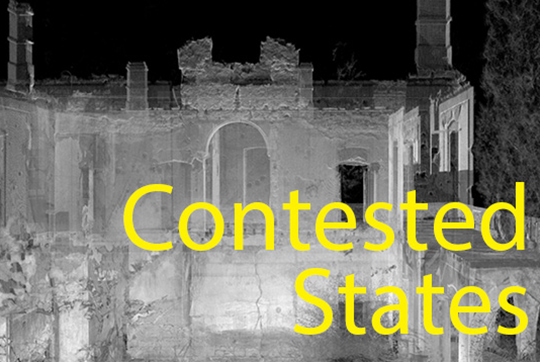
This studio serves as an exploratory testing ground through which to reframe sites of contestation, thresholds and boundaries. Focusing primarily on the UN buffer zone in Cyprus, students will explore how architecture might be utilised to frame the politics of boundary conditions, spatial manifestations of memory, and socio-political narratives of identity, conflict, and the in-between. These contested spaces serve as a symbolic locus in which individual and collective memory, trauma, place and temporality coalesce. Within this studio, students will be encouraged to re-envisage the process of creative production – utilising uncertainty, disruption, realignment and conflict as mechanisms through which to transgress boundaries and explore identities of difference.
Studio Outcome
Within this studio students will undertake:
- Research and conceptual framing In the first stage, students are asked to analyse the historical, political, and socio-spatial context of Nicosia. Through a range of analytical tools, students will explore the spatial tensions and socio-political constructs within demilitarised zones, borders and contested spaces.
- Experimental propositions Students will explore how through interdisciplinary practice we might re-read, re-imagine, and re-make contested spaces. Drawing on a range of interdisciplinary frameworks, students will be asked to produce experimental propositions that question traditional boundaries.
- Design proposition and development During this phase, students will propose and develop a design intervention for their chosen site - to reinvest the ‘no man land’, and activate cultural and social boundaries. During this phase students will develop design strategies to navigate complex emotive histories, re-frame the politics of boundary conditions, and explore spatial manifestations of memory and loss.
Studio Leaders
Heather Mitcheltree currently teaches design at the Melbourne School of Design. Having worked for over 15 years at the University of Melbourne across a range of teaching and research roles, Heather has a broad interdisciplinary research background. Heather’s work focuses primarily on trauma-scapes, and interdisciplinary approaches to understanding and representing complex socio-spatial narratives and the psychological impact of the built environment. Heather’s practice lies at the margins of art, architecture, research, and theory, and in addition to research and teaching, she engages in private design work, art practice, creative design and art collaborations, and research consultation.
Mitchell Ransome currently teaches design and works in the Digital Fabrication Workshop at the Melbourne School of Design. He has an in-depth knowledge of experimental fabrication techniques in architecture, furniture design, model making, materiality and detailing. Through his work Mitchell has developed a strong base across a wide variety of digital skills, such as 3 and 4 axis fabrication, sheet forming, 3D scanning and digital manipulation. Mitchell’s private work focuses on photography and the dislocation and exile of people and place. He has a recently published a book, ‘The Opposite to Good but not Bad’. Both individually and collectively, Heather and Mitchell have had their work exhibited at the Museum of Contemporary Art in Sydney, the Melbourne International Fringe festival, the Buffer Fringe Performing Arts Festival 2019 in Cyprus, and featured in a range of national and international publications.
Readings & References
- Charlesworth, E. R. (2006). Architects without frontiers: war, reconstruction and design responsibility: Amsterdam; Boston; London: Architectural Press, 2006.
- Collins, C. A., & Opie, A. (2010). When places have agency: Roadside shrines as traumascapes. Continuum: Journal of Media & Cultural Studies, 24(1), 107-118.
- DeTurk, S. (2017). Memory of absence: Contemporary counter-monuments. Art & the Public Sphere, 6(1/2), 81. * Dovey, K. (2008). Framing places: mediating power in built form (2nd ed. ed.): London; New York: Routledge.
- Hadjri, Karim, Ozersay, Fevzi and Chatzjichristou, Christos.(2014).Healing the liminal space: a student project on the Nicosia buffer zone. GAU Journal of Social and Applied Sciences, 6 (10). pp. 412¬427.
- Mitcheltree, H., & Ransome, M. (2020). Contested States: Creating affective encounters with spaces of Conflict and Identities of Difference. Inflection: Boundaries, Vol 07., 122-131.
- Odenthal, H. V. (2013). The Green Line, Cyprus: A Space of Exception or an Exceptional Space?
- Schmidt, L. (2017). TRAUMA ARCHITECTURE AND ART: BOROS BUNKER BERLIN. Scope: Contemporary Research Topics (Art & Design), 14, 15-25.
- Tumarkin, M. (2005). Traumascapes: the power and fate of places transformed by tragedy: Carlton, Vic.: Melbourne University Publishing, 2005.
Schedule 18:15-21:15 Mondays and Thursdays
Need enrolment assistance?
Stop 1 provides enrolment and other support to Bachelor of Design, Bachelor of Environments and Melbourne School of Design students.