Studio 10
Inten(d)sity Ballarat
Ammon Beyerle
Studio Description
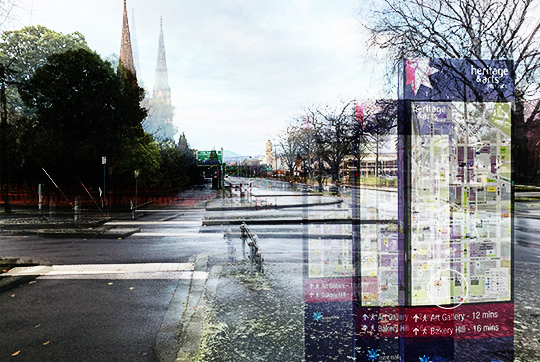
St Andrew’s Kirk site has been central Ballarat’s most iconic medium-density residential development site for over a decade. At ~15,000m2 it comprises a gothic Cathedral, manse, community hall, large unkempt carpark, rubbled-grass, motel, former Loreto College and burnt-out St Josephs School building. In the early 1990s, Postcode 3000 transformed how people thought of central Melbourne, as a place to live – demonstrating how urban change brings cultural change.
Forward to 2020, this studio imagines Postcode 3350 – the opportunity to rethink regional city centres, as places to live. Ballarat – the capital of Western Victoria has little to no inner-city medium-density housing, and like most regional Victorian cities, powerful community representatives guard ideals of low-density urban fabric, affordability, and car-accessibility with aesthetic notions of heritage. Fringe development is proliferating, dis-integrating community, destroying the environment, and drying up the economy.
Can we explore another intensity?
Studio Outcome
Ballarat expects to double to 200,000 by 2040 and intends to maintain a “10 minute city”… Unsolicited, a consortium of architects and progressive developers have teamed-up with the Council and State Government to imagine an exemplary housing project in the centre of town. The selected site is walking distance from a 59min train-ride to Melbourne, and 200m from the new 1000-job GovHub and library Civic Hall Site. Urban intensification, via a wave of economic change is coming to the regions.
Through masterplans and design of public and private spaces, students will be challenged to investigate how new experiences of the self, the social, and material ecologies might be enabled and enhanced. Can fundamental urban design principles of density, permeability, and ground-floor activation transform a city? This studio considers concepts of difference, tension and agency in architecture to explore living in regional cities, restitching loved places into lived ones.
Studio Leader
Ammon Beyerle is a registered architect and director of Here Studio, an architectural practice of sustainability activists in central Victoria. Here Studio is focused on “participatory design” of community projects, and “affordable everyday architecture”, and have undertaken a number of challenging public projects. Ammon completed a PhD “Architecture and Participation: agonism in practice”, under Karen Burns and Kim Dovey – studying architecture and German at the University of Melbourne, (and Paris-Val-De-Seine, and T-U Berlin). Ammon has taught architecture, landscape architecture, construction technology and urban design since 2005, focussing on sustainability, adaptive reuse, medium-density housing and public space.
Readings & References
- Bishop, (2006) Participation.
- Bourriaud, (2002) Relational Aesthetics.
- DeLanda, (2005) Space: extensive and intensive, actual and virtual.
- Dovey, etal, (2014) “Density without Intensity” and “Public/private urban interfaces”; etal, (2018), Mapping Urbanities
- Edensor, (2006) “The Culture of the Indian Street”.
- Franck, etal, (2006) Loose Space: Possibility and Diversity in Urban Life
- Gehl, (1987) Life Between Buildings; (2010) Cities for People.
- Guattari, (1992). Chaosmosis; (1989) The Three Ecologies.
- Hinkel, ed., (2011). Urban Interior: Informal explorations, interventions and occupations.
- Jacobs, (1961) “The Uses of Sidewalks”.
- Kingwell, etal, (2009) Rites of way: the politics and poetics of public space.
- Latour, (2005) Reassembling the Social.
- Lefebvre, (1968) The Right to the City.
- Miessen, and Mouffe, (2008) “Violating Consensus”.; and Basar, eds., (2006) Did Someone Say Participate?
- Newman, (1992) “The Compact City”
- Sennett, (1970). The Uses of Disorder.
- Soja, (1996). Thirdspace.
- Vezzoli, and Manzini, (2008) Design for Environmental Sustainability.
- Spanish and Dutch architects (ie MVRDV) exploring density in regional cities.
- https://www.spatialagency.net
- https://www.theguardian.com/books/2020/jan/18/the-self-delusion-tom-oliver-review
- https://www.ballarat.vic.gov.au/city/city-strategy/ballarat-strategy-2040
Schedule 15:15-21:15 Thursdays
Need enrolment assistance?
Stop 1 provides enrolment and other support to Bachelor of Design, Bachelor of Environments and Melbourne School of Design students.