Studio 3/01
Iconic Fort, Cultural Fulcrum: the Dorney House in Landscape
Andrew Saniga
Studio Description
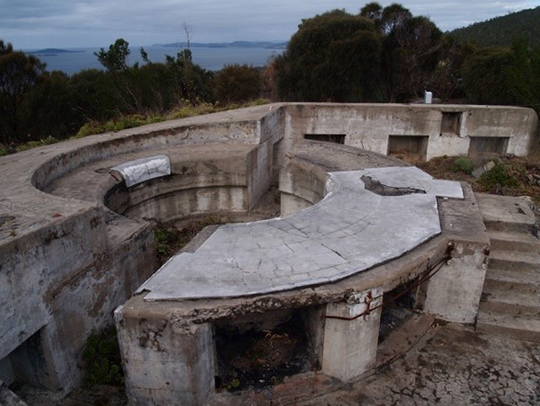
The Dorney House, historically ‘Fort Nelson’, is currently owned by the Hobart City Council and is widely acclaimed as one of Tasmania’s most dramatic modernist icons. Designed by J H Esmond Dorney in 1948, and rebuilt 1966 and 1978 after fires twice destroyed it, Dorney’s house reveals connections between architecture, landscape and history, epitomising unions between settlement and ecology. One architectural historian described its engagement with the hilltop location as a ‘pivot point,’ in the ‘dynamic urban landscape and layered landforms of the estuarine Greater Hobart region.’ (Woolley, in Lewi and Goad [eds] 2019, p. 252). The building is strikingly innovative in form – circular and segmented, inside and out - and is physically grafted to a historic gun emplacement built in 1904. Together with the forested 35hectare allotment, known as the ‘Porter Hill Environment Precinct’, both house and site are currently in a state of flux and require innovative and speculative ideas for conservation and public use.
Studio Outcome
The life and work of architect Esmond Dorney – a survivor of incarceration as a prisoner of war and a well-known architect residing atop a hill – presents a critical avenue for exploration. But Fort Nelson also serves as a hinge for exploring the broader social milieu of Hobart’s post-WWII condition, engendering links to such events as: the exploitation of landscape and natural resources via infrastructure; the emergence of new perceptions of Tasmanian wilderness; and, the epic conservation battles of the 1960s and 70s that in many senses define Tasmania in the national and international context. During a three-day fieldtrip to Hobart from 14-16 March (partially subsidised by the MSD) students will meet Dorney’s descendants, speak with ecologists and geographers, and complete site analysis and schematic design work. Upon return they will be asked to develop ideas for the future of the site.
Studio Leader
Andrew Saniga is Associate Professor in Landscape Architecture, Planning and Urbanism. He teaches landscape design and history of landscape architecture.
Readings & References
- Leigh Woolley, 2019, ‘The Dorney House’, in H. Lewi and P. Goad (eds), Australian Modern Architecture, Landscape and Design, Thames and Hudson, London, 252.
Studio Mondays 12:00-18:15 in MSD Room 124
Travel Hobart, Tasmania | 14-16 March | $500
Need enrolment assistance?
Stop 1 provides enrolment and other support to Bachelor of Design, Bachelor of Environments and Melbourne School of Design students.