Studio 5/01
Re-imagining the Concrete Lawn as a Wetland
Ray Green
Studio Theme
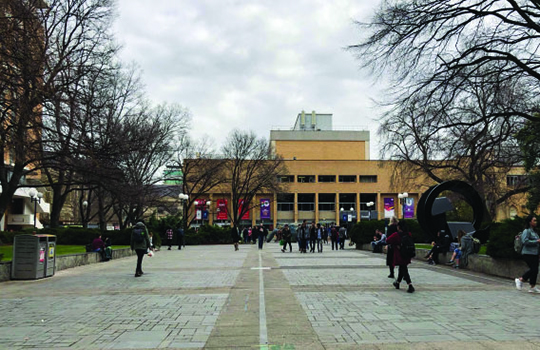
Before the University of Melbourne’s Parkville campus had been constructed the area currently known as the Union Lawn, also known as the Concrete Lawn, was a large wetland. The initial development of the campus transformed this wetland into an ornamental lake, which was later filled in and replaced with a mixture of hard surfaces, plantings, sculpture and other landscape features we see there today. The site is bordred by four buildings, including the Student Union, the Architecture Building, Raymond Priestley Building and the historic Baldwin Spencer Building. This centrally located area is much used and has great potential to be transformed into a new and exciting place that incorporates areas of constructed wetlands integrated with more trafficable spaces.
Studio Theory
Wetlands and humans have had a long relationship over the course of human evolution. Viewed from this evolutionary perspective, wetlands, being inherently highly bio-diverse places, would have been important to the indigenous Australians, the Wurundjeri people, who once relied on this wetland for the
plant and animal resources they needed to survive. Habitat Selection Theory suggests that contemporary humans may still possess affinities for these wetland-type environments. Wetlands can, however, be perceived negatively as being “messy” and inhospitable places. In the re-design of this space, therefore,
consideration of these and other theoretical propositions need to be considered.
Studio Brief
Students will explore how this site can be re-imagined to reference the wetland that once existed at the site with the aim of transformeing it in to a well-loved and sustainable place at this highly prominent location on the campus. Students will be expected to develop design proposals that incorporate not just areas of wetland and associated plantings but also trafficable surfaces, and associated terrestrial plantings, that can afford a broad range of activities for students and others. They also simultaneously have to incorporate a range of sustainability features in their designs in terms of energy use, ecology, materials, human socio-behavioural interactions and other design features associated with the notion of sustainable urbanism.
Studio Leader
Ray Green, who is a professor of landscape architecture in the Melbourne School of Design, will led this studio. His research focuses on sustainable land development and the benefits associated with human contact with nature in urban settings. Ray is the author or co-author of various publictions related to the theme of this studio, including the books: Planning, Housing and Infrastructure for Smart Villages (2019); Coastal Towns in Transition (2010); The Green City: Sustainable Homes, Sustainable Suburbs (2005); Towards Low Carbon Cities in China (2015) and Design for Change (1985). Prior to joining the University of Melbourne, Ray spent 12 years in professional landscape architectural practice, at which time he undertook a vareity of projects in the United States and Mexico, Asia and Australia. In 2012 he was made a
Fellow of the American Society of Landscape Architects in recognition of his accomplishments in the field.
Readings & References
- Dobbie, M. and Green, R. (2013). Public perceptions of Australian freshwater wetlands. Urban and Landscape Planning. Vol. 110, pp. 143-154.
- Green, R. (2013). Close to Nature. In Australian Healthcare Design 2005-2015: A Critical Review of the Design and Build of Healthcare Infrastructure in Australia. International Academy for Design and Health. pp. 76-81.
- Nassauer, J.I., (ed) (1997). Placing Nature: Culture and Landscape Ecology. Island Press. Washington, D.C.
- Nassauer, J. I. (1995). Messy ecosystems, orderly frames. Landscape Journal, 14(2): pp.161-170
- Orians, G. H. and J. H. Heerwagen, J. H. (1992). Evolved responses to landscapes. In: J. H. Barkow, L. Cosmides and J. Tooby (eds.). The Adapted Mind, pp. 555-579, Oxford University Press
- Orians, G. H. (1980). Habitat selection: general theory and applications to human behavior. In: Lockard, J. S. (ed.) Evolution of Human Social Behavior. Elsevier, N. Y. pp. 49-66
- Orians, G. H. (1986). An ecological and evolutionary approach to landscape aesthetics. pp. 3-22. In: E. C. Penning-Rowsell and D. Lowenthal (eds.) Landscape Meanings and Values, London, Allen & Unwin.
Studio Tuesdays 15:15-18:15 in MSD Room 228, Thursdays 18:15-20:15 in MSD Room 138
Need enrolment assistance?
Stop 1 provides enrolment and other support to Bachelor of Design, Bachelor of Environments and Melbourne School of Design students.