Studio 03
DIG
Virginia Mannering
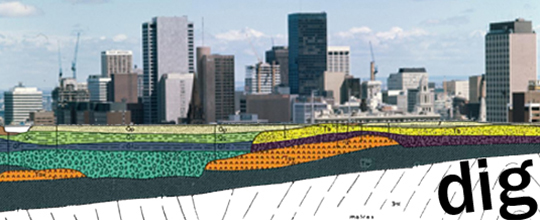
Studio Description
Students taking this studio will explore a thesis project using the “dig” as a methodological, conceptual and architectural driver. For example, students will examine site and context by exploring newspaper, film and image archives, creating layered maps that tell the story of place through multiple and overlapping lenses, and using collage as a design tool. The architectural project might focus on geological or landscape histories, or question design and construction in an era concerned with anthropogenic environmental change, with particular reference to the ground the project sits on and the environment, climate or site into which it is anchored (or not). The section as a volumetric expression of the project is key, as is a scalar reading of site.
The class will be encouraged to consider their architectural outcomes in a multitude of ways: temporal qualities, archaeological, ecological, material, community safety and inclusion, and critical topics such as decolonisation, multispecies architecture, climate change. The brief can be open, developed by the student via class consultations and discussion, or for students who prefer more of a framework, a brief of either a museum, observatory, archive or library in Melbourne, or in an appropriate regional town will be offered.
Previous studio work here:
- https://www.dezeen.com/2021/12/16/university-of-melbourne-student-projects-school-shows/
- https://msd.unimelb.edu.au/msdx/archive/2020_s2/thesis-studios-and-research/architecture/architecture-thesis-studio-03
- https://www.msdx-gallery.com.au/studios/thesis-studio-03-inland-public/
Studio Outcomes
Idiosyncratic projects developed via careful readings of ‘site’ and imaginative proposals engaging with and questioning the nature of public and civic architecture will be the fundamental outcomes of the studio. Deliverables will include the translation of research into spatial diagramming, mapping, models and evidence of an interactive process. The semester will require both the development, refinement and questioning of the chosen typology as well as ongoing spatial research conducted through mapping, forensic reconstructions, cataloguing, collage and narrative production. Students will explore archives for material from outside canonical architectural resources and methods e.g. film, literature, landscape, art, archaeological reports and language studies.
Studio Leader
Virginia Mannering is a designer and award winning researcher-writer. She teaches design studio, and art/architectural history and is a PhD candidate at the University of Melbourne. www.virginiamannering.com
Readings & References
- Architectural References: Asymptote, Steel Cloud; Madelon Vriesendorp and Rem Koolhaas, Hotel Sphinx Planetarium with Swimming Pool; Candilis-Josic-Woods' Free University Building, Berlin; Cristiano Toraldo, Maquina de vacaciones; Cedric Price, Potteries Thinkbelt; the work of James Corner and Mathur and da Cunha
- Desimini, Jil and Waldheim, Charles. ‘Cartographic grounds : projecting the landscape imaginary.’ New York Princeton Architectural Press, 2016.Edmonds, Penelope. ‘Urbanizing Frontiers : Indigenous Peoples and Settlers in 19th-Century Pacific Rim Cities’. Vancouver : UBC Press, 2010.
- Hope, Zach. ‘“It’s a Bit Pompeii-like”: The Unexpected “buried Blocks” of Melbourne’. The Age, 9 October 2019. https://www.theage.com.au/national/victoria/it-s-a-bit-pompeii-like-the-unexpected-buried-blocks-of-melbourne-20190905-p52oa6.html.
- Mattern, Shannon Christine. ‘Code + Clay ... Data + Dirt : Five Thousand Years of Urban Media’. Minneapolis : University of Minnesota Press, 2017. http://0-www.jstor.org.lib.exeter.ac.uk/stable/10.5749/j.ctt1pwt6rn.
- Mattern, Shannon. ‘The Big Data of Ice, Rocks, Soils, and Sediments’. Places Journal, 7 November 2017. https://doi.org/10.22269/171107.
- Presland, Gary. ‘The Place for a Village : How Nature Has Shaped the City of Melbourne’. Melbourne : Museum Victoria Publishing, 2009. *https://prov.vic.gov.au/
Schedule Mondays 15:15-18:15 and Thursdays 18:15-21:15
Need enrolment assistance?
Stop 1 provides enrolment and other support to Bachelor of Design, Bachelor of Environments and Melbourne School of Design students.