Studio 10
Good Citizens
Tania Davidge
Studio Description
How can architects design places and spaces that help to foster civic participation? What does it mean to be a good architectural citizen?
Research, in Australia and more broadly, identifies that civic participation in democracy and trust in our political classes is in decline. People feel that politicians are out of touch with ordinary people, that their concerns are not being heard and the forums for meaningful conversation are limited. Political scientists argue that to arrest this decline in political trust, governments need to find ways to rebuild connections with their citizens and better involve ordinary citizens with democratic/governing processes.[1]
In this context and in the shadow of an Australian federal election, this thesis studio will explore the relationship between architecture, governance and community. Students will examine the relationship between spaces of governance and the citizenry they serve. They will look at how architecture wields power in relation to the machinations of government and expresses social identity. Students will explore ways in which community can be supported to participate meaningfully in formal and informal civic practices and processes. They will look at how people can be afforded agency within these structures and address how participation and agency can be facilitated and supported through design and architecture.
Studio Outcomes
This thesis studio will give students the opportunity to develop their own projects in line with the studio thematic. To develop a project, brief, site and design strategy students will explore what it means to be a good citizen, how architectural design might facilitate meaningful community assembly and conversation, how themes of democracy, governance, citizenship, assembly and conversation in philosophy and art might inform architectural practice and how this research might be expressed through architectural design.
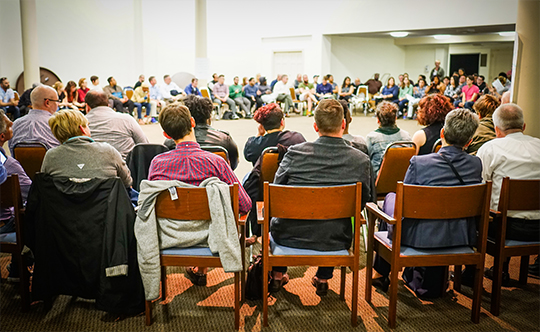
Students preferring a more structured approach will be guided to develop a Citizens’ Assembly — a space for a representative demographic of ordinary citizens to meet, discuss and debate complex issues facing government in order to inform government policy. This medium scale public building will be sited in relation to existing government structures and required to consider urban relations with a designed public space component.
Studio Leader
Tania Davidge is an architect, advocate, writer, researcher and educator. She has a Master’s degree in Advanced Architectural Design from Columbia University in New York and extensive experience in architecture, urban design and strategic design.
Tania is the co-founder of the architectural research practice, OoPLA (formerly OpenHAUS). At OoPLA, she focuses on engaging people and communities with architecture, cities and public space in creative ways. Tania is also a passionate advocate for public space. As the president of the public space advocacy group, Citizens for Melbourne, Tania led the successful ‘Our City, Our Square’ campaign opposing the demolition of Federation Square’s Yarra building and its replacement with an Apple store.
Readings & References
- Bell, Duncan and Bernardo Zacka. Political Theory and Architecture. London: Bloomsbury Academic, 2020.
- Big Deal, ABC iview, https://help.abc.net.au/hc/en-us/articles/4406721518095-Christiaan-Van-Vuuren-finds-out-what-s-the-BIG-DEAL-with-Australia-s-democracy
- Davidge, Tania. "Good Citizens." Parlour (19 January 2021). https://parlour.org.au/opinion-analysis/good-citizens/
- Dovey, Kim. “Architecture, Power and Parliament: How do Buildings Shape Politics?” Papers on Parliament no. 69. Parliament of Australia, October 2018. www.aph.gov.au/About_Parliament/Senate/Powers_practice_n_procedures/pops/Papers_on_Parliament_69
- Finkelpearl, Tom. What We Made: Conversations on Art and Social Cooperation. Durham: Duke University Press, 2013.
- Fraser, Nancy. "Rethinking the Public Sphere: A Contribution to the Critique of Actually Existing Democracy." Social Text, no. 25/26 (1990): pp. 56-80.
- Habermas, Jürgen. "The Public Sphere: An Encyclopedia Article (1964)." New German Critique, no. 3 (Autumn, 1974): pp. 49-55.
- Hoskyns, Teresa. "City/Democracy: Retrieving Citizenship." In Architecture and Participation, edited by Peter Blundell-Jones, Doina Petrescu, and Jeremy Till. New York: Spon Press, 2005. pp. 117-23.
- Involve, “Citizens’ Assembly.” www.involve.org.uk/resources/methods/citizens-assembly
- Iveson, Kurt. "Putting the Public Back into Public Space." In The People, Place and Space Reader, edited by Jen Jack Gieseking, William Mangold, Cindi Katz, Setha Low, and Susan Saegert. New York: Routledge, 2014. pp. 187-91.
- Kester, Grant H. Conversation Pieces: Community and Communication in Modern Art. Berkeley: University of California Press, 2004.
- Kohn, Margaret. "Space and Politics." In Radical Space: Building the House of the People. Ithaca, NY: Cornell University Press, 2018. pp.13-26
- Ockman, Joan. "What Is Democratic Architecture?" Dissent 58, no. 4 (2011): 65-72.
- Participedia. https://participedia.net/
- Pieris, Anoma. Indigenous Cultural Centers and Museums. Maryland: Rowman & Littlefield, 2016.
- Scully, Jess. Glimpses of Utopia: Real Ideas for a Fairer World. Neutral Bay: Pantera Press, 2020.
- Yaneva, Albena. Five Ways to Make Architecture Political: An Introduction to the Politics of Design Practice. New York: Bloomsbury, 2017.
Schedule Mondays and Thursdays 12:00-15:00
Need enrolment assistance?
Stop 1 provides enrolment and other support to Bachelor of Design, Bachelor of Environments and Melbourne School of Design students.