Studio C/02
The Exquisite Corpse
Virginia Mannering
Studio Description
The broad area of study in this studio is the Murray River [Dhungala], running across three states from the Australian Alps, New South Wales, through regional centres such as Albury Wodonga, Swan Hill and Mildura, to the estuaries of South Australia. These are the traditional lands of the Yorta Yorta, Wamba Wamba, Barapa Barapa and Ngarrindjeri people. Exploring a series of nodes as case studies and then expanding to explore the length of the river, student projects will speculate on the impacts of global concerns such as climate change, contested histories and complexities of place that might affect the area and the possible futures and public architectures that could be imagined for them.
The studio brief will be to design a “River Council” building for each town, situated in the Murray River zone. Students will be encouraged to consider regional needs and to think of ‘civic’ and ‘public’ architecture in a multitude of ways: temporal qualities, archaeological, ecological, material culture, community safety and inclusion, and critical broader topics such as decolonising the regional-urban space, more-than-human subjects, climate change and the Anthropocene.
Studio Outcomes
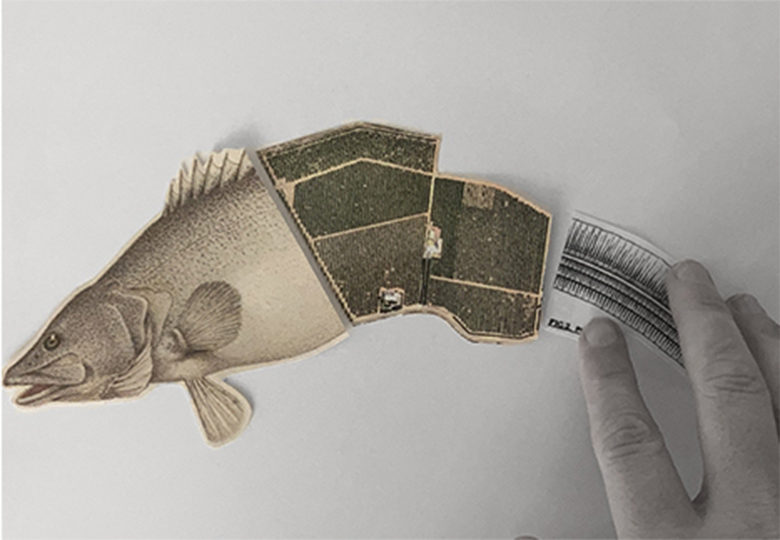
The studio uses the Surrealists' artists experimental assemblages of images/words [the exquisite corpse or cadavre exquis] as a driver for site exploration, program, and design (more on that in class, of course!) Idiosyncratic projects developed via careful readings of ‘site’ and imaginative proposals engaging with and questioning the nature of public and civic architecture will be the fundamental outcomes of the studio. Deliverables will include the translation of research into spatial diagramming, mapping, models and evidence of an interactive process.
All projects are individual, but using the exquisite corpse as our driver, we will see each project as part of a collaborative whole, one architectural proposal located at each town along the river.
Studio Leader/s
Virginia Mannering is a designer and award winning researcher-writer. She teaches design studio, and art/architectural history and is a PhD candidate at the University of Melbourne. www.virginiamannering.com
Readings & References
Architectural References: Asymptote, Steel Cloud; Madelon Vriesendorp and Rem Koolhaas, Hotel Sphinx Planetarium with Swimming Pool; Candilis-Josic-Woods' Free University Building, Berlin; Cristiano Toraldo, Maquina de vacaciones; Cedric Price, Potteries Thinkbelt
Readings:
Gammage, Bill (2011). The biggest estate on earth : how Aborigines made Australia. Allen & Unwin, Crows Nest, N.S.W
Davies, P., & Lawrence, S. (2019). Engineered landscapes of the southern Murray–Darling Basin: Anthropocene archaeology in Australia. The Anthropocene Review, 6(3), 179–206. https://doi.org/10.1177/2053019619872826
Lawrence, Susan & Davies, Peter, (author.) (2019). Sludge : disaster on Victoria's goldfields. La Trobe University Press in conjunction with Black Inc, Carlton, Vic
O'Gorman, Emily & CSIRO (2012). Flood country : an environmental history of the Murray-Darling basin. CSIRO Publishing, Collingwood, Victoria
Pascoe, Bruce (2014). Dark emu. Broome, W.A. Magabala Books
Walliss, Jillian (2018). ‘The Antipodean Limits of a Manifesto: OMA and the Australian Countryside’, Fabrications, 28:1, 110-112, DOI: 10.1080/10331867.2018.1410921
Weller, Richard & Bolleter, Julian, (author.) (2013). Made in Australia : the future of Australian cities. UWA Publishing, Crawley, Western Australia
Schedule Mondays 15:15-18:15 and Thursdays 18:15-21:15 in MSD Room 144
Need enrolment assistance?
Stop 1 provides enrolment and other support to Bachelor of Design, Bachelor of Environments and Melbourne School of Design students.