Studio D/06
Proposal to reclaim Government Office Space for Public Infrastructure
Leonidas Koumouris
Studio Description
Today’s culture is somehow both mega atomized and blandly conformist. The contemporary public sphere creates an overriding pressure for conformity of language and ideas; and the worst part is, it’s all pantomime. Nobody says what they really think. Rather, everybody defers to an illusory accord, and this makes for a highly distorted perception of reality.
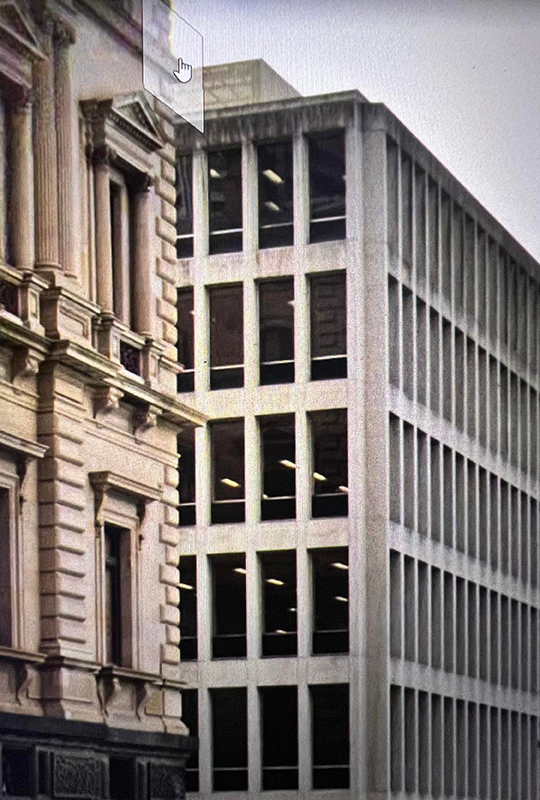
The adjacent architectural manifestations can be seen in the erosion of anonymity and basic privacy within the workplace, on the street, and most importantly for us in the public sphere. The ever more ambiguous distinctions between what is private and public have all worked (successfully) to disintegrate both the distinction between 'work' and 'leisure/rest', while simultaneously acting to diffuse change. Nowhere is this more apparent than at 20 Macarthur Street, where a site that is 'technically' public is rarely engaged with, the interstitial spaces rarely traversed. It behaves (as many contemporary 'public' buildings do) as an island, an atomised space. This sort of atomisation when viewed through the illusory accord has cultivated an occasionally shared but desperately warped relationship to truth, to living.
Simultaneously, it seems as though one half of architecture is retreating into itself, into pragmatic symbolism. Questions of design seem to revolve simply around arrangement, around formal gestures; the height of a lamp switch, the hue of a tile. The Other Half, generally comprised of the mega-offices of the world, concern themselves with the opposite – volume, massing, concept. Drawings conceived, and seemingly delivered at 1:500 scale. These are the offices most commonly responsible for our grand public architecture, much to the chagrin of the first half.
Thus, the studio asks a simple but radical question – can we unify these 'halves' and become again what we once were, experts of planning as well as practitioners of detail? Can we re-purpose office space for public infrastructure, for an art gallery and education centre? Can we de-establish the ambiguity between the public/private? We will take ownership of the structure, of the plan, while still having equal concern for finishes and arrangement; all of this in a building of genuine scale. Architecturally, the office plan offers a generic building layout. Typically organized as unobstructed space with a minimum number of vertical supports and vertical circulation and clustered services, the office plan can easily be adapted to any use and occupation. This uniformity in plan and elevation belies a deeper complexity of detail – a door handle, a ledge, the location of an outlet.
We will challenge existing methods of exhibition and education within a context defined for us, by someone who existed long before us, uninfluenced by our contemporary world... Can we manipulate a shrine to corporatism into a monument for it’s direct other, public collectivism? This is not simply a question of repurposing space for the public, but repurposing space almost for repurposing’s’ sake! We live in an age of consumption, an endless cycle of destruction and reconstruction. As practitioners of space, we must learn to utilise and manipulate that which already exists. We will learn to do this meaningfully, with efficiency, and above all with proportion and scale.
Studio Outcomes
Over a 12 week course a consistent approach of inquiry will guide students through three moments of specific engagement.
- The Precedent and the Site - Students will engage in a precedent study of a single re-purposed, refurbished, or renovated building. The exercise will be short and sharp. A clean set of documents will be produced. A plan, a section, an elevation, a detail, a render. We will operate at scales of 1:200 and 1:20. We will aim to establish a formal drawing language for each student individually and for the studio holistically.
- The Site + the Project - Students will replicate the existing conditions of the site and its surrounds. Students will speculate on appropriate or inappropriate contemporary responses to exhibition and education, engage with more precedents, re-draw, engage with classical responses, and repeat. The project will begin to take shape at scales of 1:20 and 1:200. The detail is essential, but it is nothing without an overriding logic. Students will begin to engage with the overall programmatic assemblage, as well as primitive configurations within space. Students will slowly form a ‘position’ on the public; on their response to architecture. There is no guarantee that these will be related. Students will begin to challenge ‘market logic,’ what makes a good public space, and how to interpret global forces from within the plan.
- A Public Space on Spring Street - In the final period of semester students will continue with their proposals, and start to formulate their ideas in both speculative representation and 'hard orthographics.' The project presented will finely balance a future not too ridiculous to conceive of, a proposal not too contemporary as to be misunderstood. A rigorous research project manifested as genuine architectural response. The 1:20 and 1:200 scales provide an astute level of detail and a platform for speculation, for a reality that could exist. The proposal will challenge the logic of capital as edifice; it will imagine a different future, borne literally from the remnants of the past. Put simply, a well considered refurbishment of an iconic office building into an iconic public space. Contemporary, strange, recognisable, and above all utterly essential.
- Participation - It is an expectation that students will engage, converse and participate in class regularly, if not always. Throughout semester students will engage with a series of readings that may or may not inform their precedents. The aim here is to establish an understanding of Theory, of world forces, and of architecture as ‘hard precedent.’ These things are not always compatible, and they do not need to literally be tied together or influence each other. Awareness is the key, not heavy-handed referentialism [sic].
Studio Leader
Leonidas Koumouris is an architectural designer working in Melbourne. He has taught in Sydney, in Spain and in Melbourne.
Readings & References
Readings and references will be provided in Week 1. In the meantime…
Schedule Tuesdays 12:00-15:00 and Fridays 15:15-18:15 in MSD Room 141
Need enrolment assistance?
Stop 1 provides enrolment and other support to Bachelor of Design, Bachelor of Environments and Melbourne School of Design students.