Studio DE/01
Princes Pier Collisions. Past & Present / Landscape & Architecture
Isabel Lasala
Studio Description
The exponential growth and accelerated transformation of our cities have significant implications for our architecture and urban environment, including the disruption of the activities of our neighbourhoods, buildings, and in some cases, infrastructures. The latter is essential for this studio, as it proposes to redesign, reprogram, and ultimately preserve a significant piece of infrastructure that is also a crucial part of the city's history.
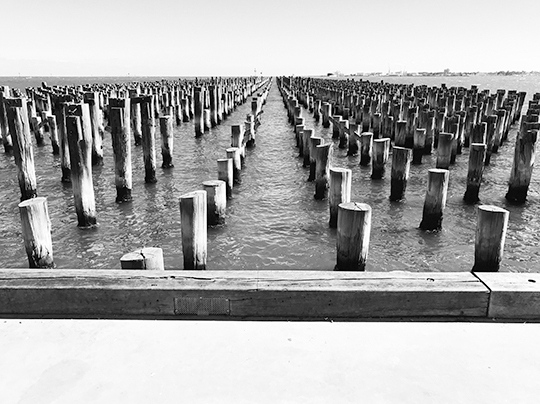
Princess Pier is a 580-meter structure situated in Port Melbourne, which received the influx of new migrants coming to Australia searching for a new prosperous life during the first half of the nineteenth century.
After a series of fires, only one-third of the original structure remains in use. However, the other two thirds did not disappear altogether, as the piles that once supported the pier's surface are still there.
This studio asks students to design a community centre and a vibrant and engaging public space on this site by implementing design strategies to prompt formal and spatial associations with history.
The studio suggests undertaking this challenge through a particular design process, where a specific design device—derived from the concept of Illusion—can be implemented to prompt and stimulate the perception of spatial configurations lost due to processes of rapid urban transformation.
Studio Outcomes
This process will be undertaken using three methods that complement each other:
- Observation of the site and its surroundings: students will be required to analyse the site to approach the main problem critically.
- Case study methodology: a selection of precedents will be chosen purposefully and analytically by the students to set the state of the art.
- Design exploration: with the information from the previous two methodologies, students will be encouraged to find project-based answers to the studio questions through an iterative process.
Students will need to communicate their projects through a range of different media, including:
- Physical and digital models made to develop the different stages of the design process (conceptual, topographic contours, surfaces, textures and materiality).
- Drawings to address the different levels of precision the studio requires (sketches, diagrams, sections and plans).
- Images meant to illustrate the less tangible aspects of the project, such as atmospheres and views from afar (conceptual photomontages, linear views, etc.).
Studio Leader
Isabel Lasala is a Venezuelan architect and academic based in Melbourne, Australia. She is one of the Directors of Lasala & Lasala Design Studio, an award-winning practice with more than twenty years of experience. Isabel holds a Bachelor of Architecture from Universidad Central de Venezuela, a Master of Architecture from ETSAB/Universitat Politècnica de Catalunya, an MPhil in Landscape Architecture from University of New South Wales and is a PhD candidate at RMIT University. Her practice-based research investigates new possibilities emerged at the intersection of architecture and landscape architecture. In 2014, Ediciones FAU/UCV published her book Creating Places: Exalting and Overcoming the Architectural Object in the Work of Pablo Lasala. Before settling in Australia in 2009, Isabel was a Senior Lecturer at the Faculty of Architecture and Urbanism of UCV. In Australia, she has taught design studios at Melbourne University, Monash University, RMIT, UNSW, and University of Technology Sydney.
Readings & References
- Andersen, B 2003, Alvar Aalto and Jorn Utzon: An Architecture of Ancient Gathering Forms, University of Aalborg, Aalborg.
- Burns, C & Kah, A 2005, Site Matters: Design Concepts, Stories, and Strategies, Routledge, New York.
- Carr, S, Francis, M, Rivlin, L & Stone, A 1992, Public Space. Environment and Behaviour, Cambridge University Press, New York.
- Corner, J (ed.), 1999, Recovering Landscape: essays in contemporary landscape architecture, Princeton Architectural Press, New York.
- Cosgrove, D 1999, Mappings, Reaktion Books, London.
- Galofaro, L 2002, Artscapes El arte como aproximación al paisaje contemporáneo, Gustavo Gili (Land&ScapeSeries), Barcelona.
- Leatherbarrow, D 2004, Topographical Stories. Edited by John Dixon Hunt, Penn Studies in Landscape Architecture. Philadelphia: University of Pennsylvania Press.
- Gehl, J 2001, Life between buildings: using public space, Island Press, Washington DC.
- Gehl, J 2013, How to study public life?, Island Press, Washington DC.
- Pallasmaa, J 2012, The eyes of the skin. Architecture and the senses, John Wiley & Sons, Chichester, UK.
- Pallasmaa, J 2012, The thinking hand. Existential and Embodied Wisdom in Architecture, AD John Wiley & Sons, Chichester, UK.
- Petschek, P 2008, Grading for landscape architects and architects, Birkhauser, Basel - Boston – Berlín.
- Ruby, I & A 2006, Groundscapes The rediscovery of the ground in contemporary architecture, Gustavo Gili (Land&ScapeSeries), Barcelona.
Schedule
Mondays 09:30-12:30 in MSD Room 138 and Thursdays 09:30-12:30 in MSD Room 449
Need enrolment assistance?
Stop 1 provides enrolment and other support to Bachelor of Design, Bachelor of Environments and Melbourne School of Design students.