Studio DE/06
Desert Futures III: The Sand Reckoner
Charlotte Algie
Studio Description
‘Desert Futures’ researches new architectural possibilities derived from the unique qualities of arid zones. Australia is primarily an arid continent, featuring predominant low humidity, very low annual precipitation, and high diurnal range (change in temperature from night to day). Desert Futures explores new theoretical and technical frameworks relating to the performance of architecture in these conditions. The concept of performance itself -its design traditions and futures- is always central to the studio project. Students are encouraged to examine related themes in a broad and inclusive way.
Desert Futures, III The Sand Reckoner will have a material orientation. The title for the studio is named for Archimedes’ text, in which he set out the idea for a number system capable of measuring the universe through observation of the myriad of sand particles observed at a site. We will seek similar inspiration from geotechnical aggregates and ground, and work to generate architectural concepts from the assembly and experience of mass, its substrates, supports and physics systems via exploration in virtual and physical realms. The studio will emphasise exploration about the experience of mass in space and time through design in durational media, via experimentation with media including film and the gaming environment Unity.
Desert Futures III adheres to the brief to design a private philanthropic foundation. Medium in scale, the brief combines a range of functions (technical/institutional/domestic) and offers potential to challenge relationships between privacy and public-ness, formality and informality, while encouraging new ways to relate architecture to its broader economic and political conditions. Our brief specifically supports students to build their skills in negotiating the technicalities of a complex architectural brief in creative ways on their own terms.
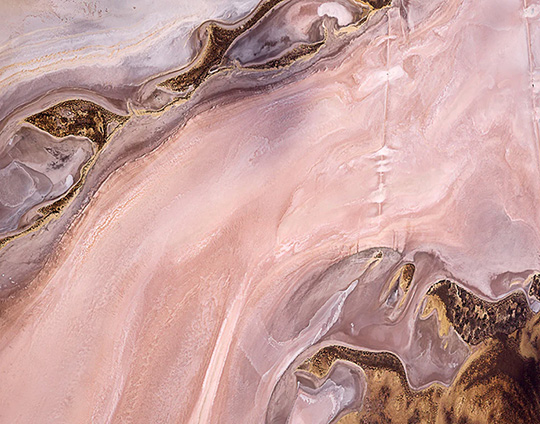
Desert Futures III will be sited in north-western Victoria’s semi-arid zones. In Boorong Country, students will site a philanthropic foundation at the edge of Lake Tyrell, a saline lake in a topographical depression famous for turning to a bright pink colour under certain seasonal chemical conditions. We will study the unique botany and fauna of the site as tectonic and geometric inspiration while integrating each tier of this ecology centrally into the evolution of design representation and concept.
Studio Outcomes
Students will develop techniques for vivid representative, territorial backgrounds to design, and will rehearse new workflows that integrate digital territorial geologies and ecologies. Additionally, students will test a range of different ways to simulate and study architectures of mass computationally in terms of both physics and thermal transfer: These will include experiments in Grasshopper/ Karamba and Unity.
The studio will begin with a series of prototypes that span digital and physical media to generate a range of formal and compositional ideas. After completing the sequence of design studies, students will quantify the various scales of the brief. Finally, students will synthesise the brief with the ideas developed through their creative design exercises, to produce a conceptually inquisitive, and representationally explorative design outcome. Preparatory design studies will include production of material tests using sand, earth, aggregates and other systems drawn from the ground and region of the site. We will expand into design ideas for architecture by testing assemblies in digital space that consider materiality and the construction event, its flow and movement. The studio will develop the understanding of themes surrounding architectures of mass with reference to architectural history. Additionally, we will explore contemporary building supply chains, imagining ways of designing our projects are realised through innovative processes and details. To challenge the way of representing buildings being put together and taken down, or reconfigured, the studio will devise creative ideas through drawings of states of change in a building, whether under construction, or after completion.
Our final projects in Desert Futures III will be represented with a focus on orthographic drawings and perspective views. Additionally, students will be encouraged to explore production in durational media, i.e. Unity, film or animation, as has featured in previous studio iterations. Introductory tutorials for those without prior experience in digital software, film and animation will be provided.
The studio centres in design themes with strong focus on building itself, innovatively approaching both its assembly and representation. Students will be encouraged to test and develop their own innovative ideas through plan, axonometric, and section. Explorations will be made into graphic ideas of superimposition, story board, or frames to suggesting duration or time in the built environment through drawing. Film and animation will remain a core component of the final projects.
Studio Leader
Charlotte Algie is a director of the office NN specialising in infrastructural, cultural and public architecture. Her completed practice projects include the Reverberation Screen for the Berlin Opera, recognized -among other honours- by the German Engineering Prize 2018, and the BDA State Prize for Berlin, 2018. Her current practice focus is a Victorian State Government creative research project. NN has previously exhibited at ArtOMI Newmark Gallery, dOCUMENTA(13), the Biennale di Venezia, Milan Triennale, the Yale Architecture Gallery, among other public forums.
Charlotte is a researcher in the Design Research stream at Melbourne School of Design. She has taught design at a range of different international design schools previously, including Syracuse University School of Architecture and Yale School of Architecture in the USA, the UdK Berlin in Germany, and RMIT School of Architecture. Her most recent prior academic role was tenure as editor of the Yale Architectural Journal, Perspecta.
Readings & References
- Archimedes, The Sand Reckoner, in Heath, Thomas ed. The Works of Archimedes, Cambridge: Cambridge University Press, 2009);
- Lucia Allais, Designs of Destruction: The Making of Monuments in the Twentieth Century (University of Chicago Press, 2018);
- Samia Henni ed., Deserts Are Not Empty, (New York: Columbia University Press, 2022);
- Geoffrey Serle, From Deserts the Prophets Come: The Creative Spirit in Australia 1788–1972 (Melbourne: Heinemann, 1973);
- Nicholas Thomas, Landscapes: Possession and Dispossession, in Possessions: Indigenous Art, Colonial Culture, (New York: Thames and Hudson, 1999);
Schedule
Mondays 09:00-12:00 and Thursdays 12:00-15:00 in MSD Room 141
Need enrolment assistance?
Stop 1 provides enrolment and other support to Bachelor of Design, Bachelor of Environments and Melbourne School of Design students.