Studio DE/29
INFILL HOUSING
Lisa Garner
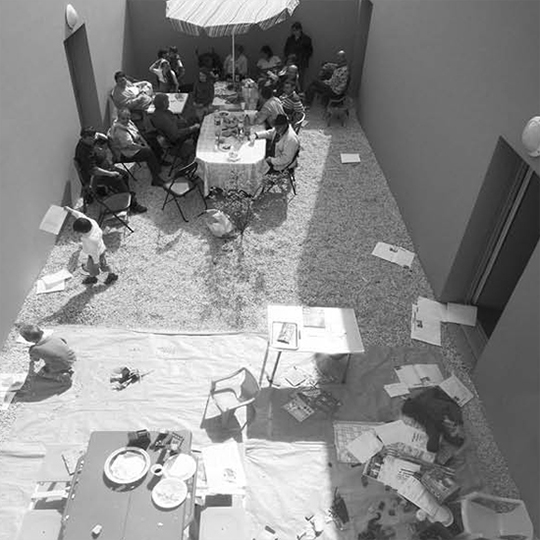
Studio Description
Despite the pandemic slowdown, Melbourne's population is projected to double by 2050.
Housing supply has failed to keep pace. The traditional approach of building our city upwards, or outwards, is putting strain both on the lives of residents as well as the natural environment it presides in.
In this studio, students will develop housing typologies and neighbourhood-scale strategies within Melbourne’s pre-established, Middle-ring suburbs to address our cities housing needs more sustainably - providing liveable and sustainable housing in the locations where it is needed most.
We will examine how and why the rising costs of inflation, materials, and labour are creating new challenges for the design industry and consider ways to build more and better housing in this challenging climate.
Students will work on a selected street and precinct in Maribyrnong City Council, with the goal of transforming an aging housing stock into a liveable and sustainable community through incremental densification.
The studio will feature guest lectures and regular design feedback from industry experts from organisations such as Housing Choices, Property Collectives, Nightingale Housing, and local planners from Maribyrnong City Council.
Studio Outcomes
The studio is aimed at students looking to hone their multi-residential design skills to tackle real-world challenges and reflect on the future of Melbourne's housing landscape.
Deliverables and learning outcomes will be focused on two scales; building/typology and neighbourhood/street.
At the building scale, students will explore themes of design efficiency, resourcefulness, and innovative construction methods informed by local and global examples.
At the neighbourhood and street scale, we will investigate initiatives promote density and open up spatial possibilities, by asking: to what extent can resources, spaces, and services be shared?
Thinking beyond the private lot, we will consider how streets and public realm can be replanned to better suit human and environmental needs. And how emerging technologies, such as shared electric vehicles can impact the use of residential land.
The final outputs will be adaptable design typologies that meet a specific brief and demonstrate new strategies and innovations at both the building and neighbourhood scales. The outputs will be presented in Pecha Kucha-style pitches using 2D drawings, visualizations, as well as physical models.
Studio Leader
Lisa Garner co-founded the architecture practice LIAN following a successful entry to the Victorian Government’s ‘Future Homes’ competition in 2020.
She is currently involved in the delivery of the first demonstration project of this initiative, delivering 12 new social housing units in Melbourne’s western suburbs. Lisa’s interests in improving the liveability and amenity of multi-residential design combines her experience of architectural practice and research across Melbourne and Berlin, where she has worked on award-winning projects across all scales of residential development. LIAN continues to engage with the thematic of housing through projects spanning from architecture, planning and research.
Readings & References
Research Articles / Papers
- Towards a new development model for housing regeneration in greyfield residential precincts
Peter Newton, Shane Murray, Ron Wakefield, Catherine Murphy, Lee-Anne Khor and Tom Morgan - Infill Opportunities, Design Research Report, MADA
Books
- Typology+ : Innovative Residential Architecture
Peter Ebner , Eva Herrmann , Roman Roellbacher, 2009 - Living & Partly Living: Housing in Australia
Hugh Stretton, Ian McKay, John Mant, Robin Boyd, 1971
- Rethinking Suburban Housing,
Juan Carral - Yes to the City: Millennials and the Fight for Affordable Housing,
Max Holleran, 2022 - Complex housing: designing for density
Robinson, Julia Williams, 2018 - Radical housing : designing multi-generational + co-living housing for all
Dove, Caroline
Journal Article
- The Social Sustainability of Medium Density Housing: A Conceptual Model and Christchurch Case Study, Ancell, Sarah ; Thompson-Fawcett, Michelle,
Housing studies, 2008, Vol.23 (3), p.423-442
Websites
- 20 Minute Neighbourhoods: https://www.planning.vic.gov.au/policy-and-strategy/planning-for-melbourne/plan-melbourne/20-minute-neighbourhood/all-about-20-minute-neighbourhood
- A New Normal: https://www.normalise.it/the-projects
News Articles
- The house prices that are still rising: How inflation is blowing out building costs: https://www.smh.com.au/property/news/the-house-prices-that-are-still-rising-how-inflation-is-blowing-out-building-costs-20220714-p5b1pi.html
Schedule
Mondays 09:00-12:00 and Thursdays 15:15-18:15 in MSD Room 238
Need enrolment assistance?
Stop 1 provides enrolment and other support to Bachelor of Design, Bachelor of Environments and Melbourne School of Design students.