Studio DE/31
Bothy
Andre Bonnice
Studio Description
This will be the third (and final?) instalment of Bothy.
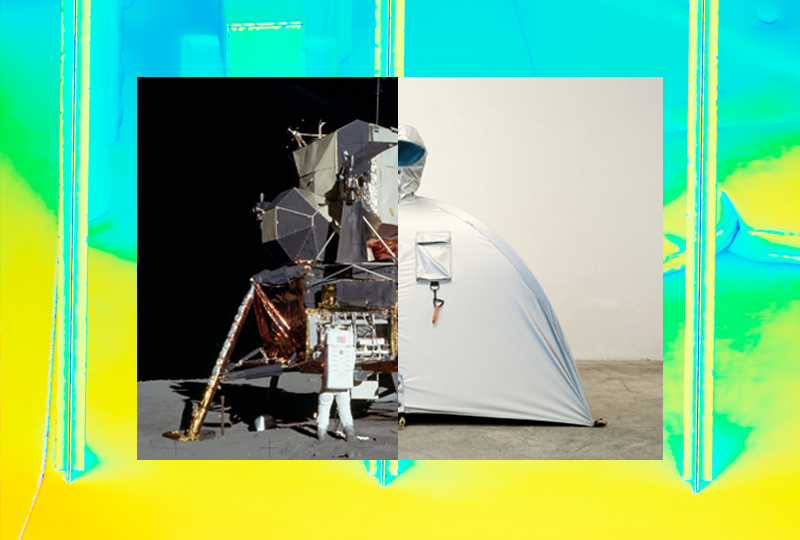
In a world increasingly defined by a climate of extremes, Bothy will explore architecture's often hostile relationship with its environment. Prioritising the formal and spatial potential of a thermo-driven architecture as an alternative to orthodox Australian construction techniques (massive thermal bridges).
Greenhouses, space shuttles, escape pods, and survival chambers will be mined to develop a survival kit of architectural elements and case-studies. This will be done through modest means, pilfering the shelves of hardware and camping stores for the materials, components and ad-hoc details. Prioritising a ‘hackable’ architecture that can be adapted over time.
The architectural project will take the form of a rural vivarium, a self-sufficient place of refuge. The studio will pursue a distinct aesthetic resolution of formal and technical investigations that will manifest as a speculative proposal for a series of system-based structures.
Studio Outcomes
The studio will begin with cataloguing and stockpiling a kit of parts mined from various art and and architecture precedents. Initial design esquisses will focus on small-scale mobile survival structures. Each will incorporate a particular aspect of survival, energy generation, water capture and filtration, and waste management. Developing systems-based approaches that demonstrate a sophisticated understanding of the co-dependencies and relationships between design, materials, utility, culture and the environment.
Alongside technical investigations, these exercises will incorporate a series of formal and geometric studies. These will utilise chance-based simulations and animations as a way to distribute architectural elements in open-form arrangements, rendering them as pavilions, landscape elements, monuments and dwellings.
There will be attention to design communication through detailed digital modelling, physical prototypes, orthogonal drawings and rendered imaging by way of supporting a rigorous research and design methodology. In-class tutorials will be provided for 3D modelling and visualisation techniques. The studio will involve both individual and group-based tasks. Final projects will be developed either individually or in groups, with students expected to contribute equally toward a considered and articulated proposal.
Studio Leader
Andre Bonnice is a registered architect and director of Simulaa, a Naarm based architecture practice working across architecture, urbanism, computation, media and environmentalism. In 2021, Simulaa was shortlisted for the NGV Architecture Commission, among 4 other shortlisted teams, and won the Installation Competition for the 2022 Tallinn Architecture Biennale in Estonia. Most recently Simulaa won the 2022 AA Unbuilt Prize, for the project ‘Gas Stack’.
Andre’s experience spans the design and delivery of small installations, single and multi-residential and public/educational projects. Alongside practice, Andre has held teaching positions at the RMIT School of Architecture and at Monash Art, Design and Architecture. Andre values the importance of experimentation in the design studio, through an emphasis on speculative design propositions, as a way to affect or influence modes of practice and broader critical, social and cultural thinking.
Readings & References
- Gold, B, 2010, ThermoPoetics: Energy in Victorian Literature and Science, The MIT Press, Cambridge
- Hill, D, 2012, Dark Matter and Trojan Horses. A Strategic Design Vocabulary, 1st edn, Strelka Press, London
- Mattern, S 2017, Code and Clay, Data and Dirt: Five Thousand Years of Urban Media, 1st edn, University of Minnesota Press, Minneapolis
- Mangan, N 2016, Limits to Growth, exhibition publication, 20 July - 17 September, Monash University Museum of Art, Melbourne
- Iturbe, E 2019, ‘Architecture and the Death of Carbon Modernity’, Log, vol. 47, pp. 10-24
- Ghosn, R 2019, ‘Carbon Re-Form’, Log, vol. 47, pp. 106-117
- Vogt, A 2005, ‘Étienne-Louis Boullée’, in P Ursprung (ed.), Herzog & De Meuron: Natural History, 1st edn, Lars Muller Publishers, Baden, pp 173-183
- Roche, F & Lavaux, S, DD 05 R&SIE: Corrupted Biotopes, Damdi, Seoul
Schedule
Mondays 18:15-21:15 in MSD Room 237 and Thursdays 09:00-12:00 in MSD Room 246
Need enrolment assistance?
Stop 1 provides enrolment and other support to Bachelor of Design, Bachelor of Environments and Melbourne School of Design students.