Studio DE/32
Hangar
Dayne Trower and Simona Falvo
Studio Description
“The precise new anatomy of architecture.
Source of bewilderment to the 'modernists’, the new academy.
Clearness of function must be achieved. It applies to everything.”
‘Aircraft’, Le Corbusier
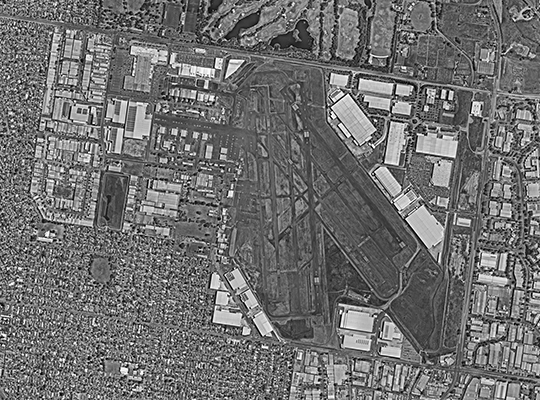
Located in Melbourne’s southeast and founded in 1962, the Moorabbin Air Museum and Airport has one of the most significant collections of Australian aircraft.
The celebrated and extensive aviation history in Australia was established as early as 1892 by Australian inventor, Lawrence Hargrave. Described as the ‘father of the airplane’, Hargrave believed that flight was achievable through invention, experimentation and persistence, with his most notable design being the cellar (box kite) wing. While his early aviation studies were often ridiculed, Hargrave’s research took place prior to the first powered flight by the Wright Brothers in 1903.
The innovation and experimentation apparent in these early flights set a tremendous trajectory for the establishment of a celebrated yet complex aviation culture in Australia and abroad. The implications for ideas on architecture have accordingly been explored obsessively, and elegantly, by masters in the profession.
Hangar will develop upon this this rich history and investigate the formation of a new aviation museum at the Moorabbin site, including hangar space, archives, restoration facilities, museum and community spaces. At its core, innovation in design, approach and process will aim to echo this history of invention and explore the numerous possibilities for architecture operating in this realm.
Studio Outcomes
Students will initially be required to undertake a variety of research and design-based projects through site visits, mapping and model making to establish an understanding of their own design processes and how these can be shaped in response to the context of the Moorabbin Air Museum site and its broader surrounds. Students will then be given a brief, which they can expand upon and challenge, for a mid to large scale project relating to what has been discovered throughout the preliminary weeks of the semester.
Students must be able to:
- Conceptualise and engage in rigorous research through design to open the potential for experimentation and innovation.
- Communicate ideas and designs verbally, visually and textually through a range of investigative media.
- Research with enhanced appreciation of theoretical, environmental, social, historical, cultural and technical contexts in relation to the activity of architecture.
- Examine architecture’s responsibility in the regional realm and its potential, from the micro, human and macro scales.
Studio Leaders
Dayne Trower
Dayne is an architect and director of Trower Falvo Architects. Prior to starting his own practice, Dayne worked on a number of significant local and international projects, predominantly with Sean Godsell Architects, including the 2014 M Pavilion. Dayne is also trained in design and has worked alongside renowned Australian designer, Brian Sadgrove. Dayne is especially interested in design that is site and culturally specific, developed through a rigorous process of examination and research and his work, which has been widely published and exhibited, inherently explores these concepts.
Simona Falvo
Simona is an architect and director of Trower Falvo Architects, having completed her Master of Architecture at the Melbourne School of Design. She graduated with first class honours and has studied abroad at the University of Stuttgart and University of Gothenburg. Simona has worked on a variety of projects at different stages ranging from retail and residential projects to larger scale townhouse and apartment projects. She has extensive experience in all stages of the design process from initial concept design, planning, documentation and project delivery.
Readings & References
- Selected excerpts from ‘Aircraft’, Le Corbusier
- ‘Building Sights: Boeing 747’ in ‘Reading Design’, Foster, N.
- ‘The Agency of Mapping: Speculation, Critique and Invention’, Corner, J.
- ‘Intersections’ in ‘Furniture, Structure and Infrastructure’, Bertram, N.
- ‘A Provisional Theory of Non-Sites’ and selected articles in ‘Robert Smithson: The Collected Writings’, Flam, J. (ed.)
- ‘Powers of Ten and the Relative Size of Things in the Universe’ (film), Eames, C. and Eames, R.
Additional readings and reference material will be provided throughout the semester.
Schedule
Mondays 18:15-21:15 in MSD Room 215 and Thursdays 18:15-21:15 in MSD 236
Off-campus Activities
Week 2 / Moorabbin Air Museum
Need enrolment assistance?
Stop 1 provides enrolment and other support to Bachelor of Design, Bachelor of Environments and Melbourne School of Design students.