Studio 4/01
Landscape Planning for Biodiversity
Siqing Chen
Studio Description
Landscape planning for biodiversity is vital for conserving ecosystems, preserving natural heritage, delivering essential ecosystem services, enhancing climate change resilience, and promoting human health and well-being. This studio focuses on developing strategies for landscape corridors and networks at regional scale as well as creating design solutions that enhance biodiversity at site scale. GIS applications are introduced as a tool for exploring ecological and cultural systems across multiple scales to inform planning and design strategies.
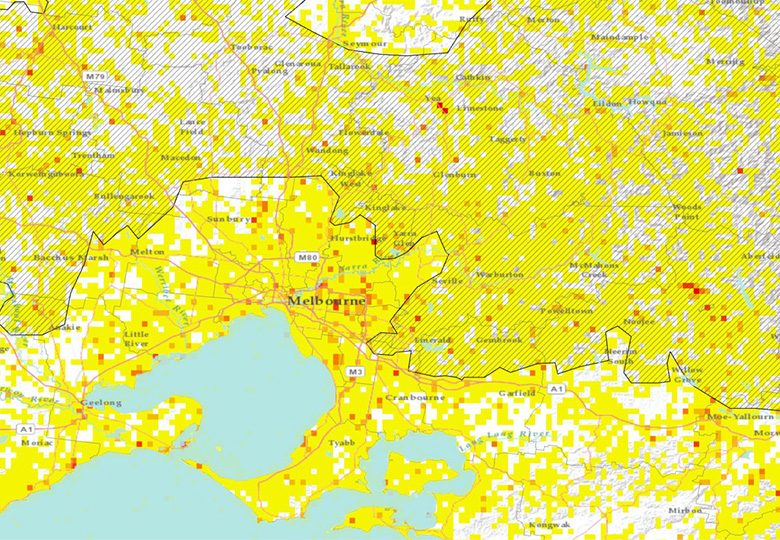
Using metropolitan Melbourne and its surrounding landscapes in general and an identified severely impacted landscape in particular, this studio introduces the conceptual framework for regional landscape assessment and planning. GIS techniques are applied to visualise and analyse demographic, ecological, cultural, and socioeconomic data for biodiversity planning. Taking a regional perspective in understanding the composition and configuration of human settlements and activities in the landscape, this studio aims to reshape the region’s spatial pattern for sustainable biodiversity planning practice.
Studio Outcomes
The first part of this course will be a collaborative site inventory and documentation, including data collection, mapping and visualisation. Students will then explore topics such as modelling and mapping species richness and distribution patterns; identifying habitat gaps and design linkages to to form biodiversity corridors; integrating ecological infrastructure elements (such as parks, green spaces, rivers, etc.) into biodiversity networks; evaluating impacts of human activity on habitat and ecosystem quality; balancing critical habitat conservation and ever-increasing urban development; and reconfiguration of sprawling suburbs into ecological communities that enhance biodiversity. In this process students will use spatial modelling to develop biodiversity indicators, such as remoteness, wilderness, species richness, endemism, habitat integrity, etc. The simulation outcomes are used to inform the delineation of biodiversity corridors and networks at metropolitan or regional scale. Finally, students will explore some design opportunities at an identified site (downscaling) along the corridors/networks for enhanced overall biodiversity performance.
Studio Leader/s
Dr Siqing Chen is a senior lecturer in landscape architecture at MSD. Trained in China and the US as an ecologist and landscape architect, Siqing has practiced since 2002 in a range of private and public sector settings in China, US and Australia. Siqing's teaching and research concerns emerging issues of landscape planning, energy landscape, and ecological urbanism. He has published widely on these topics and supervised more than 20 PhD and Landscape Design Thesis in these areas including Cheng Xing’s design thesis “Transitioning to renewable energy: An integrated landscape approach” which has recently won the Landscape Architecture Australia Student Prize.
Readings & References
- Ahern, J. et. al. 2017. Biodiversity Planning and Design: Sustainable Practices. Island Press.
- Bennett, A. F. 1999. Linkages in the landscape: The role of corridors and connectivity in wildlife conservation. Cambridge: IUCN
- Commonwealth of Australia, 2009. Assessment of Australia's Terrestrial Biodiversity 2008. Canberra.
- Dramstad, W., Olson, J. D., & Forman, R. T. T. 1996. Landscape ecology principles in landscape architecture and land-use planning. Washington, D.C.: Island Press.
- Forman, R. T. T. 2008. Urban regions: Ecology and planning beyond the city. New York, NY: Cambridge University Press.
- Gibbons, P., & Lindenmayer, D. B. 2002. Tree hollows and wildlife conservation in Australia. Collingwood, Australia: CSIRO Publishing.
- Labich, W. 2015. The regional conservation partnership handbook. Redding, CT.
- Magurran, A. E. 2004. Measuring biological diversity. Malden, MA: Blackwell Science.
- Millennium Ecosystem Assessment. 2005. Ecosystems and human well-being: Biodiversity synthesis. Washington, D.C.: World Resources Institute.
Schedule Thursdsay 1:15 - 7:15 pm in MSD 246
Need enrolment assistance?
Stop 1 provides enrolment and other support to Bachelor of Design, Bachelor of Environments and Melbourne School of Design students.